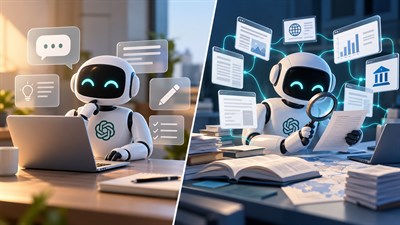
Changing careers used to mean spending weeks researching unfamiliar roles, guessing which of your skills would transfer, taking broad courses, rewriting your résumé, and hoping employers could see the connection between what you did before and what you want to do next. AI can compress much of that work.
But the most realistic career changes AI can accelerate are not random leaps into completely unrelated professions. They are usually adjacent moves where your existing experience already covers part of the new job. AI helps expose that overlap, identify the real gaps, design targeted practice, create proof of work, and prepare a more credible career-transition story.
That distinction matters. AI can make career switching faster to research and easier to test. It cannot make missing qualifications, experience, judgment, or market demand disappear.
AI can accelerate a career change when the target role shares meaningful skills, domain knowledge, workflows, or stakeholders with your current work. It can help map transferable skills, compare job requirements, build a learning plan, create portfolio evidence, reposition past experience, and simulate interviews. It cannot replace qualifications, real-world experience, human feedback, or hiring decisions.
Important: AI can reduce the friction of a career transition, but it cannot make an implausible transition plausible. The strongest opportunities usually combine existing domain knowledge, transferable skills, and a target role where you can build credible evidence before applying.
What Makes a Career Change “AI-Accelerable”?
A career change is easiest to accelerate with AI when three conditions are present: meaningful skill overlap, the ability to demonstrate the target work before being hired, and manageable barriers to entry.
Think of it as a simple framework:
High skill overlap + high proofability + manageable entry barriers = a career transition AI can genuinely accelerate.
1. Skill overlap
Start with the work rather than the job title. Two roles with very different titles can involve many of the same underlying capabilities: interviewing people, analyzing information, coordinating stakeholders, solving customer problems, building reports, explaining complex ideas, planning projects, or managing deadlines.
This is where AI is useful because it can process a large amount of career information quickly. You can give it your résumé, project descriptions, performance reviews, and several target job descriptions and ask it to identify recurring capabilities on both sides.
The important word is demonstrated. “Good communicator” is not enough. “Led weekly client calls, resolved escalations, documented decisions, and coordinated implementation across three teams” gives the model evidence to work with.
2. Proofability
Some career moves allow you to simulate meaningful pieces of the target job before anyone hires you. That makes them particularly suitable for AI-assisted career switching.
A prospective instructional designer can build a training module. A future product marketer can create a positioning analysis. A project coordinator can turn a completed initiative into a project case study. A business analyst can document and redesign a workflow.
AI can help structure, critique, stress-test, and improve those artifacts. The result is stronger than saying, “I believe my skills are transferable.” You are showing what you can already do.
3. Barrier to entry
Some gaps can be reduced through targeted learning and practice. Others are hard barriers.
AI can help you learn financial modeling, practice stakeholder interviews, understand project-management terminology, or build sample dashboards. It cannot award a professional licence, replace supervised clinical experience, satisfy a legally required degree, or manufacture years of specialist practice.
Before investing heavily in a transition, separate skill gaps from credential barriers. They are not the same problem.
A useful rule: do not ask AI “What career should I choose?” first. Ask it to identify the work you already know how to do, the problems you have solved repeatedly, and the adjacent roles where those capabilities already have market value.
Prompt: Analyze my professional background below as a career-transition strategist. Identify 10 capabilities I have demonstrated through actual work, not personality traits. For each capability, show: (1) evidence from my experience, (2) roles where it transfers, (3) how directly it transfers, and (4) what additional proof or skill I would need before applying. Do not invent experience that is not present in my input.
This prompt works because it delays career recommendations until after the model has analyzed evidence. A generic prompt such as “Give me 20 careers I might enjoy” often produces plausible-sounding occupations with little connection to your actual experience, constraints, or market value.
10 Career Changes AI Can Accelerate
The transitions below are not a ranking of the “best careers.” They are examples of moves where current and target roles can share useful workflows, stakeholders, business knowledge, or problem-solving patterns.
For every transition, the same rule applies: use AI to expose and test the overlap, not to pretend the gap does not exist.
1. Customer Support → Customer Success
Current advantage: Customer support professionals already spend their days close to customer problems. They see where onboarding fails, which product features confuse people, why customers escalate issues, and which recurring problems damage the customer experience.
What transfers: Customer communication, product knowledge, troubleshooting, expectation management, escalation handling, documentation, empathy, and the ability to identify patterns in customer pain points.
What does not transfer automatically: Customer success often requires a broader view of the relationship: adoption, account planning, retention, renewals, business reviews, expansion opportunities, and conversations about customer outcomes rather than individual tickets.
How AI accelerates the move: Collect several current customer success job descriptions and ask AI to identify their recurring responsibilities. Then compare them with your support experience. AI can help translate reactive support work into evidence of customer lifecycle awareness without pretending you already owned renewals or revenue.
It can also simulate a quarterly business review, create practice scenarios around low adoption, help you learn common customer-success metrics, or challenge you to explain how you would respond to an account at risk.
Proof before applying: Build a fictional 90-day customer adoption plan for a SaaS product. Include onboarding milestones, usage signals, risks, customer touchpoints, and actions you would take if adoption falls behind.
Real example: Imagine a support specialist handling dozens of customer conversations each week. She notices that many escalations begin because users never complete two critical onboarding steps. She should not claim that she already has customer-success experience. Instead, she can turn that observation into a sample onboarding intervention and show how she thinks beyond ticket resolution.
If you are still unsure which destination fits your background, use a structured career-transition framework before committing to one target role.
2. Teacher → Instructional Designer or Learning & Development
Current advantage: Teachers already design learning experiences. They break complex material into understandable pieces, build sequences, assess comprehension, adapt explanations for different learners, facilitate groups, and respond to feedback.
What transfers: Curriculum design, explanation, facilitation, assessment, learner analysis, feedback, lesson sequencing, and the ability to convert expertise into something another person can understand and use.
What does not transfer automatically: Corporate learning uses different tools, terminology, constraints, stakeholders, and measures of success. A teacher may need experience with learning-management systems, authoring tools, adult-learning contexts, workplace performance objectives, and business-facing training design.
How AI accelerates the move: AI can help map classroom work to instructional-design competencies, analyze job descriptions, explain unfamiliar terminology, generate practice briefs, critique learning objectives, and transform source material into a draft training structure.
The key is not asking AI to produce an entire portfolio for you. Use it as a reviewer while you make the instructional decisions.
Proof before applying: Take a real workplace topic—a security policy, customer-service procedure, product feature, or onboarding process—and turn it into a short learning module with objectives, activities, assessment questions, and facilitator notes.
Example: A teacher trying to move into instructional design does not need AI to invent a new professional identity. A stronger use is to take one real teaching unit, translate its underlying skills into corporate-learning language, then rebuild the same material as a short employee-training module. The result becomes evidence, not just a claim on a résumé.
3. Administrative Assistant → Project Coordinator or Project Manager
Current advantage: Many administrative roles contain hidden project-management work. Coordinating calendars, chasing approvals, organizing events, maintaining documentation, communicating changes, resolving scheduling conflicts, and keeping people on deadline are all forms of coordination.
What transfers: Scheduling, logistics, documentation, follow-up, stakeholder communication, prioritization, deadline awareness, meeting coordination, and organizational discipline.
What does not transfer automatically: Formal project roles may require stronger ownership of scope, risk, dependencies, budget, reporting, project methodology, and decision-making.
How AI accelerates the move: Give AI descriptions of initiatives you actually coordinated and ask it to identify project-management activities hidden inside them. Then ask it to separate administrative support from genuine project ownership so that your résumé does not overstate your role.
You can also use AI to practice building project charters, RAID logs, stakeholder maps, status reports, dependency trackers, and meeting summaries from fictional scenarios.
Proof before applying: Choose one completed initiative and document it as a project case: objective, stakeholders, timeline, dependencies, obstacles, your responsibilities, decisions, and outcome.
Real example: An executive assistant who coordinated an office move may already have managed vendors, schedules, approvals, communications, dependencies, and last-minute problems. Reconstructing that initiative as a project case makes the transferable work visible without changing the facts.
4. Sales → Account Management or Revenue Operations
Sales can lead into at least two different adjacent paths, and AI can help determine which one fits your actual strengths.
Account management is usually the closer transition for someone strong in relationships, negotiation, customer understanding, commercial conversations, and retention-oriented work.
Revenue operations may suit someone more interested in CRM systems, pipeline mechanics, reporting, forecasting processes, data quality, and improving how a sales organization works.
What transfers: Customer knowledge, pipeline familiarity, negotiation, CRM exposure, commercial judgment, communication, objection handling, and understanding how revenue moves through a business.
What does not transfer automatically: Account management may require deeper post-sale ownership and retention thinking. Revenue operations typically requires stronger process design, analytics, reporting, systems thinking, and comfort working with data.
How AI accelerates the move: Ask AI to compare a set of account management and RevOps job descriptions against your work history. Force it to cite evidence for every claimed match. This can prevent you from choosing a target simply because its title sounds attractive.
For RevOps, AI can generate fictional CRM datasets, pipeline-analysis exercises, forecasting questions, and process-improvement scenarios. For account management, it can simulate difficult renewal conversations, business reviews, and stakeholder objections.
Proof before applying: For account management, build a sample account plan. For RevOps, analyze an anonymized or fictional pipeline and produce a short recommendation memo identifying bottlenecks and process improvements.
5. Recruiter → People Operations or Talent Operations
Current advantage: Recruiters already operate inside complex people processes. They coordinate candidates and hiring managers, manage pipelines, use HR systems, document decisions, schedule interviews, handle sensitive information, and understand where hiring workflows break.
What transfers: Stakeholder management, process coordination, interviewing, candidate experience, HR-system familiarity, documentation, workflow management, and communication.
What does not transfer automatically: People Operations can cover a much broader employee lifecycle, including onboarding, offboarding, employee records, policies, HR operations, benefits processes, compliance, and people analytics.
How AI accelerates the move: Use AI to map a recruiting workflow and compare it with broader employee-lifecycle processes. It can generate mock onboarding workflows, create process-improvement cases, explain HR operations terminology, and help you practice working with fictional people data.
For legal or compliance questions, however, AI should not be treated as the final authority. Employment requirements vary by jurisdiction and can change. Verify high-stakes conclusions using current official or professional sources.
Proof before applying: Create a sample employee-onboarding workflow showing stakeholders, handoffs, documents, systems, deadlines, failure points, and metrics.
6. Content Writer or Journalist → Content Strategist
Current advantage: Writers and journalists already understand research, audience questions, narrative structure, interviewing, synthesis, editorial quality, and how to turn messy information into useful content.
What transfers: Research, audience understanding, writing, editing, interviewing, synthesis, topic expertise, editorial judgment, and information architecture at the individual-content level.
What does not transfer automatically: Content strategy requires thinking beyond individual articles. The gap may include audience segmentation, funnel logic, distribution, content operations, measurement, prioritization, business goals, conversion paths, and deciding what should not be created.
How AI accelerates the move: This is a strong use case for AI-assisted analysis. Feed it a structured inventory of existing content and ask it to cluster topics, flag duplication, map pieces to audience problems, or identify missing stages of a customer journey. Then review the output critically rather than accepting the clusters as strategy.
AI can also turn a pile of customer questions, search queries, sales objections, and interview notes into a first-pass research map. The strategist still has to decide which problems matter to the business and what deserves investment.
Proof before applying: Build a content strategy for a real or fictional product. Include target audience, core problems, topic architecture, funnel role, distribution channels, editorial priorities, and success metrics.
Real example: A journalist who has spent years covering cybersecurity may have much more than “writing experience.” The transferable asset can include domain knowledge, expert interviewing, rapid research, information verification, and the ability to understand what a technical audience cares about. A portfolio strategy should make those capabilities visible.
Prompt: I am moving from [current role] to [target role]. Below are my résumé and five current job descriptions for the target role. Build a gap analysis with four columns: skills I already demonstrate, skills I probably have but cannot yet prove, skills I genuinely need to learn, and requirements AI cannot help me bypass. Cite the evidence from my résumé or the job descriptions for every conclusion. Do not assume missing skills.
Before investing months in retraining, identify which transferable skills still carry real value and which ones need stronger evidence in the target context.
7. Digital Marketer → Product Marketing
Current advantage: Digital marketers often already work with audiences, campaigns, messaging, conversion, analytics, customer acquisition, segmentation, and cross-functional stakeholders.
What transfers: Audience research, messaging, campaign planning, performance analysis, customer acquisition knowledge, experimentation, competitive awareness, and communicating value.
What does not transfer automatically: Product marketing commonly goes deeper into positioning, customer insight, sales enablement, product launches, competitive intelligence, product adoption, win/loss analysis, and the relationship between product capabilities and market needs.
How AI accelerates the move: Give AI public product documentation, customer reviews, competitor pages, sales messaging, and several target job descriptions. Ask it to extract recurring customer pains, compare positioning claims, identify unanswered questions, and separate observations from hypotheses.
The last point matters. A model can summarize market material quickly, but a convincing summary is not the same as validated customer insight.
Proof before applying: Choose a product and create a compact product-marketing case with audience definition, problem statement, positioning, competitive comparison, launch concept, sales-enablement asset, and the research you would still need before making real decisions.
Real example: A performance marketer may discover that campaign data repeatedly shows one audience segment converting for a different reason than the company emphasizes in its messaging. Instead of presenting this as definitive market truth, the candidate can build a hypothesis and show how they would validate it through interviews, sales data, or additional research.
8. Graphic Designer → UX/UI Designer
Current advantage: Graphic designers often enter the transition with strong visual judgment, typography, layout, hierarchy, composition, creative iteration, and familiarity with design tools.
What transfers: Visual communication, interface aesthetics, layout, consistency, typography, attention to detail, and parts of design-system thinking.
What does not transfer automatically: UX is not simply graphic design for screens. The larger gaps can include interaction design, information architecture, user research, usability testing, accessibility, product constraints, behavioral reasoning, and explaining why a flow works for a user.
How AI accelerates the move: AI can generate realistic practice briefs, critique the logic of a user flow, help create research questions, organize interview notes, explain UX concepts, or act as a skeptical reviewer of a case study.
What it should not do is become a substitute for actual users. AI-generated personas and synthetic feedback can be useful for brainstorming hypotheses, but they are not evidence that real users think or behave that way.
Proof before applying: Create a UX case study that starts with a defined user problem and shows research assumptions, flow decisions, prototypes, testing, revisions, accessibility considerations, and what evidence changed your thinking.
9. Accountant or Bookkeeper → Financial Analyst / FP&A
Current advantage: Accountants and bookkeepers already understand financial records, accuracy, reconciliation, reporting cycles, business transactions, spreadsheets, and the structure behind financial statements.
What transfers: Financial literacy, spreadsheet discipline, attention to detail, accounting logic, understanding of costs and revenue, reporting experience, and familiarity with business data.
What does not transfer automatically: Financial planning and analysis often requires stronger forecasting, scenario modeling, management reporting, business partnering, analytical storytelling, driver analysis, and translating numbers into decisions.
How AI accelerates the move: Use AI to explain unfamiliar model structures, generate practice datasets, design forecasting exercises, critique assumptions, and challenge your interpretation of business scenarios.
A particularly useful method is to build a model yourself and then ask AI to act as a reviewer: “What assumptions am I making? Which formulas or drivers should I verify? What alternative explanation could produce this result?”
Proof before applying: Build a fictional monthly forecast for a small business with revenue drivers, costs, scenarios, variance analysis, and a one-page management commentary explaining what changed and why.
Risk: Do not upload confidential company financial data, customer information, payroll details, or internal forecasts to a public AI tool unless your organization explicitly permits it.
10. Operations Coordinator → Business Analyst or Process Improvement
Current advantage: Operations professionals often know how work really moves through an organization. They see handoffs, bottlenecks, duplicated effort, missing information, workarounds, delays, system limitations, and the difference between a documented process and what people actually do.
What transfers: Workflow knowledge, documentation, stakeholder coordination, operational problem-solving, systems awareness, process observation, and understanding dependencies across teams.
What does not transfer automatically: A formal business-analysis role may require stronger requirements gathering, process modeling, structured analysis, stakeholder discovery, metric definition, solution evaluation, and documentation methods.
How AI accelerates the move: Take a workflow you know well and ask AI to help separate the current state, pain points, stakeholders, root causes, constraints, future-state options, and measurable outcomes.
AI can also play different stakeholders in a requirements-gathering simulation. Ask it to behave as an operations manager, finance stakeholder, end user, and technical lead with conflicting priorities. Your task is to ask questions and reconcile requirements rather than simply accepting what the model proposes.
Proof before applying: Create an anonymized process-improvement case showing the current workflow, identified problem, requirements, proposed future state, risks, and KPIs that would indicate whether the change worked.
Which Career Changes Are Easiest to Accelerate With AI?
The table below is a practical comparison, not a scientific scoring model. “High” or “medium” skill overlap depends on the individual. Someone who has already handled cross-functional projects, for example, may have a much shorter transition than another person with the same job title.
| Current role | Target role | Skill overlap | Main gap | Best AI use | Proof to build |
|---|---|---|---|---|---|
| Customer support | Customer success | High | Commercial and customer-lifecycle ownership | Skill mapping and simulations | 90-day adoption plan |
| Teacher | Instructional design / L&D | High | Corporate context and L&D tools | Portfolio building and critique | Training module |
| Administrative assistant | Project coordination | High | Formal project ownership | Experience reframing and practice | Project case study |
| Sales | Account management / RevOps | Medium–High | Post-sale ownership or analytics/process | Scenario analysis | Account or pipeline case |
| Recruiter | People / Talent Operations | High | Broader employee lifecycle | Process mapping | HR workflow |
| Writer / journalist | Content strategist | High | Business strategy and measurement | Research synthesis and architecture | Content strategy |
| Digital marketer | Product marketing | High | Product and customer depth | Research synthesis | Positioning / launch case |
| Graphic designer | UX/UI designer | Medium | Research and product thinking | Practice and critique | UX case study |
| Accountant / bookkeeper | Financial analyst / FP&A | High | Forecasting and business partnering | Modeling practice | Forecast case |
| Operations coordinator | Business analyst | High | Formal analysis methods | Process mapping and simulations | Business-analysis case |
Do Not Retrain Yet: Test the Career Before You Commit
One of the most expensive mistakes in a career change is assuming that interest in a profession means you will enjoy doing its actual work.
You can reduce that risk before buying an expensive course, resigning from your job, or spending six months collecting certificates.
Step 1: Collect evidence from the real market
Find 10–20 current job descriptions that represent the role you actually want. One vacancy can be unusual. A larger sample reveals recurring responsibilities, skills, tools, qualifications, and terminology.
For structured occupational research, resources such as O*NET OnLine and the U.S. Bureau of Labor Statistics Occupational Outlook Handbook can provide additional context. If you work outside the United States, pair them with local labor-market and professional sources.
Step 2: Extract recurring requirements
Ask AI to identify what appears repeatedly across the job descriptions. Separate frequent requirements from tools or responsibilities mentioned only once.
Do not ask it merely to summarize the vacancies. Ask it to show the evidence behind each conclusion.
Step 3: Compare requirements with actual experience
Sort the requirements into four categories:
- Already proven: you have direct evidence.
- Transferable but not yet proven in this context: you probably have the capability, but employers may not recognize it immediately.
- Genuine skill gap: you need to learn or practice something new.
- Hard barrier: a degree, licence, certification, clearance, or required experience that cannot be solved through a prompt.
Step 4: Build one proof-of-work artifact
Do not start by trying to build an enormous portfolio. Create one artifact that resembles a real deliverable from the target job.
A useful artifact has a problem, constraints, decisions, reasoning, and an output. It should demonstrate how you think, not merely show that you can ask AI to generate a polished document.
Step 5: Get human feedback
Show the artifact to someone who currently does the job if possible. Ask what feels realistic, what looks junior, what is missing, and what would make the work credible in an interview.
Human feedback is especially useful because AI can judge internal consistency while still missing unwritten industry norms.
Step 6: Only then choose training
Once the gap is visible, training becomes much more targeted. Instead of buying a broad “become a business analyst” program because the title sounds interesting, you might discover that your real gaps are requirements gathering, BPMN, and SQL—or that the role is not attractive to you after all.
Prompt: Help me design a 7-day test of whether I actually enjoy the work of a [target role]. Give me five realistic tasks performed in that role that I can simulate without access to confidential company systems. Each task should produce an artifact I can review afterward. Do not optimize for fun; optimize for similarity to real work.
This reframes career exploration from “Do I like the idea of this career?” to the much more useful question: “Do I like doing the work?”
From Career Idea to Credible Candidate: Where AI Saves Time
AI is most useful when it shortens individual stages of a transition rather than trying to make the transition for you.
1. Career exploration
AI can identify adjacent roles you might not know exist. The safest method is to start with demonstrated capabilities and ask for roles where those capabilities are used, rather than asking for careers based only on personality.
2. Skill mapping
Large language models are good at comparing text. That makes résumés, project descriptions, competency frameworks, and job descriptions useful inputs for a first-pass comparison.
You still need to reject false matches. Using Excel once does not mean you have advanced data-analysis skills. Attending project meetings does not prove project leadership.
3. Gap analysis
A good AI-assisted gap analysis distinguishes several problems that career changers often mix together:
- Terminology gap: you already do the work but describe it differently.
- Proof gap: you probably have the capability but lack convincing evidence.
- Knowledge gap: you genuinely need to learn something.
- Experience gap: you understand the concept but have not applied it in a realistic context.
- Credential gap: an external qualification is required.
These gaps require different solutions. Rewriting your résumé may solve the first. It cannot solve the last.
4. Deliberate practice
AI can generate almost unlimited practice scenarios. A future project manager can practice responding to a delayed vendor. A customer-success candidate can handle a fictional account with falling adoption. A financial analyst can investigate a budget variance. A business analyst can interview a simulated stakeholder who gives incomplete requirements.
The model becomes more useful when you tell it not to make the scenario easy and not to reveal the ideal answer immediately.
5. Proof of work
AI can help structure portfolio projects, identify missing assumptions, critique clarity, and challenge your reasoning. But your portfolio should demonstrate your judgment rather than the model's ability to generate attractive text.
If you cannot explain why a recommendation appears in your own case study, it is not convincing evidence of your skill.
6. Positioning and interviews
Career changers have a difficult positioning problem: they need to connect old experience to a new role without pretending the transition has already happened.
The strongest story usually follows this structure:
What I have done → what capability transfers → what I did to close the gap → why this role is a logical next step.
Weak positioning: “I am a teacher looking to break into instructional design.” Stronger positioning: “I have eight years of experience designing learning sequences, assessing comprehension, adapting material for different learners, and measuring learning outcomes. I am now applying those capabilities to corporate training and have built three sample modules to demonstrate the transition.”
Prompt: Help me explain my transition from [current role] to [target role] without pretending I already have the target job. Build a 90-word career narrative using only evidence from my experience. Structure it as: what I have done → what capability transfers → what I have done to close the gap → why the target role is a logical next step. Flag any sentence that overstates my experience.
Prompt: Interview me for a [target role] as a skeptical hiring manager who knows I am changing careers from [current role]. Ask one question at a time. Focus on the areas where career changers are weakest: direct experience, transferable skills, missing domain knowledge, evidence, and motivation. After each answer, identify what sounded credible, what sounded vague, and what claim I would need to prove with a concrete example.
Where AI Speeds Up Career Switching—and Where It Can Mislead You
AI can make career exploration faster. It can also make a weak career plan sound much more convincing than it really is. That is why verification matters most precisely when the output looks polished.
AI can invent plausible careers
A model can confidently suggest a job title that exists only at a handful of companies, is called something completely different in your industry, or requires far more specialist experience than the answer implies.
Validate target roles against real vacancies before building a transition plan around them.
AI tends to overestimate transferability
Broad capabilities such as communication, leadership, problem solving, creativity, and organization can transfer across many roles. But possessing a generic capability does not prove you can apply it in the new professional context.
A salesperson and a therapist may both be strong listeners. That does not make their professional expertise interchangeable.
AI does not know what employers will accept
A career transition can look logically coherent and still face resistance in the hiring market. Employers may favor candidates with direct industry experience, a specific qualification, a conventional career path, or knowledge that is difficult to demonstrate through a portfolio.
This is why conversations with hiring managers, recruiters, and people already doing the target work remain valuable.
AI cannot remove qualification barriers
Be particularly cautious with regulated professions. Healthcare, law, engineering, education, financial services, and other fields may have jurisdiction-specific requirements covering licences, degrees, certifications, supervised practice, or professional registration.
An AI learning plan is not a substitute for checking the actual requirements that apply where you intend to work.
AI-generated applications can become generic
If thousands of candidates use similar prompts, polished language quickly stops being a differentiator.
More importantly, AI may “improve” your résumé by adding certainty you did not earn: a stronger verb, a larger scope, a fabricated metric, or responsibility implied rather than demonstrated.
Your career-change résumé should make the connection clearer. It should not make the evidence less truthful.
Do not let AI close the evidence gap by inventing evidence. If a model adds a metric, responsibility, skill, certification, or achievement you did not actually earn, remove it. A career-transition story has to survive a hiring manager’s follow-up questions.
Career data can become outdated
Job titles, tools, hiring demand, salaries, and role requirements change. Treat AI-generated market information as a research lead rather than a current market fact.
Validate important decisions against current employer vacancies, official labor-market sources, professional associations, and people working in the field. Resources such as the World Economic Forum's Future of Jobs research can provide broader workforce context, while individual career decisions still require local and role-specific evidence.
Confidential information creates privacy risk
A career transition often involves useful material from your current job: project plans, financial models, customer conversations, presentations, performance reports, internal processes, or examples of problems you solved.
That does not mean those materials should be uploaded to a public AI service.
Remove confidential information, personal data, customer details, proprietary strategy, financial records, internal documents, credentials, and other protected information unless you have explicit authorization and an appropriate approved tool. AI risk guidance from organizations such as NIST is useful when organizations are building more formal policies around responsible AI use.
What AI Cannot Decide for You
AI can compare careers. It can organize requirements. It can identify possible transferable skills. It can generate practice tasks, challenge your résumé, simulate an interview, and help turn a vague career idea into a testable transition plan.
But some of the most important career questions are not information-processing problems.
You still have to decide:
- Do I actually want to spend my working days doing this type of work?
- Can I financially absorb a temporary reduction in salary, seniority, or stability?
- Does this career fit the way I want to live?
- Is demand for this role real in my location, industry, and seniority level?
- Am I willing to acquire the missing skills rather than merely collect certificates?
- Can I produce honest evidence that I can perform the work?
- Which disadvantages of the new career am I willing to accept?
- What happens if the transition takes longer than expected?
These questions require values, context, trade-offs, and responsibility. AI can help you examine them. It should not choose the answer.
Prompt: Act as a skeptical reviewer of my career-transition plan. Do not motivate me. Look for weak assumptions. Identify: unrealistic expectations, missing qualifications, unproven transferable skills, financial or timing risks, evidence I still need, and three reasons a hiring manager might reject my transition story. Then suggest the cheapest experiment I can run to test each major assumption.
This may be one of the most useful ways to apply AI to career switching: not asking it to validate the transition, but asking it to try to break the plan before reality does.
AI can compress the distance between “I might be able to do this” and “I can test and prove whether I can do this.” That is a meaningful advantage. It is not the same as outsourcing the career decision.
The cheapest first step is rarely a new degree or a six-month course. Start with your actual experience. Map the overlap. Analyze real jobs. Identify the smallest genuine gap. Build one piece of proof. Put it in front of someone who understands the work.
Do not ask AI to choose your next career. Use it to make the next career testable.
FAQ
Can AI really help me change careers?
Yes. AI can accelerate several parts of a career transition, including career research, transferable-skill analysis, job-description comparison, gap analysis, targeted practice, portfolio development, résumé positioning, and interview preparation. It cannot guarantee that a career is right for you or that employers will accept your previous experience as equivalent to direct experience in the new role.
How do I use AI to find my transferable skills?
Give the AI evidence of work you have actually done: projects, responsibilities, results, processes, problems solved, and stakeholders you worked with. Ask it to extract demonstrated capabilities before suggesting new careers. Then compare those capabilities with multiple current job descriptions and require the model to show which part of your experience supports every claimed skill match.
What careers are easiest to switch into without starting over?
The easiest transitions are usually adjacent careers with substantial overlap in skills, domain knowledge, workflows, customers, or stakeholders. A teacher moving into instructional design, for example, may carry more directly relevant experience than someone entering from an unrelated role. The best transition depends on what you can already prove, not simply on your current job title.
Can ChatGPT tell me what career I should switch to?
ChatGPT and similar AI tools can generate possibilities, compare roles, analyze your experience, and expose trade-offs, but they should not make the decision. A model does not fully know your motivation, finances, family constraints, local job market, tolerance for risk, or whether you will enjoy performing the target work every day.
Can AI help me change careers without going back to college?
For some non-regulated roles, yes. AI can help identify narrow skill gaps that may be addressed through targeted learning, practice projects, portfolio evidence, and experience you can build without another degree. It cannot eliminate formal education, licensing, certification, supervised-experience, or registration requirements where employers, professional bodies, or regulators require them.
How can AI identify gaps between my current role and a new career?
Compare your résumé and documented work history with multiple current job descriptions for the target role. Ask AI to separate the requirements into four categories: skills already proven, potentially transferable skills that need better evidence, genuine skills you still need to learn, and hard entry barriers such as licences, qualifications, or required professional experience.
Should I use an AI career coach instead of a human career coach?
They solve different problems. AI is useful for fast analysis, repeated practice, brainstorming, comparison, and drafting. A strong human adviser can add industry context, nuanced feedback, accountability, network knowledge, and judgment about how employers actually respond. For an important transition, the two can complement each other rather than functioning as direct substitutes.
What is the biggest risk of using AI for a career change?
The biggest risk is confusing a plausible AI-generated story with real evidence. A model can make a transition sound coherent even when important skills, qualifications, experience, or market demand are missing. Use AI to form and test hypotheses, then validate the plan against current job requirements, actual work samples, trusted market sources, and people in the target field.