Browse all content
All published articles in one place. Use quick filters or jump to Search for full-text results.

AI as a Learning Companion — Structured Use for Real Skill Development
AI can either accelerate learning or destroy independent thinking. This article explains how to use AI as a structured learning companion that improves comprehension, retention, and real-world professional skills without creating dependency.

AI for Personal Knowledge Bases (Limits and Structure): How to Organize Notes, Context, and Information Without Losing Control
AI can help organize massive amounts of notes, files, ideas, and research — but without structure, personal knowledge bases quickly become unreliable and chaotic. This guide explains how to build scalable AI-assisted knowledge systems, where AI works best, where it fails, and how to maintain long-term control over your information architecture.

Using AI to Organize Digital Knowledge Safely: Smarter Notes, Files, and Information Systems
A practical guide to using AI for digital knowledge organization without creating chaos, misinformation, or privacy risks. Covers secure note management, AI-assisted tagging, document summarization, knowledge retrieval, workflow automation, and human oversight strategies.

Cross-Tool Verification: Why One Model Is Not Enough for Reliable AI Decisions
Most AI users verify nothing beyond “does this sound correct?”. That is a major operational risk. This article explains how cross-tool verification works, why different AI systems fail differently, and how to build practical multi-model validation workflows before making business, legal, technical, or strategic decisions.

Structured Verification Frameworks for AI Output: How to Validate AI Responses Before Acting on Them
AI answers can sound convincing while still being incomplete, outdated, or wrong. This article explains how structured verification frameworks help professionals systematically validate AI output before using it in reports, operations, decisions, or client-facing work.

Shadow AI in Organizations: Hidden Risk Layer
Employees increasingly use AI tools without formal approval, creating a hidden layer of organizational risk known as Shadow AI. This article explains how Shadow AI emerges, why it threatens security and compliance, and how organizations can reduce exposure without blocking innovation.

Enterprise AI Security: What Individuals Should Understand
Enterprise AI tools are rapidly entering the workplace, but many employees still misunderstand how AI security, privacy, logging, and data retention actually work. This guide explains the practical security risks of workplace AI, how enterprise AI environments differ from public AI tools, and what individuals must understand before using AI systems with sensitive company information.

Bias Amplification in Corporate Use of AI: How Hidden Framing Distorts Business Decisions
AI doesn’t just reflect bias — it amplifies it. This guide explains how corporate use of AI can distort decisions through framing, data bias, and prompt design, and what professionals must do to stay in control.

How AI Framing Affects Strategic Thinking: Hidden Biases That Shape Your Decisions
AI doesn’t just answer — it frames reality. This article explains how framing biases from AI influence strategic thinking, distort decisions, and what professionals must do to stay in control.

Pricing Strategy in AI-Assisted Freelancing: How to Charge More While Using AI
AI helps freelancers work faster—but pricing based on time can destroy income. This guide explains how to shift to value-based pricing, package AI-assisted services, and avoid the race to the bottom.

Using AI to Increase Freelance Output Without Lowering Quality
This guide explains how freelancers can use AI to produce more work without compromising quality. Includes real workflows, prompts, and strategies to maintain client trust.

Transferable Skills in the AI-Augmented Market: What Still Matters and What Doesn’t
Not all skills transfer in the AI era. This guide explains which capabilities still create value, which are becoming obsolete, and how to reposition yourself using AI.

Using AI to Map a Career Transition: A Practical Framework for Switching Careers
A practical guide to using AI for career switching: identify transferable skills, map new roles, and build a structured transition plan with real prompts and examples.

AI Interview Prep Mistakes That Recruiters Notice (And How to Avoid Them)
AI can help you prepare for interviews — or quietly sabotage your chances. Here are the most common mistakes recruiters notice and how to fix them before it costs you the job.

Preparing for Job Interviews With AI (Without Sounding Scripted)
Using AI for interview preparation can give you an edge — but only if you avoid sounding scripted. This guide shows how to prepare smarter, stay natural, and prove your real value to employers.

AI and Risk Assessment in Business Decisions: How to Evaluate Uncertainty Without Losing Control
AI can improve risk assessment in business decisions—but only when used correctly. This guide explains practical frameworks, real use cases, and the limits you must respect.

Structured Decision Briefs With AI: How to Make Better Decisions Faster Without Losing Control
Structured decision briefs powered by AI help professionals think clearly, compare options, and reduce cognitive overload — without outsourcing judgment.

Monthly Review Systems With AI: How to Analyze Progress, Fix Priorities, and Stay on Track
A monthly review system with AI helps you turn scattered results into structured insights. This guide shows how to evaluate progress, identify bottlenecks, and adjust priorities using repeatable AI workflows. Includes prompts, examples, and practical frameworks.

Quarterly Planning With AI (Strategic Layer): How to Set Direction Without Losing Control
A practical system for quarterly planning with AI: define strategic priorities, avoid over-optimization, and stay in control of decisions.

Context Switching in the Age of AI: How to Protect Focus and Avoid Productivity Collapse
AI tools promise productivity—but often increase context switching and cognitive overload. This guide explains how to reduce switching costs, structure work with AI, and maintain deep focus without burnout.

AI as a Cognitive Amplifier — Not a Distraction Engine
Most people use AI as a shortcut — and destroy their focus. This guide shows how to use AI as a cognitive amplifier: structuring thinking, reducing noise, and protecting deep work.

Where AI Creativity Must Be Supervised (Real Risks & Examples)
AI can generate creative output—but without supervision it breaks tone, context, and meaning. This guide shows exactly where human control is critical.

AI for Structured Creativity: How to Guide AI Toward Consistent Creative Output
Most people use AI for creativity in a chaotic way — generating random ideas and hoping something works. This guide explains how to structure AI creativity so it becomes predictable, repeatable, and useful in real work.
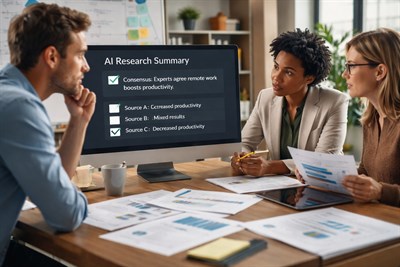
When AI Research Creates False Consensus: Why AI Makes Weak Evidence Look Like Agreement
AI research tools can unintentionally create a false sense of agreement between sources. When AI summarizes multiple articles, it often compresses nuance and disagreement into a single narrative. This guide explains how false consensus appears, why it happens, and how to structure research prompts to prevent misleading conclusions.