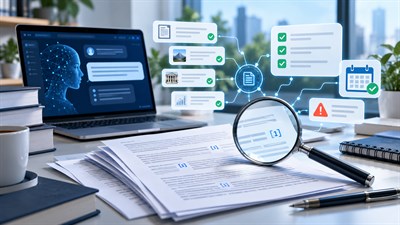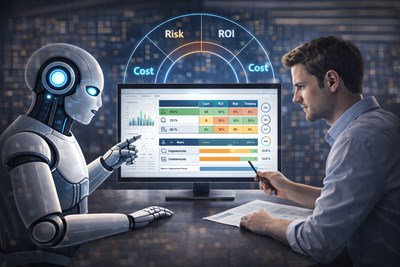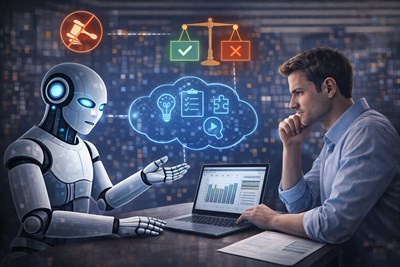
AI is increasingly used in everyday business decisions. Teams use it to compare options, summarize trade-offs, surface possible downsides, and speed up analysis that once took hours. That sounds efficient, but it also creates a new problem at work: people can start treating structured output as judgment. In practice, that is where mistakes begin.
Risk assessment is not just about listing what could go wrong. It is about understanding uncertainty, spotting weak assumptions, weighing consequences, and deciding what deserves escalation. AI can support that process, but it cannot own it. It does not carry legal exposure, operational accountability, or reputational fallout. The human team does.
This article explains how to use AI for risk assessment in business decisions without giving away control. It covers what AI is actually good at, where it improves decision workflows, where it can mislead teams, how to prompt it safely, and why final accountability must remain human. It also connects this workflow to structured decision briefs with AI, because risk analysis works best when it is embedded inside a broader decision process rather than treated as a standalone output.
What AI Actually Does in Risk Assessment
AI does not assess risk in the way decision-makers do. It does not experience downside, understand organizational politics, or carry memory of past mistakes unless that context is explicitly provided. What it does well is organize information, detect patterns in inputs, generate categories of concern, and help teams examine scenarios they may otherwise overlook.
AI does not assess risk on its own. It structures uncertainty based on patterns in the input and the model’s training. The interpretation of that output remains a human responsibility.
That distinction matters. When a team asks AI to evaluate a market expansion, vendor contract, hiring plan, or product launch, the model can produce a neat risk list. But a clean list is not the same as a reliable business judgment. The output may still be incomplete, generic, or based on unstated assumptions.
In other words, AI is useful for mapping possible risks, comparing categories, and clarifying what should be examined further. It is not a substitute for human escalation paths, expert review, or ownership. This becomes even more important in high-stakes decisions where AI should not be used as a decision-maker.
Where AI Improves Risk Evaluation in Business
Used correctly, AI can make risk assessment faster and more complete. It is especially useful in situations where the main challenge is not deep specialist judgment, but information structure. Many teams already struggle because decision discussions stay vague for too long. AI can make the unknowns visible earlier.
One common example is product strategy. A team may be deciding whether to launch a feature now, delay it, or reduce scope. AI can help structure risks across user trust, support load, engineering debt, legal exposure, and rollout timing. That does not answer the decision, but it gives the team a better starting point.
Example: A SaaS team compares three launch options for a new AI feature. The model helps organize risks into compliance, brand trust, support workload, and false-output exposure. The team then uses that structure to decide which risk areas require legal review and which can be mitigated before release.
Another strong use case is vendor selection. Procurement teams often compare providers across cost, delivery reliability, data handling, integration burden, and contractual ambiguity. AI can help extract risk signals from proposals and surface missing information that should be clarified before commitment.
Marketing teams can also benefit. Suppose a business is deciding whether to run a bold campaign tied to a sensitive social or economic topic. AI can help identify reputational risk categories, stakeholder reactions, execution dependencies, and possible interpretation failures. The value is not that the model “knows the future,” but that it broadens the review before the campaign reaches the public.
In finance or operations, AI may help teams compare scenarios under different assumptions. For example, it can outline risks if demand comes in below forecast, if a supplier delay extends beyond two weeks, or if a hiring freeze affects execution. That kind of structured scenario analysis is often more useful than a simple yes-or-no recommendation.
A Practical Framework for AI-Assisted Risk Assessment
To use AI safely in business decisions, teams need a repeatable framework. Without one, the model tends to produce broad commentary that feels thoughtful but is difficult to operationalize. A disciplined workflow turns AI from a vague assistant into a controlled support tool.
1. Define the decision context clearly
The first step is to describe the actual business decision, not the general topic. “Assess the risks of expansion” is too broad. “Assess the risks of opening a sales operation in a new market within six months with a fixed headcount and limited legal support” is much better. Good risk analysis depends on concrete boundaries.
2. Identify what is already known and unknown
AI works better when uncertainty is visible. Teams should separate facts, assumptions, constraints, and open questions. This prevents the model from blending known reality with guessed context.
3. Ask AI to structure risks by category
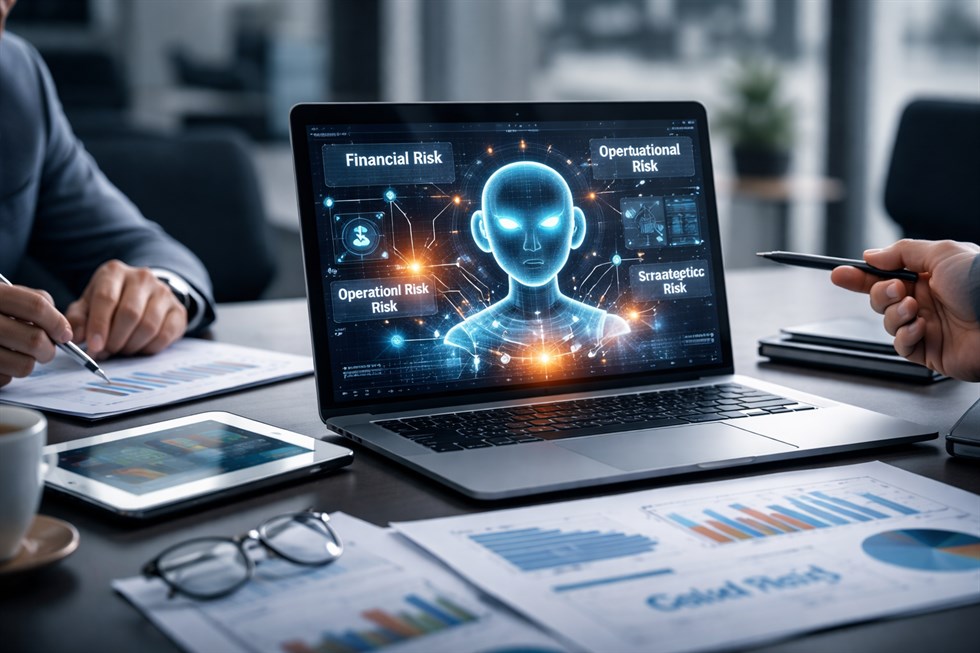
Instead of asking for a recommendation immediately, ask the model to organize possible downside into useful business buckets: financial, operational, legal, strategic, reputational, customer-facing, and execution-related. This reduces the chance of jumping too early into false certainty.
4. Force the model to surface blind spots
One of the best uses of AI is challenging incomplete thinking. Ask what assumptions the team may be missing, where data is weak, and which risks are difficult to quantify. This often exposes the real issue: not whether the choice is good or bad, but whether the team is underestimating uncertainty.
5. Separate analysis from ownership
After AI structures the landscape, human decision-makers must decide what needs specialist review, what can be mitigated, what can be accepted, and what should stop the initiative altogether. That final step cannot be delegated.
Use AI to widen the field of view before a decision. Do not use it to simulate authority or to bypass review that the business would otherwise require.
When this framework is documented inside a decision memo, the result becomes much stronger. That is why teams often get better outcomes when they combine risk analysis with structured decision briefs with AI rather than asking the model for isolated conclusions.
Real Business Scenarios Where This Approach Works
Abstract theory is rarely enough. The real test is whether the workflow holds up in actual business contexts.
Scenario 1: Market entry decision
A company is considering entering a new region. Leadership wants speed, but the operations team is worried about support readiness and local compliance. AI can help organize risks into localization gaps, hiring constraints, payment complexity, customer expectation mismatch, and regulatory unknowns. This makes the next step clearer: which risks require research, which require local advisors, and which are acceptable launch trade-offs.
Scenario 2: Replacing a core vendor
An operations team wants to switch software vendors because of cost pressure. AI can be used to compare migration risks, downtime exposure, security review burden, retraining needs, and contract termination issues. It can also highlight where the business is relying too heavily on promises in the vendor’s sales materials rather than on evidence.
Scenario 3: Changing pricing strategy
A subscription business is considering a sharp pricing increase. AI can help structure risks around churn, perception of unfairness, competitor response, support escalation, and internal forecasting bias. It can also help the team distinguish between measurable commercial risk and harder-to-measure brand risk.
Scenario 4: Publishing AI-generated customer-facing content
A content team wants to scale output with generative AI. Risk analysis here may include factual errors, tone inconsistency, disclosure issues, SEO quality decline, and reputational damage if outputs appear careless or misleading. This is also a point where teams should revisit where AI should not be used in high-stakes contexts, especially if the content affects legal, financial, or safety-related user decisions.
How to Prompt AI for Risk Analysis
The quality of AI-assisted risk assessment depends heavily on prompt design. Weak prompts produce generic warnings. Strong prompts constrain the task, define the role of the model, and prevent premature recommendations.
The examples below are control prompts. They are not meant to replace judgment or automate decisions. Their purpose is to constrain AI behavior during specific workflow steps — helping structure information without introducing assumptions, ownership, or commitments.
Analyze the key risks involved in this decision: [insert decision]. Categorize them into financial, operational, strategic, legal, and reputational risks. Do not recommend a final decision. Only structure the risk landscape based on the information provided.
Review this proposed business decision and identify the assumptions it depends on. For each assumption, explain what could go wrong if it proves false. Do not invent missing facts. Mark uncertainty explicitly.
List the possible negative outcomes of this plan. For each one, describe the likely trigger, the business area affected, and whether the impact would be reversible or hard to reverse. Use qualitative likelihood only: low, medium, or high.
Compare these two options from a risk perspective only. Ignore upside. Focus on failure modes, hidden dependencies, and decision points that would require human escalation.
Act as a structured reviewer. Based on the information below, identify what is known, what is assumed, what is uncertain, and what additional evidence would be needed before a responsible decision could be made.
These prompts work because they do not ask the model to “decide.” They ask it to classify, separate, compare, and expose uncertainty. That is a safer and more useful role.
What Good AI Risk Output Looks Like
Teams often focus too much on whether AI output is impressive. The better question is whether it is operationally useful. Good risk output is not dramatic or overly clever. It is structured, cautious, transparent about uncertainty, and easy to challenge.
A useful output usually has several characteristics. It distinguishes fact from assumption. It separates categories cleanly. It identifies missing information instead of pretending certainty. It avoids language that suggests authority without evidence. And it makes room for human review instead of trying to close the discussion too early.
Strong output: “The decision depends on three assumptions that have not been validated: customer demand, implementation capacity, and legal clarity. The most material downside appears operational rather than financial, but this cannot be confirmed without internal support data.”
That kind of answer helps a team move forward. It shows where to investigate next. By contrast, weak output sounds final too early: “This is a good decision with manageable risks.” That may feel efficient, but it is not serious risk analysis.
Limits and Risks of Using AI in Decision-Making
AI can improve business analysis, but it also creates its own layer of risk. Some of those risks are obvious, such as factual errors. Others are more subtle, such as the false sense of completeness that comes from well-formatted output.
AI can present incomplete, shallow, or incorrect risk scenarios with high confidence. Confidence in wording is not evidence of accuracy.
Hallucinations and fabricated certainty
The model may state things that sound plausible but are not grounded in the provided facts. This is especially dangerous when decision-makers are rushed and assume that polished language means analysis has already been done.
Bias in framing
AI may overemphasize some categories of risk and underemphasize others depending on how the prompt is framed. For example, a model prompted mainly around cost efficiency may underweight reputational or customer trust concerns.
Lack of internal context
Most business risk is context-heavy. A risk that looks minor in general may be critical for one company because of staffing, history, contractual exposure, or regulatory position. Unless that context is provided, the output stays generic.
Over-reliance by non-experts
AI can be particularly risky when used by people who are not equipped to challenge it. The danger is not only bad output. It is the absence of resistance to bad output.
Decision laundering
One of the most serious organizational risks is using AI to make a decision look more objective than it really is. A team may already want a particular outcome and use AI-generated risk analysis to justify it after the fact. That is not disciplined decision support. It is optics.
For that reason, AI-supported risk assessment should always be reviewable. Inputs, assumptions, and prompts should be visible enough for others to challenge them. Otherwise, the process becomes harder to trust, not easier.
When AI Should Not Be Used for Risk Assessment
There are situations where AI may still help with formatting or summarization, but should not be treated as an assessment layer at all. These are high-stakes domains where the cost of error is too high, the context is too sensitive, or the decision requires formal authority, duty of care, or licensed expertise.
Examples include legal advice tied to active disputes, medical decisions affecting health outcomes, safety-critical operational calls, fraud accusations, employment actions with major consequences, and crisis communications that may trigger regulatory or reputational exposure. In such cases, teams should review where AI should not be used: high-stakes decisions explained and apply stricter escalation rules.
If the business would normally require a lawyer, doctor, compliance lead, safety officer, or executive owner to sign off, AI should not be treated as the assessment authority.
The same caution applies to irreversible decisions. When a choice cannot easily be undone, even a small analytical error becomes more serious. AI may still help organize inputs, but it should not narrow the final judgment.
How to Keep Humans in Control
Keeping human control does not mean ignoring AI. It means assigning AI a bounded role inside a workflow that still has human gates.
A practical way to do this is to require that every AI-assisted risk review answer four questions before a decision moves forward:
What facts were provided to the model? What assumptions did the model surface? What remains uncertain after the analysis? Who is accountable for deciding despite that uncertainty?
These questions force ownership back into the workflow. They also make it easier to see whether the model is helping or merely adding noise.
Some organizations go further and treat AI output as a draft artifact only. A human reviewer must rewrite the risk summary in their own words before it can be used in a decision document. This is often a smart discipline, because it prevents passive acceptance.
AI can support analysis, but it cannot own outcomes, justify irreversible action, or absorb business consequences. Responsibility remains with the people making and approving the decision.
This is also why risk analysis should not sit alone in a chat transcript. It should feed into a documented decision process. Many teams benefit from converting the analysis into structured decision briefs with AI, where options, assumptions, risks, mitigations, and ownership are visible in one place.
Final Human Responsibility
The central governance principle is simple: AI may help a team think better, but it does not make the team less responsible. If a decision fails, the organization cannot point to the model as the accountable actor. That is true legally, operationally, and ethically.
For that reason, the safest use of AI in business decisions is not recommendation replacement, but analytical support. It can help a team slow down where it is overconfident, widen the set of risk factors under review, and expose assumptions that deserve scrutiny. Those are meaningful gains. But the final call must remain human, especially when consequences are material.
Used in that disciplined way, AI becomes valuable not because it eliminates uncertainty, but because it helps teams face uncertainty more honestly.
FAQ
Can AI accurately assess business risks?
AI can help structure business risks, compare categories, and surface hidden assumptions, but it cannot fully understand organizational context or real-world consequences. It should be used as a support tool, not as the final decision-maker.
What is the biggest risk of using AI in business decisions?
One of the biggest risks is false confidence. AI can produce polished output that looks complete even when it is generic, incomplete, or based on weak assumptions. That can mislead teams into moving too quickly.
How should teams use AI for risk assessment safely?
Teams should define the decision clearly, provide relevant context, ask AI to structure risks rather than decide, and require human review before any action is approved. AI works best when bounded by process and accountability.
When should AI not be used in risk assessment?
AI should not be treated as the assessment authority in high-stakes situations such as legal disputes, medical matters, safety-critical decisions, crisis communications, or other irreversible choices with major consequences.
What makes a good prompt for AI risk analysis?
A good prompt constrains the task. It asks the model to categorize risks, identify assumptions, expose uncertainty, or compare downside without making the final decision. Strong prompts reduce the chance of overreach and vague output.
How does AI risk assessment relate to structured decision briefs?
Risk analysis becomes more useful when it feeds into a documented decision brief. That way, assumptions, trade-offs, mitigations, and ownership are visible together instead of being scattered across chat outputs or informal notes.