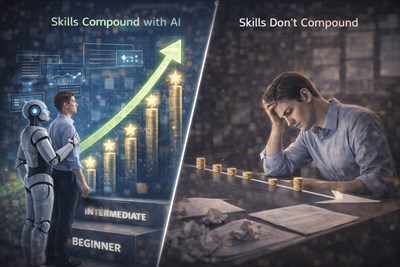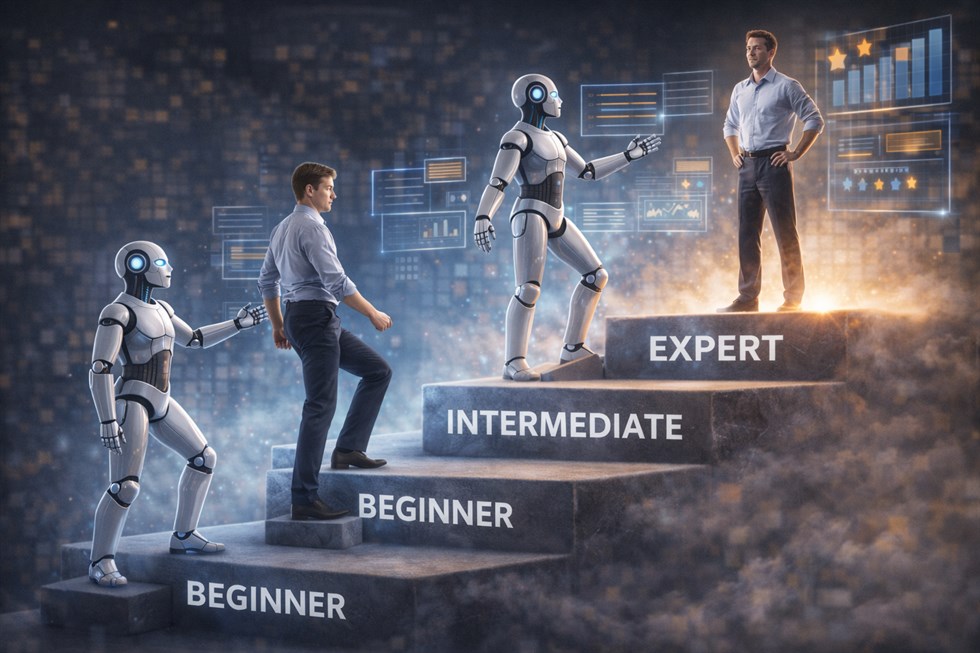
AI changes skill progression by compressing early learning stages while expanding responsibility at higher levels. Beginners can now produce usable output faster, intermediates gain leverage through AI-assisted judgment, and experts shift from execution to oversight and decision ownership. This creates both a career opportunity and a risk: people may appear more skilled earlier, but expectations around accountability rise sharply. The traditional beginner → intermediate → expert ladder still exists, but AI reshapes what each level actually means at work.
AI and the New Skill Ladder
For decades, skill progression followed a predictable pattern. Time, repetition, and mentorship gradually moved a person from novice to expert. Output quality improved as experience accumulated, and responsibility increased slowly alongside competence.
AI breaks this balance.
Modern tools drastically shorten the execution phase of work. Tasks that once required months of practice—writing reports, generating code, analyzing data, drafting marketing copy—can now be completed in minutes. However, AI does not compress thinking, judgment, or accountability at the same rate.
This creates a new dynamic: compressed learning paired with expanded responsibility. People move faster through visible skill levels, but the cost of mistakes increases because AI-generated output often looks confident even when it is wrong.
AI changes how fast people move through skill levels — but not how responsibility is assigned.
The ladder is not gone. It is misaligned. Organizations that fail to recognize this misalignment risk promoting people based on output speed rather than real competence.
Beginner Level — What AI Accelerates (and What It Destroys)
At the beginner level, AI is most seductive. It removes friction, lowers anxiety, and allows newcomers to produce work that looks professional almost immediately.
What AI accelerates for beginners:
- Exposure to real tasks earlier
- Faster feedback loops
- Reduced fear of blank pages or complex tools
What AI can quietly destroy:
- Understanding of fundamentals
- Cause-and-effect reasoning
- The ability to diagnose errors independently
Consider a junior marketer using AI to generate ad copy. The text may perform well enough, but if asked why certain phrases convert better, the marketer often cannot explain. The output exists without the underlying model of how persuasion works.
The same applies to an entry-level analyst who relies on AI to summarize reports. The summary may be accurate, but when assumptions are wrong or data is missing, the analyst lacks the mental framework to notice.
A beginner can produce acceptable output with AI, but often cannot explain why it works.
Used incorrectly, AI allows beginners to skip struggle—the very process that builds intuition. Used correctly, it can become a tutor rather than a replacement.
Explain this result step by step as if I had to do it manually tomorrow.
This type of prompt forces learning to stay intact. It slows down output in exchange for understanding, which is exactly what beginners need.
Intermediate Level — Where AI Becomes a Force Multiplier
The intermediate stage is where AI begins to reward real skill rather than hide its absence.
An intermediate professional can already do the work without AI, albeit more slowly. This changes how AI is used. Instead of replacing effort, it augments judgment.
At this level, AI becomes a tool for:
- Exploring multiple options quickly
- Identifying blind spots
- Testing assumptions under different constraints
At the intermediate level, AI shifts from doing work to challenging thinking.
A product manager, for example, may use AI to generate alternative hypotheses about customer behavior—but will validate them against real data and experience.
A developer reviewing AI-generated code focuses less on whether it compiles and more on security, edge cases, and maintainability.
An analyst may ask AI to stress-test insights by deliberately challenging conclusions or simulating counterfactual scenarios.
This is also the stage where professionals learn to detect hallucinations, bias, and overconfident answers. The ability to say “this looks right, but something feels off” becomes a defining skill.
AI rewards those who can correct it.
Expert Level — From Execution to Oversight
Experts do not simply use AI more. They use it differently.
At high levels of skill, execution is no longer the bottleneck. Decision quality is. Experts delegate execution to AI while retaining ownership over outcomes.
This shifts their role toward supervision:
- Defining what matters
- Setting constraints and priorities
- Evaluating second- and third-order effects
Expert interaction with AI is driven less by prompts and more by questions:
- “If this is wrong, what breaks?”
- “What assumptions are hidden here?”
- “Who is affected if we act on this?”
Experts understand that AI output is provisional. They treat it as a draft, a hypothesis, or a simulation—not a decision.
Crucially, they also accept that accountability remains theirs. When AI-supported decisions fail, it is the expert’s reputation, role, and responsibility on the line.
What AI Cannot Replace in Skill Progression
Despite its power, AI cannot replace several core elements of human skill development.
- Contextual judgment: Understanding nuances that are not written down
- Ethical responsibility: Deciding what should not be done
- Cross-domain reasoning: Connecting insights across fields
- Real-world accountability: Owning consequences beyond the screen
These are not technical limitations. They are structural ones. AI operates on patterns; responsibility operates in reality.
AI removes friction from execution, not from responsibility.
This is why expertise still matters. Not because experts type faster or know more commands, but because they understand impact.
Limits and Risks of AI-Accelerated Skill Growth
AI-driven acceleration comes with real risks that organizations and individuals often underestimate.
One risk is a false sense of expertise. When output looks polished, it is easy to assume competence exists underneath. This can lead to premature promotions and fragile careers.
Another risk is skill atrophy. Over-reliance on AI for basic tasks can erode foundational abilities, making it difficult to operate when tools fail or contexts change.
There is also the danger of over-trust. AI systems can be confidently wrong, especially in edge cases or unfamiliar domains.
Finally, accelerated progression can create career instability. People may rise quickly but lack the depth needed to adapt when roles become more complex.
These risks are not reasons to avoid AI—but reasons to use it deliberately.
Final Human Responsibility
No matter how advanced AI becomes, responsibility does not shift.
Organizations may adopt AI tools, teams may integrate them into workflows, and individuals may rely on them daily. Yet when outcomes matter—financially, legally, ethically—it is still a human name attached to the result.
Seniority continues to matter because it reflects experience in handling consequences, not just producing output.
AI can assist decisions, but it cannot carry responsibility for them.
Understanding this is the difference between using AI as a career accelerator and becoming dependent on it.
FAQ
Does AI make it easier to become an expert?
AI accelerates exposure to advanced tasks but does not replace judgment or responsibility.
Can beginners rely on AI to learn faster?
They can, but only if AI is used to explain, not replace, core skills.
What skills matter most in the AI era?
Critical thinking, verification, context awareness, and decision ownership.
Will AI eliminate career ladders?
No. It compresses early stages and raises expectations at higher levels.
How should companies evaluate skill with AI?
By assessing reasoning quality, not output speed.