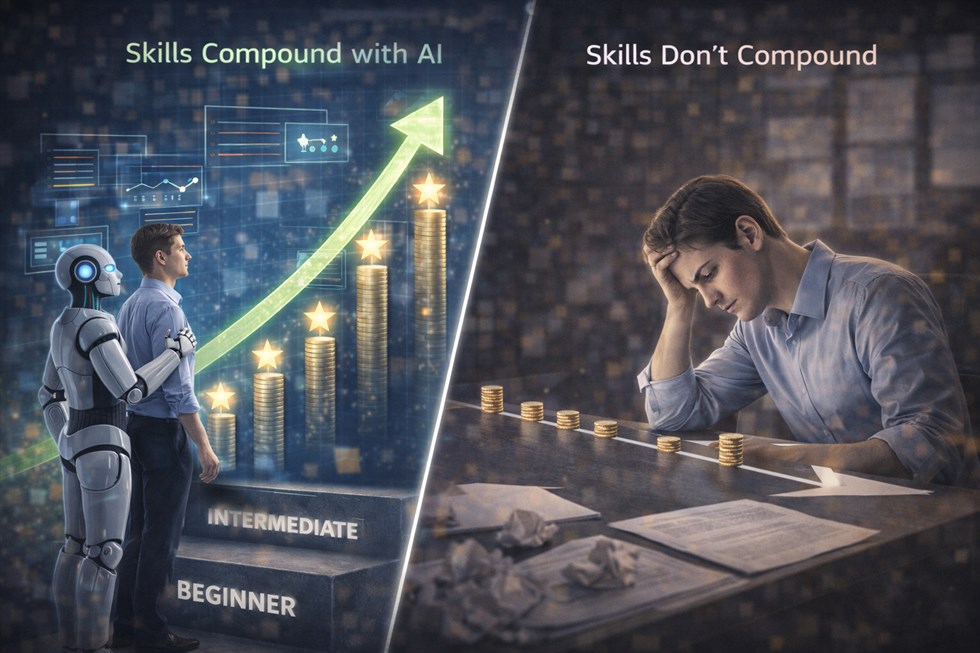
Not all skills benefit from AI. Some skills compound — they grow in value because AI increases their leverage, speed, and reach. Others don’t compound — they plateau or get commoditized because AI can replicate the output without needing the underlying expertise. The difference is not “creative vs technical” or “white-collar vs blue-collar.” The real divider is decision ownership: skills compound when a human remains responsible for meaning, trade-offs, and outcomes.
This matters at work because career growth increasingly depends on what a person is trusted to decide, not how fast they can produce drafts, slides, or code. AI raises the baseline execution level. The winners are those who move up the skill ladder toward judgment, accountability, and systems-level thinking — while using AI for execution.
For practical workflows on using AI without losing control, see: How to Use AI at Work Effectively.
Core idea: A skill compounds with AI when AI increases the impact of that skill without removing the human’s responsibility for correctness, consequences, and priorities.
What “compounding skills” mean in the age of AI
A compounding skill is an ability that becomes more valuable over time because it improves how a person thinks, decides, and influences outcomes — and those improvements stack. In the AI era, compounding is not about mastering a single tool. It’s about building capabilities that scale with better tools.
AI makes output cheaper. When output is cheap, value shifts to:
- Choosing the right problem (what is worth doing at all).
- Defining success (what “good” looks like in the real world).
- Evaluating truth and quality (what is correct, safe, and credible).
- Making trade-offs (what to prioritize under constraints).
- Owning the outcome (taking responsibility when it fails).
Skills that center on these decisions compound because AI can accelerate the “doing” while leaving the “deciding” in human hands. By contrast, skills that focus on repetitive execution without judgment often stop compounding because AI can do them faster and cheaper with acceptable quality for many contexts.
A simple test: if AI can generate the deliverable, the value shifts to whoever can judge it, adapt it to context, and take responsibility for it.
The compounding test: how to classify any skill
To decide whether a skill compounds with AI, classify it by the kind of leverage it creates. A skill compounds when it improves at least one of these:
- Decision quality (better choices, fewer costly mistakes).
- Context control (knowing what matters in this situation, for this organization).
- Constraint navigation (time, budget, risk, compliance, brand, ethics).
- Outcome accountability (owning consequences beyond the artifact).
- Cross-functional influence (aligning people, not just producing outputs).
A skill does not compound when its value is mostly:
- Mechanical production of common outputs.
- Memorizing tool steps that change frequently.
- Following templates with minimal situational adaptation.
- Routine formatting and process compliance without deeper understanding.
Compounding skills increase a person’s leverage. Non-compounding skills increase a person’s output. AI makes output abundant — leverage stays scarce.
Skills that compound with AI
These are the skills that typically grow stronger when paired with AI because AI amplifies them rather than replacing them.
1) Problem framing and scoping
Problem framing is the ability to define what is actually being solved, what success means, and what constraints matter. AI can generate options, but it cannot reliably choose the right objective in a real organization with real consequences.
Example: A product manager asks AI for 10 feature ideas. The compounding skill is not “getting 10 ideas.” It is choosing the 2 that fit the strategy, user pain, timeline, and business model — and rejecting the rest.
What makes this compound is repetition across contexts: every project strengthens the ability to define better questions, set better constraints, and prevent wasted work.
2) Judgment under uncertainty
Work rarely has complete information. AI produces plausible content — sometimes wrong, sometimes risky. The human skill is judging when confidence is warranted, what to verify, and which risks are acceptable.
Example: A finance lead uses AI to summarize contract clauses and flag risks. The compounding skill is deciding what is material, escalating the right issues, and preventing downstream liabilities.
3) Systems thinking
Systems thinking means seeing second-order effects: how a change affects operations, support, sales, compliance, and reputation. AI can list dependencies, but humans must decide which dependencies matter and what trade-offs to accept.
Example: A team automates customer support replies with AI. Systems thinking anticipates escalation paths, brand voice drift, data privacy risk, and long-term customer trust — then designs guardrails.
4) Communication, synthesis, and alignment
AI drafts messages quickly. But alignment requires tailoring to stakeholders, negotiating trade-offs, and resolving ambiguity. These are compounding because each project builds better instincts for clarity and influence.
Example: A project lead uses AI to draft a roadmap update. The compounding part is turning conflicting inputs into a coherent narrative that secures buy-in and reduces churn.
5) Deep domain expertise paired with evaluation
AI can imitate domain language. But domain experts can evaluate what is correct, relevant, and safe — and can spot subtle errors. This compounds because expertise increases the quality of evaluation, which increases trust and responsibility.
Example: A lawyer uses AI to accelerate research. The compounding skill is legal reasoning: selecting precedent, testing arguments, and ensuring claims match jurisdiction and facts.
In many roles, AI turns “execution speed” into a commodity. Domain judgment becomes the differentiator.
Skills that do not compound with AI
These skills often plateau because AI can replicate the output with minimal context — and the market learns to accept “good enough” automation for many tasks.
1) Pure execution without ownership
If a task is mostly producing a standard artifact (a summary, a basic report, a simple email, a template-based landing page), AI reduces the value of being the person who types it.
Example: Manually rewriting meeting notes into a standard format used to signal diligence. With AI transcription and summarization, the value shifts to deciding what actions matter and ensuring follow-through.
2) Tool memorization as a career strategy
Knowing the exact buttons in a specific tool rarely compounds because tools change quickly, and AI increasingly hides interfaces behind natural language. Tool knowledge still matters, but it must serve deeper capabilities (judgment, workflow design, quality control).
3) Template-only content production
Content that follows predictable formulas can be generated at scale. When everyone can produce “a decent version,” the advantage comes from strategy, originality, and audience insight — not from filling the template.
Example: “10 tips” articles can be produced endlessly. The compounding value is developing a point of view, evidence, and trust — not the list itself.
4) Routine formatting and low-context process work
Formatting slides, cleaning text, converting documents, basic categorization — these tasks remain necessary but rarely compounding as core career capital. They are ideal to delegate to AI.
Non-compounding skills are not “bad.” They are simply risky as primary career identity because AI compresses their market value.
Real workplace examples: compounding vs non-compounding in practice
Example A: Marketing
Non-compounding: Writing five ad variations from a template and changing a few words.
Compounding: Choosing the positioning, defining the offer, understanding customer objections, and setting a measurement plan — then using AI to generate drafts and test angles.
Example B: Data work
Non-compounding: Manually building the same monthly report and copying charts into slides.
Compounding: Defining leading indicators, challenging assumptions, interpreting anomalies, and communicating implications to leadership — then using AI to accelerate analysis and narrative drafts.
Example C: HR / People ops
Non-compounding: Drafting standard job descriptions without role design.
Compounding: Designing the role, evaluating capability gaps, improving interview signals, reducing bias, and aligning hiring to strategy — then using AI to draft materials and structure evaluation.
Example D: Engineering
Non-compounding: Writing boilerplate code without understanding failure modes.
Compounding: Architecture, security reasoning, performance trade-offs, reliability strategy, and code review judgment — then using AI for scaffolding and rapid iteration.
A recurring pattern: AI can accelerate “making.” Humans still win on “meaning,” “trade-offs,” and “consequences.”
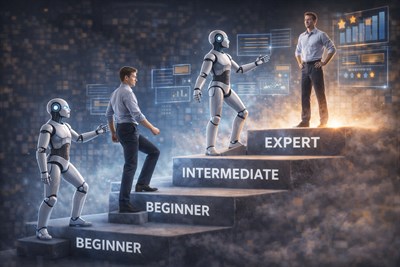
How AI reshapes the skill ladder (Beginner → Expert)
AI changes how people move from beginner to expert. It can speed up early execution: a beginner can produce a draft, code snippet, or plan quickly. But AI does not automatically create expertise — because expertise is defined by reliable judgment under real constraints.
In practice, AI shifts the ladder upward:
- Beginners can produce more artifacts earlier.
- Mid-level professionals are pressured to own outcomes faster.
- Experts differentiate by evaluation, risk control, and decision accountability.
For a deeper breakdown of why this ladder is changing and how to adapt: How AI Changes Skill Progression (Beginner → Expert).
AI can compress the “learning by doing” phase. It does not compress the “learning by being responsible for outcomes” phase.
Prompt blocks: use AI to amplify compounding skills
The examples below are control prompts. They are not meant to replace judgment or automate decisions. Their purpose is to constrain AI behavior during specific workflow steps — helping structure information without introducing assumptions, ownership, or commitments.
List my current work tasks and classify them into: (1) Compounding skills, (2) Non-compounding execution, (3) Ambiguous. For each task, explain the decision ownership involved and what risks I carry if it’s wrong.
Help redesign my weekly workflow so AI handles low-context execution while I retain responsibility for scoping, evaluation, and stakeholder alignment. Output: a step-by-step workflow with checkpoints and “human must decide” gates.
Given my role and industry, propose a 90-day plan to strengthen compounding skills: problem framing, judgment, systems thinking, and communication. Include weekly practice tasks and measurable signals of improvement.
Take this AI-generated draft (paste below) and produce a verification checklist: what could be wrong, what requires sources, what assumptions are hidden, and what should be escalated to a human decision-maker.
Interpretation guide for checklists: treat “Yes” as permission to proceed, “No” as a stop signal that requires clarification, verification, or a human decision. If several items are “No,” narrow scope and reduce risk before continuing.
Limits and risks: how AI can sabotage skill compounding
AI can strengthen careers, but it can also quietly erode expertise. The biggest risks show up when output looks impressive while understanding declines.
Risk 1: Illusion of competence
AI produces plausible answers. People may start trusting fluency over truth. This creates fragile performance that breaks under real scrutiny.
Risk 2: Skill atrophy
If AI is used to skip thinking steps (planning, reasoning, checking), core skills weaken. Over time, the person becomes dependent on the tool and less capable without it.
Risk 3: Hidden errors and reputational damage
AI can hallucinate facts, misread context, or produce confident but incorrect guidance. In many roles, a single mistake can cost trust, money, or legal exposure.
Risk 4: Over-optimization for speed
Speed is seductive. But if speed replaces quality control, the organization accumulates debt: sloppy decisions, inconsistent messaging, broken processes, and avoidable rework.
AI accelerates both good and bad judgment. Without checkpoints, it compounds the wrong things.
Final human responsibility: what AI cannot compound for anyone
The most important career asset in the AI era is responsibility. AI can draft, summarize, generate, and automate. It cannot reliably:
- own a decision when stakeholders disagree,
- take responsibility for consequences,
- be accountable for ethics, safety, and compliance,
- earn trust through consistent judgment over time.
That is why compounding skills are the skills that keep humans in the loop as accountable decision-makers. The strongest career move is not “learn AI tools faster.” It is to move up the ladder toward ownership: define problems, set constraints, evaluate truth, and take responsibility for outcomes — while using AI to accelerate execution.
A practical rule: AI should increase a person’s leverage without decreasing their accountability. If accountability disappears, the skill stops compounding.
FAQ
Which skills are most future-proof with AI?
Skills that involve judgment, context, trade-offs, and accountability are most future-proof because AI amplifies them instead of replacing them.
Is prompting a compounding skill?
Prompting alone usually does not compound. Problem framing, evaluation, and workflow design compound; prompts are just a temporary interface.
Do technical skills still matter if AI can code?
Yes. Technical skills compound when they include architecture, security, debugging judgment, and reliability thinking. Pure boilerplate coding value is more likely to plateau.
How can a professional tell if a skill will stop compounding?
If AI can produce the output and the organization no longer needs the person to own correctness, risk, or consequences, that skill is likely to plateau.
Can beginners compete with experts using AI?
Beginners can execute faster and create passable drafts. Experts remain differentiated by judgment, verification, and responsibility under real constraints.
What should a 90-day upskilling plan focus on?
It should focus on problem framing, evaluation, domain depth, communication, and systems thinking — using AI for execution while keeping human checkpoints for truth and trade-offs.