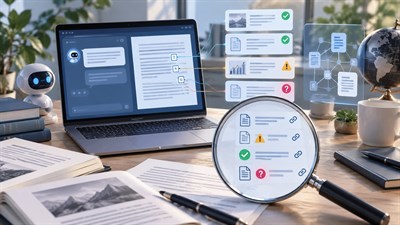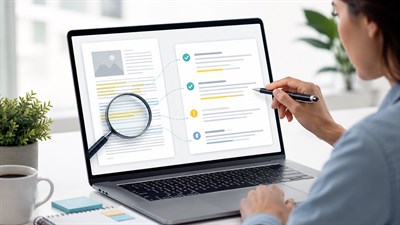
AI-generated citations can look surprisingly convincing. A response may include an author, publication title, date, journal name, URL, or even a DOI. In a work document, that level of detail can make the source appear trustworthy before anyone has actually checked it.
But a professional-looking citation is not evidence by itself. The source may not exist. It may exist but say something different from what the AI claims. Or it may have been accurate when published but no longer be current enough for the statement being made today.
To verify an AI citation, check three things separately: whether the source is real, whether it is relevant to the exact claim, and whether it is up to date enough for that claim. Only after all three checks should you decide whether the citation is safe to use in a report, presentation, article, proposal, or client deliverable.
Key takeaways: A valid-looking AI citation is not evidence by itself. Verify three things separately: whether the source actually exists, whether it supports the exact claim the AI made, and whether it is recent enough for that claim. Open the original source whenever possible, check the author, publisher, title, date, and URL, then locate the supporting passage yourself. For time-sensitive facts, verify whether newer evidence has replaced or changed the cited information. Treat AI-generated citations as leads to investigate—not as proof.
The Three Tests Every AI Citation Should Pass
The easiest way to evaluate an AI-generated citation is to avoid treating verification as a single yes-or-no question. Instead, run three separate tests: existence, relevance, and freshness.
A citation can pass one test and still fail the others. A real article can be irrelevant to the claim. A relevant article can be outdated. A current-looking citation can be entirely fabricated.
Test 1 — Is the source real?
Start by confirming that the source actually exists. Do not assume that a detailed citation is more likely to be genuine simply because it contains realistic metadata.
Check the citation's core bibliographic details:
- author or authors;
- exact title;
- publisher, journal, institution, or website;
- publication date;
- URL;
- DOI or other identifier, when applicable;
- volume, issue, or page numbers for academic publications.
Ideally, you should be able to locate the original source through the publisher, journal, institution, official database, or another authoritative location. If the citation cannot be reproduced independently, treat it as unverified.
Test 2 — Does the source actually support the claim?
This is where many citation checks fail. Finding a real article with the correct title does not prove that the AI used it correctly.
The source might discuss the same topic without supporting the specific statement. The AI may have overstated a conclusion, removed an important limitation, confused correlation with causation, combined results from different studies, or attached a real citation to a claim taken from somewhere else.
You need to locate the actual passage, table, dataset, conclusion, or official statement that supports the claim being made.
If the source says that a result was observed in one controlled experiment, for example, the AI should not automatically turn that result into a universal statement about all workers, all companies, or all uses of AI.
Test 3 — Is the source current enough?
A source does not become unreliable simply because it is old. Some research remains useful for decades. Historical records obviously do not need to be published yesterday.
Freshness matters when the claim itself can change.
This includes claims about:
- software features;
- AI model capabilities;
- prices;
- laws and regulations;
- company leadership;
- market share;
- current statistics;
- product availability;
- company policies;
- government rules;
- industry adoption rates.
A source from several years ago may still be real and accurately cited, yet be unsuitable for a sentence written in the present tense.
A citation can be completely real and still be the wrong evidence. Existence, relevance, and freshness are three separate verification tests.
How to Verify an AI Citation Step by Step
The following process works for citations generated by ChatGPT and other AI systems, whether you are checking academic research, business statistics, news sources, government documents, product documentation, or ordinary web pages.
Step 1 — Copy the citation exactly as the AI gave it
Before searching for anything, copy the citation without correcting it.
Preserve the title, author names, publication date, URL, DOI, page numbers, publisher, and any other metadata exactly as provided. This matters because one of the things you are checking is whether the AI supplied the bibliographic information correctly.
If you silently fix an author name or publication title during your search, you may accidentally make a bad citation appear more accurate than it originally was.
Step 2 — Open the URL instead of trusting the citation text
If the AI provided a URL, open it.
Then check where it actually leads. A legitimate-looking URL can still fail in several ways:
- the page returns a 404 error;
- the URL redirects to a homepage;
- it opens a search page instead of the cited document;
- the domain is correct but the article is different;
- the title or author does not match;
- the page no longer exists.
Do not count a plausible URL structure as evidence that a citation is genuine.
Step 3 — Search for the title independently
If the URL does not work, or if no URL was provided, search for the exact title independently.
Put the title in quotation marks and look for the original publisher, journal, organization, university, government agency, or other primary host.
For academic research, you may also check sources such as Google Scholar, Crossref, PubMed, or the database most appropriate to the subject.
The important point is independence: you are trying to reproduce the citation outside the AI response.
Step 4 — Match the bibliographic details
Finding a similar title is not enough. Compare the details supplied by the AI against the actual publication.
Check whether:
- the authors match;
- the title matches;
- the journal or publisher matches;
- the year is correct;
- the DOI points to the correct work;
- the volume and issue are correct;
- the page numbers exist where applicable.
AI systems can sometimes combine details from multiple genuine publications into one citation. The author may be real, the journal may be real, and the title may sound plausible while the exact combination does not correspond to any actual publication.
Step 5 — Find the exact claim inside the source
Once you know the source exists, verify the evidence itself.
Search the page or document for the statistic, phrase, concept, or conclusion the AI used. If the AI claims that a study found a 24% increase, locate that number. If it claims that a government agency recommends a specific action, locate the recommendation in the original guidance.
Keyword overlap is not enough. A source can mention the same subject while reaching a different conclusion.
I will give you an AI-generated claim and the text of the cited source. Identify the exact passage that supports the claim. If the source does not directly support it, say so. Do not infer evidence that is not explicitly present. Separate direct support, partial support, and no support.
This kind of prompt can make comparison faster, especially with long documents. However, the AI's comparison should assist your review, not replace access to the original source.
Step 6 — Check whether the AI changed the meaning
AI summaries often fail through subtle distortion rather than complete fabrication. The underlying source may be genuine, but important context can disappear during summarization.
Compare the AI's wording with the source's wording carefully. Pay particular attention to:
- numbers and percentages;
- sample size;
- population studied;
- country or geographic scope;
- time period;
- experimental conditions;
- confidence or uncertainty;
- words such as may, could, suggests, and associated with;
- whether the source demonstrates correlation or causation.
Example: A study reports that employees using a specific AI tool completed one controlled writing task 18% faster. The AI summarizes this as “AI increases employee productivity by 18%.” The citation may be real, but the broader claim is not supported by the study.
This distinction matters at work because a small change in wording can turn a limited finding into an unsupported business conclusion.
Step 7 — Check the publication and update date
Do not stop after finding a visible date on the page. Determine what that date represents.
A source may contain several relevant dates:
- original publication date;
- last updated date;
- date the underlying data was collected;
- date a report was released;
- date you accessed the page.
These are not interchangeable.
A report published in 2025 could rely primarily on data collected in 2022. A webpage updated yesterday may still contain statistics from several years ago.
Step 8 — Search for newer evidence
If the claim is time-sensitive, do not merely ask whether the source was correct when published. Ask whether better or newer evidence now exists.
Look for updated official statistics, newer research, revised regulations, current documentation, updated company policies, or later versions of the same report.
This source was published on [DATE] and is being used to support the following claim: “[CLAIM].” What parts of this claim could be time-sensitive? List what I should verify with newer primary or authoritative sources before using the citation today. Do not assume the cited information is still current.
For a broader workflow covering source verification across an entire AI-generated response, see How to Verify ChatGPT Sources and Citations.
Step 9 — Decide whether the citation is safe to use
After verification, assign the citation one of four practical outcomes.
Use: The source exists, the metadata is accurate, the evidence directly supports the claim, and the information is current enough.
Use with qualification: The source is valid, but the claim needs narrower wording to match the evidence.
Replace: The source is genuine but outdated, weak, secondary, or less authoritative than another available source.
Reject: The source cannot be found, is misattributed, contains incorrect metadata, or does not support the claim.
A Fast AI Citation Verification Checklist
When you are reviewing multiple citations, use a consistent checklist rather than relying on whether each source “looks credible.”
| Check | What to verify | Red flag |
|---|---|---|
| Existence | Source, title, and author actually exist | Cannot find the original |
| URL | Link opens the correct source | 404, homepage, or unrelated page |
| Metadata | Author, title, date, journal, DOI, and publisher match | Mixed or incorrect details |
| Claim | Source supports the exact statement | Same topic, different conclusion |
| Numbers | Statistics and context match | Correct number used in the wrong context |
| Date | Evidence is current enough for the claim | Old evidence supporting a present-tense claim |
| Authority | Source is appropriate for the type of claim | Weak secondary source used when a primary source exists |
Fast rule: If you cannot open the original source and locate evidence for the specific claim, do not treat the AI citation as verified.
Real Examples of AI Citations That Look Valid but Fail
The easiest citation errors to detect are completely invented sources. More difficult cases involve citations that are partly correct.
Example 1 — The source does not exist
Imagine an AI produces an academic citation containing two plausible researcher names, a professional-sounding study title, a recognized journal, a year, volume number, and DOI.
You search the exact title and find nothing. The DOI does not resolve. Searching the journal archive produces no matching paper. One of the authors has published on a related subject, which may explain why the citation looked believable.
The citation fails the first test: existence. It should not appear in your work, even if the underlying claim sounds reasonable.
Example 2 — The article exists, but the claim is not in it
Suppose an AI cites a real report about workplace AI adoption and states that companies using generative AI reduce administrative costs by 30%.
The report exists. The title, publisher, and publication date are correct. However, when you search the report, the 30% figure does not appear. The document discusses administrative automation more generally but never reports the claimed cost reduction.
The citation is real but irrelevant to the specific claim. It fails the second test.
Example 3 — The number is real, but the context is wrong
Consider a hypothetical survey in which 37% of respondents in one industry and one country say they use AI tools at least weekly.
An AI response turns this into:
“37% of employees now use AI every week.”
The percentage may be copied accurately, but its population has changed. A result from a limited sample has been reframed as a global workforce statistic.
This kind of citation error is particularly dangerous because the source and number may both be genuine.
Example 4 — The citation was correct, but is now outdated
Imagine a software comparison written using documentation from two years ago. At the time, the citation correctly described a product limitation. Since then, the feature has been added.
The citation remains real. The old documentation may still be accessible. It even accurately supports what was true at the time.
But it cannot support a present-tense statement such as “The product does not support this feature.” The citation fails the freshness test.
How to Use AI to Help Verify a Citation Without Trusting AI Twice
There is an important trap in AI-assisted fact-checking: asking an AI system whether another AI-generated citation is correct and treating the second answer as independent confirmation.
That is not independent verification.
AI can help organize the process, compare text you provide, identify missing metadata, extract claims, create search queries, and highlight inconsistencies. But the AI should not become the evidence used to prove that another AI output is correct.
A useful principle is:
AI can assist with verification; it cannot serve as the independent evidence being verified.
Good uses of AI during citation checking include:
- extracting every factual claim from a paragraph;
- comparing an AI summary with source text you provide;
- identifying missing bibliographic fields;
- generating exact search queries;
- listing aspects of a claim that may be time-sensitive;
- highlighting differences between two versions of a source.
Audit this citation, but do not assume it is genuine. Break the verification into: (1) existence, (2) bibliographic accuracy, (3) support for the exact claim, and (4) freshness. For every conclusion, tell me what must still be checked against the original source independently.
This workflow keeps AI in the role it handles best: helping you inspect evidence rather than replacing the evidence.
How Current Does a Source Need to Be?
There is no universal rule that a source must be less than one, three, or five years old. The correct freshness threshold depends on how quickly the underlying fact can change.
Fast-changing information
For fast-changing claims, even a source from several months ago may require another check.
This category includes:
- AI product capabilities;
- software features;
- subscription prices;
- current laws or regulations;
- company executives;
- current market statistics;
- product availability;
- government policies;
- platform rules.
Moderately changing information
For subjects such as workplace AI adoption, market trends, industry behavior, or organizational practices, older evidence may still be useful, but newer research is generally preferable when making claims about current conditions.
Always distinguish between “a 2023 survey found” and “companies currently do.”
Foundational or historical information
Older sources may be entirely appropriate for established theories, historical events, original research, definitions, or foundational academic findings.
In these cases, age alone is not a reason to reject the citation.
Freshness is claim-dependent, not a fixed number of years. Ask how quickly the underlying fact can change, then choose evidence that is recent enough for that specific claim.
Red Flags That an AI Citation May Be Fabricated or Misused
No single warning sign proves that a citation is false, but several patterns should trigger closer verification.
- The title matches your question almost too perfectly.
- The supplied URL does not resolve.
- The DOI cannot be found.
- The author and title combination cannot be reproduced independently.
- The citation details change when the AI is asked to provide them again.
- The source discusses the same topic but never makes the cited claim.
- Precise page numbers do not match the document.
- A secondary blog or summary is cited even though an obvious primary source should exist.
- Old statistics are presented with words such as “currently,” “today,” or “now.”
- The AI cannot identify where in the source the supporting evidence appears.
These signals do not automatically mean fabrication. They mean you should stop treating the citation as trustworthy until you can verify it independently.
What to Do When You Cannot Verify an AI Citation
Uncertainty should lead to a decision, not to vague confidence.
If the source cannot be found: do not cite it.
If the source exists but the claim cannot be located: do not use it as evidence for that claim.
If the source supports only part of the claim: rewrite the claim so its scope matches the evidence.
If the source is outdated: find a current source or explicitly qualify the statement by date.
If the source is behind a paywall: do not claim that you have verified the full article based only on an AI summary, search snippet, abstract, or second-hand description.
“I could not disprove this citation” is not the same as “I verified this citation.” Verification requires positive evidence that the source exists and supports the claim.
Citation checking is only one part of evaluating an AI response. A response can contain valid sources and still include unsupported conclusions, missing context, calculation errors, or claims that are not cited at all. For a broader process, use How to Fact-Check ChatGPT Answers: 7-Step Guide.
Limits and Risks of AI Citation Verification
Even a strong verification workflow has limitations. Understanding them helps prevent a second layer of false confidence.
AI can hallucinate during verification
An AI system may confidently state that a paper exists, that a DOI is correct, or that a source supports a claim even when it has not reliably verified those facts.
That is why AI-generated verification should never replace checking the original source.
Search results are not the source
Search snippets are useful for discovery, but they are not sufficient evidence. A snippet may be truncated, outdated, pulled from a different part of the page, or stripped of qualifying context.
Whenever possible, open the underlying page or document.
A real source can still be low quality
Existence does not equal authority. A source may be real but poorly researched, promotional, anonymous, methodologically weak, or inappropriate for the claim.
For important factual statements, ask whether a stronger primary or authoritative source exists.
Primary and secondary evidence are not equivalent
If an AI cites a blog summarizing a government report, check the government report. If it cites a news story about a study, check the study. If it cites an article discussing company documentation, check the documentation.
The closer you can get to the original evidence, the easier it becomes to detect interpretation errors.
Paywalls create false confidence
A citation behind a paywall may be genuine, but if you have only seen the title and abstract, be careful about claiming that the full paper supports a detailed conclusion.
An AI summary of inaccessible content is not a substitute for verifying the content itself.
Citation laundering can create the illusion of confirmation
A weak claim can spread across multiple websites, AI-generated articles, summaries, and aggregators until it appears to have many independent sources.
But several pages repeating the same unsupported statement do not create independent evidence.
Trace important claims back to the earliest credible or primary source whenever possible.
Who Is Responsible for an AI Citation Used at Work?
AI can make citation-heavy research faster, but it does not transfer professional responsibility away from the person using the output.
If a citation appears in a client report, presentation, article, policy document, decision memo, proposal, research summary, or recommendation, the person publishing or submitting that material should know what the source actually supports.
This does not mean manually reading every page of every document from beginning to end. It means verifying the evidence proportionately to the importance of the claim.
A low-stakes background detail may require a quick check. A statistic influencing a major business recommendation should receive much more scrutiny.
Use a simple final test before publishing: Real → Relevant → Current → Safe to use. If one of those steps is unresolved, the citation is not ready to carry the claim.
AI can suggest the source. AI can help inspect it. But the person publishing or acting on the claim owns the final verification.
FAQ
How can I tell if an AI citation is real?
Search for the exact title independently and confirm that the author, publisher or journal, date, URL, and DOI match the original source. Do not rely on the citation format alone. If you cannot locate the source through the publisher, an authoritative database, or another reliable location, treat the citation as unverified.
Does ChatGPT make up citations?
AI systems can generate incorrect or nonexistent citations, including plausible-looking titles, authors, URLs, or publication details. They can also cite real sources incorrectly. For that reason, a citation generated by ChatGPT or another AI tool should be checked against the original source before being used as evidence.
How do I verify a citation generated by AI?
Verify four things: that the source exists, that the bibliographic details are accurate, that the source directly supports the specific claim, and that the evidence is current enough. Open the original source whenever possible and locate the relevant passage, statistic, table, or conclusion yourself.
Can a real citation still be misleading?
Yes. A real source can be attached to a claim it does not support, quoted outside its original context, summarized too broadly, or used after the information has become outdated. Finding the source proves only that it exists. You still need to verify relevance and freshness.
How do I know if a source actually supports an AI claim?
Locate the exact evidence in the original source and compare it with the AI's wording. Check the population, sample, geography, dates, conditions, numbers, and qualifiers. If the source supports only a narrower statement, rewrite the claim instead of stretching the evidence.
How recent should a source be?
There is no universal age limit. The required freshness depends on the claim. Software features, prices, laws, current statistics, and company policies may require very recent evidence. Foundational research and historical information can remain valid for years or decades. Freshness should be judged according to how quickly the underlying fact can change.
Can I use AI to check another AI's citations?
Yes, but only as an assistant. AI can compare text, extract claims, identify missing citation details, and suggest what to verify. It should not be treated as independent proof that a citation is genuine or accurate. Final verification should be based on the original source or another authoritative source.
What should I do if I cannot find an AI-generated source?
Do not cite it. Try searching the exact title, author, publisher, DOI, and distinctive phrases independently. If the source still cannot be located, replace it with a source you can verify. A citation that merely sounds plausible is not sufficient evidence for professional work.