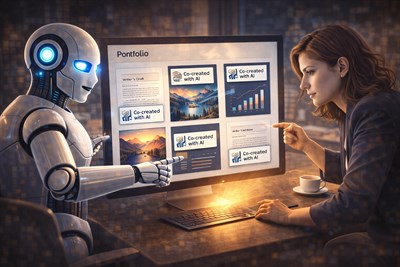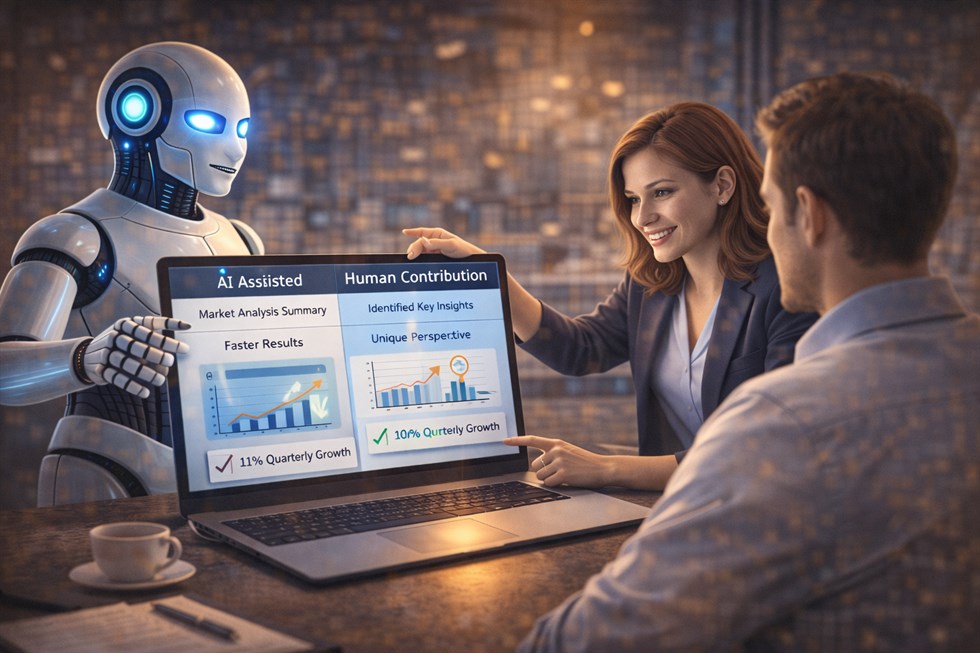
AI can generate outputs in seconds — text, code, slides, designs, even “polished” strategies. That’s exactly why output alone is no longer proof of competence. Employers hire people for judgment, accountability, and decision-making under constraints. To prove human value in AI-assisted work, you must show what the model cannot: how you framed the problem, what you rejected, what you verified, what risks you managed, and what you ultimately took responsibility for.
AI output is not proof of expertise. Human value is demonstrated through decisions, risk awareness, and responsibility.
Why Output Alone Is No Longer Proof of Competence
For years, many roles relied on deliverables as proxies for skill: “Here’s the report,” “Here’s the landing page,” “Here’s the code.” But AI compresses the time-to-output so much that deliverables can be produced without deep understanding. That shifts the hiring signal. What matters now is whether you can own the outcome — not just produce something that looks correct.
In practical terms, this means your portfolio must answer questions employers increasingly ask (explicitly or implicitly):
- Did you understand the domain — or just generate plausible text?
- Did you validate the output — or ship it as-is?
- Did you identify constraints and risks — or ignore them?
- Can you explain trade-offs — or only show a final artifact?
In the AI era, the strongest proof is not “what you made,” but “how you decided.” Documenting reasoning is the new credibility marker.
If your portfolio includes AI-assisted projects, do not treat AI as a secret. Instead, present it as a tool you can control with transparency and structure. This connects directly to the portfolio approach described in Using AI Without Hiding It in Your Portfolio, where the emphasis is on honest disclosure plus clear human ownership.
Real example: A product analyst uses AI to draft a market summary. The “human value” is not the summary text. It’s the analyst’s work in selecting data sources, defining what “market” means for the company, excluding unreliable claims, and translating insights into decisions (pricing, positioning, roadmap).
What Employers Actually Evaluate in AI-Assisted Work
When AI can “help” with everything, employers look for signals that you are more than a prompt operator. In most knowledge work, they evaluate whether you can reliably produce correct, safe, and useful outcomes. That reliability comes from human skills that AI does not provide by default:
- Problem framing: defining success criteria, constraints, and what not to do.
- Judgment: selecting among options and explaining why.
- Verification: checking claims, edge cases, assumptions, and failure modes.
- Risk awareness: spotting legal, ethical, reputational, or operational risks.
- Accountability: owning final decisions and consequences.
Put differently: AI can propose. Humans must decide.
Real example: A marketer uses AI to draft a campaign. The human value is demonstrated by revising language for compliance, removing risky claims, aligning messaging with brand strategy, and choosing which AI-generated concepts should never be published.
Employers trust people who can show verification and accountability — especially when AI is involved.
5 Practical Ways to Prove Human Contribution in AI Projects
To make your human contribution visible, you need a proof system. Below are five methods that work across roles (marketing, product, engineering, design, operations, analytics). Each method includes a practical way to show evidence in a portfolio or case study.
1) Document the decisions that changed the outcome
Show the decisions you made that materially altered the result: what you prioritized, what you simplified, what you delayed, what you excluded. Decision logs can be short — but they must be specific.
- What was the goal and constraint?
- What options existed?
- Why was one chosen?
- What risk did that decision reduce?
2) Show what you rejected (and why)
AI often generates attractive but wrong or misaligned outputs. Rejections are powerful evidence of judgment. Include 1–3 “rejected outputs” with notes explaining why they failed: wrong assumptions, incorrect facts, tone mismatch, regulatory risk, strategy conflict, etc.
3) Make constraints explicit
Constraints are where competence becomes visible. AI output looks “good” when constraints are vague. Human value shows when constraints are real: budget, deadlines, compliance, technical limitations, brand voice, stakeholder preferences, platform rules.
Transparency increases trust when you explain how AI was used, what was changed, and why.
4) Demonstrate verification (not confidence)
AI confidence is not correctness. Your proof should show verification steps: how you checked claims, tested edge cases, validated numbers, confirmed policies, or reviewed outputs against requirements.
5) Clarify who owned the final responsibility
Your portfolio should make it obvious that the final outcome was your responsibility. That means you chose what shipped, signed off on what was published, and accepted accountability for errors and risks.
Real example: A developer uses AI to generate a first-pass function. Human proof includes: unit tests added, performance considerations addressed, security review notes, and a refactor explaining why the original AI code was unsafe or brittle.
How to Structure Your Portfolio for AI Transparency
A strong AI-era portfolio is not a gallery of outputs. It’s a set of case studies that reveal your thinking. The most effective format is “process + proof,” not “before/after” alone.
Use a consistent template for each AI-assisted case study:
- Context: what problem existed and why it mattered.
- Constraints: rules, limits, stakeholders, timelines, risk boundaries.
- AI role: what AI did (drafting, ideation, summarization, code scaffolding, etc.).
- Your role: what you decided, verified, changed, and owned.
- Proof: artifacts that demonstrate judgment (rejections, checklists, tests, review notes).
- Outcome: results and what you learned.
This structure aligns with the transparency approach described in Using AI Without Hiding It in Your Portfolio, where disclosure becomes an advantage when paired with clear human responsibility.
If you can’t explain the constraints and verification steps, your portfolio risks looking like AI-generated “surface work.”
Portfolio formatting example: “AI drafted three versions of the onboarding email flow. I rejected two due to misleading claims and poor segmentation logic. I rewrote the final version to match compliance rules and added an A/B test plan with success criteria.”
Where Human Responsibility Becomes Critical
In some areas, “AI-assisted” can quickly become “professionally risky” if you cannot demonstrate strong human review. These are environments where errors create real harm: legal exposure, financial losses, safety issues, medical impact, or irreversible reputational damage.
As a rule: the higher the stakes, the more explicit your human accountability must be. For a deeper breakdown of these boundaries, see Where AI Should Not Be Used: High-Stakes Decisions Explained.
- Legal and compliance: contracts, claims, regulated disclosures.
- Medical and health: diagnosis, treatment advice, clinical decisions.
- Financial decisions: investment guidance, credit decisions, pricing models that can discriminate.
- Safety-critical operations: infrastructure, security, emergency protocols.
- HR and people decisions: hiring, firing, performance evaluation without transparent human review.
In high-stakes environments, using AI without documented human review increases professional liability.
Real example: A recruiter uses AI to summarize candidates. Human proof includes a rubric, documented overrides, bias checks, and a policy that AI summaries cannot be used as the sole basis for rejection.
Prompt Blocks You Can Use to Capture Human Proof
The examples below are control prompts. They are not meant to replace judgment or automate decisions. Their purpose is to constrain AI behavior during specific workflow steps — helping structure information without introducing assumptions, ownership, or commitments.
List which parts of this work were AI-generated and which required human judgment. Highlight where decisions changed the outcome.
Identify risks in this AI-generated output and suggest what a human reviewer should verify before publishing.
Explain what constraints shaped the final result and which trade-offs were intentionally chosen.
Limits and Risks of AI Transparency
Transparency is powerful — but sloppy transparency can backfire. The goal is not to overshare every prompt. The goal is to show reliable ownership and professional integrity.
Risk 1: Over-claiming “AI did everything”
If you present your work as mostly AI-generated, you may unintentionally signal that you lack core skills. Your disclosure should highlight human control, not human absence.
Risk 2: Under-claiming or hiding AI use
Hiding AI use is increasingly risky. If discovered (through interviews, tests, inconsistency, or review), it can damage trust more than honest disclosure would.
Risk 3: Misattributed ownership
AI can reproduce patterns from training data. If you present AI-generated work as fully original without checks, you risk credibility issues (and in some contexts, IP or compliance problems).
Risk 4: False confidence and unverified claims
AI can be confidently wrong. A portfolio that showcases unverified outputs can signal carelessness. The fix is not “avoid AI,” but “show verification.”
Claiming full authorship of AI-generated work can damage credibility if your process is examined.
Final Responsibility Still Belongs to the Human
No matter how advanced AI becomes, it does not carry professional liability. You do. Your name is attached to the work, the decision, the launch, and the consequences. That is why the strongest career move is to treat AI as an amplifier — and yourself as the accountable operator.
To prove human value in AI-assisted work, your portfolio should make one thing unmistakable: you can be trusted to produce outcomes that are correct, safe, aligned, and defensible — because you apply judgment, verification, and responsibility.
AI can assist. Only a human can own the decision.
FAQ
How do I prove I didn’t just copy AI output?
Show your process: include rejected AI drafts, document what you changed and why, and describe verification steps (tests, checklists, source checks, compliance review). Output is easy; decision evidence is hard to fake.
Should I disclose AI use in my portfolio?
Yes — if you do it professionally. Structured transparency builds trust, especially when paired with clear human ownership and accountability. A useful reference is Using AI Without Hiding It in Your Portfolio.
What do employers look for in AI-assisted work?
They look for problem framing, judgment, verification, risk awareness, and accountability. Employers increasingly evaluate whether you can reliably deliver outcomes — not just generate plausible artifacts.
Can using AI reduce perceived skill level?
It can — if your portfolio only shows polished output with no explanation of constraints, decisions, and validation. If you highlight where human judgment changed the result, AI use often increases credibility rather than reducing it.
Is it risky to hide AI usage?
Yes. If AI use is uncovered later, it can undermine trust and professional credibility. In high-stakes environments, hiding AI involvement is especially dangerous. See Where AI Should Not Be Used: High-Stakes Decisions Explained for boundary cases.
What is the best one-sentence proof of human value in AI-assisted work?
The best proof is documented decision-making: you can show what AI generated, what you rejected, what you verified, and why the final outcome is responsibly yours.