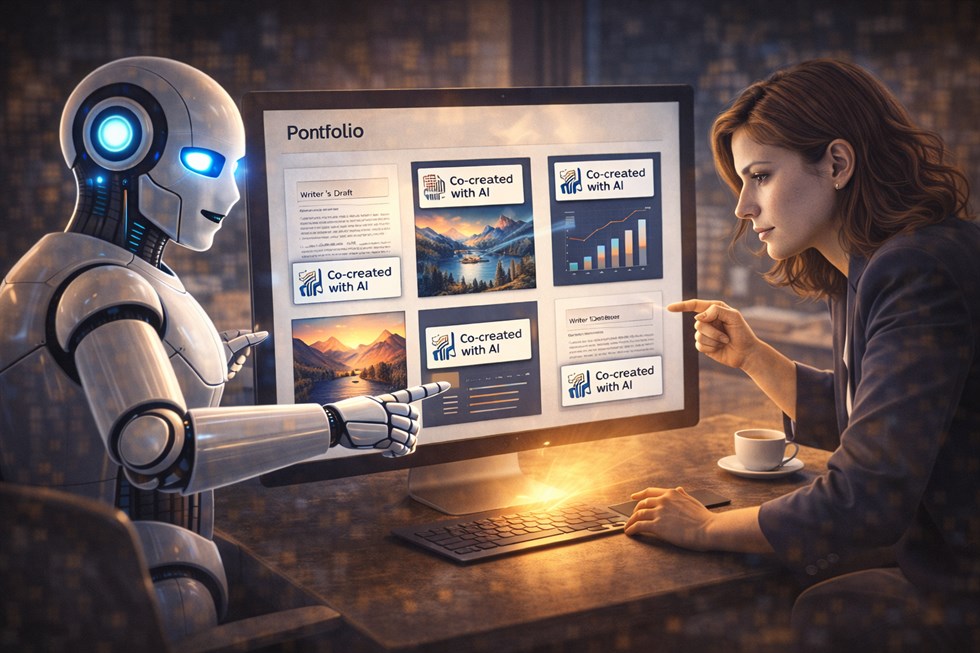
Using AI in your work is normal now. Hiding it is what creates risk. Employers don’t reject AI-assisted output — they reject unclear ownership, vague process, and work that looks “too perfect” but can’t be explained. A strong portfolio in 2026 shows what you did, what the AI did, what you verified, and what decisions you made. This article gives you practical wording, real examples, and prompt templates you can reuse — so your portfolio reads like proof of judgment, not proof of manual labor.
If your portfolio cannot explain decisions, trade-offs, and validation steps, it isn’t “polished” — it’s untrustworthy. AI disclosure becomes a strength when it clarifies ownership.
Why hiding AI in a portfolio backfires
Many candidates assume that admitting AI use will make them look weaker. In practice, the opposite often happens. Hiring managers already assume AI is used across writing, analysis, design, and coding. What they need to understand is whether you can control the tool, verify outputs, and take responsibility for the final result.
- Hiding AI creates ambiguity: If the work looks unusually fast, broad, or “clean,” reviewers will wonder what is yours.
- Employers can often tell anyway: Generic phrasing, uniform tone, and “textbook” structure are common AI signals.
- Unclear process kills trust: When the output has no reasoning trail, it’s hard to assess competence.
- AI mistakes are your mistakes: If you can’t explain assumptions and sources, you can’t defend the work.
Framed correctly, AI disclosure communicates maturity: you used modern tools, but your thinking, constraints, and verification stayed human.
Related: the real career advantage is not “using AI,” but choosing work that compounds with it. See Which Skills Compound With AI and Which Don’t for the mental model behind this.
What employers actually want to see
Portfolios exist to answer one question: Can this person deliver reliable outcomes in a messy real environment? AI doesn’t remove mess — it often adds new failure modes. The strongest portfolios make those failure modes visible and controlled.
What reviewers look for (even if they don’t say it explicitly):
- Decision points: Where you made calls the tool could not make.
- Constraints: Audience, domain rules, legal limits, tone, timelines, data privacy.
- Validation: How you checked correctness, quality, and fit.
- Iteration: What changed from version 1 to final, and why.
- Ownership: You can explain and defend the final output without the tool present.
AI-assisted work becomes impressive when it demonstrates control: clear constraints, good prompts, verification, and a human final call. Don’t hide AI — document mastery over it.
How to show AI use without looking like you “outsourced” your brain
The goal is not to write “I used ChatGPT” as a confession. The goal is to show AI as a supporting tool in a disciplined workflow. The simplest structure that works across roles is:
- Objective: what outcome you needed
- Constraints: what had to be true
- AI contribution: what the model produced
- Human contribution: what you decided, corrected, validated, and shipped
- Evidence: artifacts (notes, versions, tests, sources, metrics)
Real examples you can copy (analyst, manager, writer)
Example 1 — Analyst portfolio (market sizing + competitor map)
Objective: Build a market overview and competitor positioning for a new product concept.
Constraints: Use only verifiable sources; avoid unsupported TAM claims; clearly separate assumptions from facts.
AI contribution: Suggested competitor categories, drafted a first-pass comparison table, and proposed questions to validate the market structure.
Human contribution: Removed invented competitors, replaced generic metrics with real ones, validated each company via official sites/reports, and rewrote conclusions based on evidence. Built the final positioning logic and narrative.
Proof artifacts: Source list, “assumptions vs evidence” section, a changelog showing what was removed/rewritten, final deck + appendix.
Example 2 — Manager portfolio (process redesign + stakeholder alignment)
Objective: Reduce cycle time in a cross-functional workflow (handoffs, approvals, reporting).
Constraints: No new headcount; minimal change to existing tools; compliance requirements must stay intact.
AI contribution: Helped draft interview questions, summarized themes from meeting notes, and proposed alternative workflow variants.
Human contribution: Ran stakeholder interviews, selected a feasible process based on constraints, negotiated ownership changes, and defined success metrics. Implemented rollout plan and feedback loop.
Proof artifacts: Before/after workflow diagram, decision log, rollout comms, KPI snapshot after 30–60 days.
Example 3 — Writer / content portfolio (long-form guide with accuracy constraints)
Objective: Produce a high-intent guide that ranks and converts (clear steps, FAQs, examples).
Constraints: No fabricated facts; cite sources; match brand voice; avoid over-promising.
AI contribution: Generated alternative outlines, suggested FAQ questions, and drafted a rough first version for sections that required structure.
Human contribution: Verified facts with primary sources, rewrote sections to match voice and experience, added real examples, removed generic filler, and finalized CTAs. Ensured internal linking and intent coverage.
Proof artifacts: Source notes, draft-to-final diffs, SERP intent checklist, performance metrics (CTR, time on page) when available.
Notice the pattern: the examples never position AI as “the author.” AI is the assistant. You are the accountable professional.
How to write AI disclosure in portfolio entries (bad vs good wording)
The words you choose matter. Some phrases make you sound like you replaced competence with automation. Others make you sound like a modern operator with strong judgment.
- Bad: “Generated with ChatGPT.”
- Good: “AI-assisted draft; I defined constraints, validated claims, and rewrote the final output based on domain rules.”
- Bad: “Used AI to write the entire report.”
- Good: “Used AI for structure and alternative phrasing; conclusions and recommendations are mine and were validated against sources and stakeholder input.”
- Bad: “AI did the analysis faster.”
- Good: “AI accelerated synthesis; I verified data, removed unsupported claims, and made the final trade-offs.”
- Bad: “Prompt engineering.” (as the main skill)
- Good: “Constraint-setting and validation workflow.”
If you want a simple rule: describe AI like you’d describe Excel. It’s a tool in your workflow, not a substitute for ownership.
Where to disclose AI use (and how much detail is “enough”)
Disclosure should be consistent, not loud. You generally don’t need to publish full chat logs. Provide enough detail to prove you controlled the process:
- In each project summary: one sentence about AI’s role (drafting, structuring, summarizing, ideation, refactoring).
- In a “Process” section: 4–8 bullets explaining your workflow and verification.
- In an appendix (optional): selected prompts, redacted if needed, plus notes on what changed.
For roles where confidentiality matters (consulting, legal, enterprise), you can disclose the workflow without revealing content:
- “AI-assisted summarization of de-identified notes”
- “AI used on synthetic data / public sources only”
- “No client data uploaded; prompts were abstracted and redacted”
Prompt blocks you can reuse in your portfolio workflow
These prompts are not meant to replace judgment. They exist to document constraints, reveal reasoning, and reduce the chance of accidental over-claiming. Use them to produce portfolio-ready artifacts like decision logs, assumption lists, and verification checklists.
Prompt: Portfolio disclosure sentence (clean and professional)
Write one sentence for a portfolio case study explaining AI usage in a credible way. Include: (1) AI’s role (draft/structure/synthesis), (2) what I validated, (3) what I owned as final decisions. Avoid phrases like “generated by AI.”
Prompt: Decision log extraction
From this project summary, extract: key decisions I made, trade-offs, constraints, and what was validated. Output as a bullet “decision log” with 6–12 items.
Prompt: Assumptions vs evidence table
Create a two-column table: “Assumption” vs “Evidence / Source needed.” Flag anything that sounds like a fact but lacks a source. Suggest the best type of primary source for each.
Prompt: Risk scan for AI artifacts
Review this text and identify signs of AI artifacts: generic claims, missing examples, overconfident tone, invented specifics, weak causality. For each issue, suggest a fix.
Prompt: Interview-ready explanation
Create a 60-second spoken explanation of this project for an interview: problem, constraints, what I did, how AI was used, how I verified correctness, final outcome.
Limits and risks
Being transparent about AI does not mean “sharing everything.” There are real risks — and you should manage them deliberately.
- Over-crediting AI: If you sound like the tool did the thinking, reviewers will assume you can’t repeat results without it.
- Under-verification: AI can invent sources, misread context, and confidently output wrong conclusions.
- Confidentiality and data leakage: Never paste proprietary data, client info, or internal metrics into public tools.
- Compliance restrictions: Some industries have rules about tool usage and documentation.
- Misleading attribution: Don’t claim authorship of content that is actually a rework of copyrighted material or proprietary docs.
Transparency works only when paired with verification. “AI-assisted” is credible when you can show what you checked, what you changed, and why the final result is yours.
Final human responsibility (the part that decides trust)
Here is the standard your portfolio must communicate: you are accountable for the outcome. AI can help you move faster, but it cannot take responsibility for errors, ethics, confidentiality, or fit-for-purpose decisions.
So the closing message of every case study should be implicit (or explicit):
- I set constraints and quality bars.
- I verified claims and removed unsupported content.
- I made trade-offs and signed off the final version.
- I can explain the work without the tool present.
If you can show that, AI disclosure becomes an advantage: it signals modern workflow literacy and professional judgment.
FAQ
Should I disclose AI usage in my portfolio?
Yes. Most employers assume AI use already. Disclosure increases trust when you clearly state what AI did, what you verified, and what decisions you owned.
Can AI-assisted work reduce my chances of getting hired?
Usually no. What reduces chances is unclear ownership, lack of reasoning, missing validation, or a portfolio that can’t explain decisions.
How detailed should I be about prompts and tools?
Keep it practical: one sentence in the summary plus a short “Process” list is enough. Share selected prompts only if they demonstrate constraints and verification.
What is the best wording to describe AI use professionally?
Use phrases like “AI-assisted draft,” “AI-supported synthesis,” or “AI used for structure,” and immediately add what you validated and what you owned as final.
Is it okay to include AI prompts in the portfolio?
Yes, selectively. Show prompts that reveal thinking and constraints. Avoid dumping long chat logs. Always include what changed after AI output.
What if my industry is strict about confidentiality?
Describe the workflow without exposing data: “de-identified notes,” “public sources only,” and “no proprietary data uploaded.” You can still show decision logs and validation steps.
Should juniors hide AI usage to look more “capable”?
No. Juniors are evaluated on learning ability and judgment signals. Honest disclosure with clear verification often reads as maturity, not weakness.
Want to make this even stronger? Add a short “AI workflow” section to each project and link it to your most compounding skills — the ones that prove judgment, not automation. Start with Which Skills Compound With AI and Which Don’t and position your case studies around those skills.