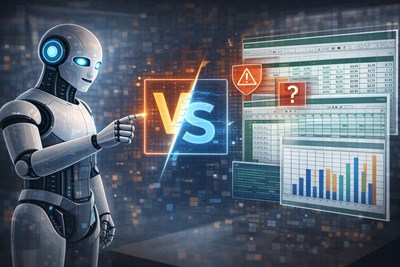
AI can feel like a smart analyst: it talks fluently, finds “insights,” and explains trends in a way that sounds plausible. That’s exactly why blind trust is dangerous. A confident explanation is not the same as a correct analysis. The core rule is simple: AI explains patterns — it does not validate them. If you treat AI output as verified truth, you’re not doing data-driven work — you’re outsourcing judgment to a system that cannot be accountable.
Introduction — Why Blind Trust in AI Analysis Is Dangerous
Blind trust fails quietly. The output often looks reasonable, the story is coherent, and the tone is confident — so the error slips into a slide deck, a KPI review, or a decision memo without resistance. Then the damage shows up later: missed targets, wrong priorities, wasted spend, or a strategy built on a false signal.
The real risk is not that AI makes mistakes. The real risk is that AI mistakes look like valid analysis unless your workflow forces verification.
What AI Actually Does When “Analyzing Data”
When people say “AI analyzed the data,” they often imagine a tool that understands numbers the way an analyst does: checking validity, testing assumptions, and confirming logic. That’s not what most AI systems do by default.
- Pattern recognition & summarization: AI is strong at describing apparent patterns in what you provide.
- Language-based explanation: AI produces narratives that sound like analysis — even when the underlying math is missing.
- No ground-truth awareness: AI does not inherently know whether a claim is true; it predicts plausible statements.
- Weak built-in verification: unless your workflow demands checks, AI will not reliably validate sources, calculations, or data quality.
So the safe mental model is: AI can help you explore and articulate possibilities, but it cannot be assumed to have “confirmed” anything.
Common Ways AI Gets Data Analysis Wrong
AI errors in data analysis are often systematic, not random. They tend to appear in predictable failure modes — especially when inputs are incomplete, metrics are ambiguous, or the question is underspecified.
Invented Metrics and Calculations
AI may “complete the pattern” by inventing formulas, producing numbers that were never calculated, or implying it performed steps it didn’t. This happens most often when the prompt asks for a conclusion (“Which segment is best?”) without providing an auditable calculation path.
- Made-up formulas that look professional (“weighted score,” “confidence index,” “normalized performance”).
- Numbers that don’t match the input totals.
- Percent changes or averages that cannot be reproduced.
False Correlations
AI is excellent at storytelling — which makes it dangerously good at turning coincidence into explanation. A chart can show two lines moving together, and AI will happily provide a narrative that implies causation.
- Correlation ≠ causation: AI often blurs this line unless you explicitly constrain it.
- Confounders ignored: seasonality, channel mix, pricing changes, sampling bias.
- Reverse causality: the “cause” may actually be an effect.
Ignoring Data Quality Issues
Most bad decisions are not caused by bad modeling — they’re caused by bad data. AI can miss this because it doesn’t “feel” missingness, outliers, and selection effects unless you force the checks.
- Missing values treated as zeros or silently skipped.
- Outliers driving averages and trends.
- Biased samples (only high-value customers, only recent data, only one region).
- Metric drift: definitions changed over time, but AI summarizes as if stable.
Where AI Helps in Data Analysis (Safely)
Used correctly, AI can increase speed and clarity — without owning truth. The safe zone is “exploration support,” not “validation.”
- Structuring questions: turning a vague goal into specific analysis questions.
- Exploratory summaries: describing what the dataset appears to contain and what to check next.
- Hypothesis generation: proposing possible explanations as hypotheses, not conclusions.
- Explaining trends (as hypotheses): offering candidate narratives with explicit uncertainty.
A practical test: if the output is something you would put into a decision doc, AI should be producing questions, assumptions, and checks — not final claims.
Where Blind Trust Breaks Data-Driven Decisions
Blind trust becomes expensive when analysis is used to allocate resources, justify trade-offs, or create commitments. These are the contexts where a wrong “insight” is not just an error — it becomes a policy, a budget, or a strategy.
- Forecasts: overly confident projections without uncertainty bands or reproducible methods.
- Financial projections: invented assumptions and hidden compounding errors.
- KPI-based decisions: optimizing the wrong metric because definitions were misunderstood.
- Resource allocation: shifting headcount or spend based on unverified segment performance.
In these areas, the correct workflow question is not “What does AI think?” but “What can we verify enough to responsibly act on?”
Decision Test for AI Data Analysis

1. Can I reproduce the numbers without AI?
2. Can I explain the assumptions in one paragraph?
3. Do I know what would change this conclusion?
4. Am I willing to defend this decision without mentioning AI?
A Safe Pattern for Using AI in Data Analysis
You don’t need perfect tools to avoid blind trust. You need a repeatable verification pattern with explicit human ownership. Use the following model as a default:
- Human defines the question: what decision will this analysis support, and what would change based on the result?
- AI explores and summarizes: describe patterns, generate hypotheses, list what should be checked.
- Human verifies data and logic: confirm calculations, definitions, time windows, and data quality checks.
- Human validates conclusions: decide what is supported, what is uncertain, and what is not supported.
- AI never owns the final interpretation: conclusions and accountability remain human-owned.
This is consistent with the broader “human control” principle outlined in How to Use AI at Work Effectively: AI can increase clarity, but it must not silently take ownership of commitments and decisions.
Why AI Explanations Feel Right (Even When They’re Wrong)
AI can be wrong in a way that feels correct. That’s the trap. The output is coherent, well-structured, and confident — which triggers human trust even when the underlying reasoning is incomplete or non-reproducible.
- Coherent narratives: humans mistake story quality for evidence quality.
- Overconfidence bias: confident tone acts like a false “reliability signal.”
- Explanation ≠ correctness: a plausible explanation can still be wrong.
This is why verification must be designed into the workflow. Without a gate, the most persuasive answer wins — not the most accurate one.
Checklist — Can This AI Analysis Be Trusted?
How to interpret this checklist: treat it as a decision gate, not a score. If you answer “No” to any high-impact item (reproducibility, assumptions, data verification, accountability), the output is not safe to use for decisions yet. Your goal is not to get all “Yes” answers — your goal is to find the weak link before it turns into a confident mistake.
- Are calculations transparent? If “No,” you can’t audit errors or reproduce results.
- Can results be reproduced? If “No,” the insight is not reliable enough to act on.
- Are assumptions explicit? If “No,” AI may be smuggling in hidden premises.
- Has the data been verified? If “No,” you may be optimizing noise, not signal.
- Is a human accountable for the decision? If “No,” you have delegated responsibility without noticing.
Practical rule: If you can’t show your work, don’t ship the conclusion.
What to Use Instead of Blind Trust
If the analysis matters, you need verification artifacts — not just explanation. This is where “boring” tools and explicit logic outperform confident narrative.
- Manual validation: sanity-check totals, time windows, and definitions.
- Spreadsheets: explicit formulas and traceable calculations.
- Step-by-step logic: showing intermediate steps, not only final output.
- Decision records: documenting what was assumed, what was verified, and what remains uncertain.
Frequently Asked Questions (FAQ)
Can AI be trusted for data analysis?
AI can support exploration and explanation, but it cannot be blindly trusted. Any analysis that influences decisions must be verified, reproducible, and human-owned.
Why does AI data analysis often sound correct but turn out wrong?
Because AI produces coherent explanations, not validated calculations. Narrative clarity is often mistaken for analytical correctness.
How can I verify AI-generated analysis?
By reproducing calculations, making assumptions explicit, checking data quality, and ensuring a human is accountable for the final conclusion.
Should AI be used for business or financial decisions?
AI can inform decisions, but it should never own conclusions or commitments. High-impact decisions require human validation and responsibility.