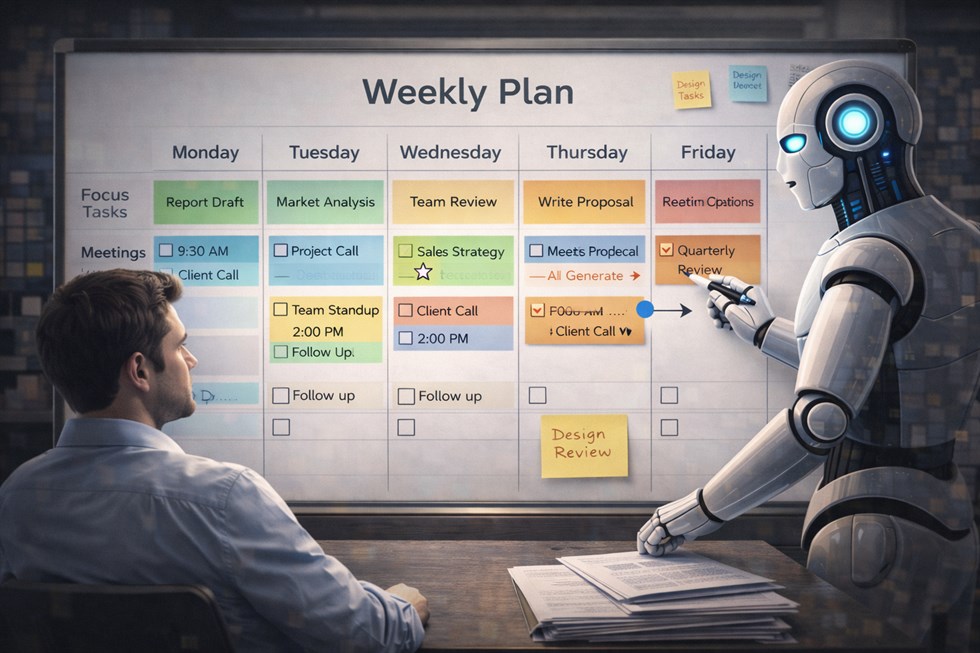
Weekly planning with AI is a structured approach to preparing, clarifying, and reviewing work — without transferring responsibility for decisions to a system. In real work environments, weekly planning is not about maximizing efficiency on paper, but about maintaining focus, reducing cognitive overload, and surviving uncertainty. AI can support this process by organizing inputs and reflecting patterns, but it can also quietly destroy planning discipline through over-optimization and false productivity. This guide explains how to use AI for weekly planning in a way that holds up under real workloads, changing priorities, and imperfect information.
Unlike daily task juggling or reactive to-do list management, weekly planning creates a stable horizon for decision-making. When AI is introduced incorrectly, that horizon collapses into constant replanning. When introduced correctly, it strengthens the system without taking control.
What Weekly Planning With AI Actually Means
Weekly planning with AI does not mean delegating planning. Planning is not data processing — it is a judgment process involving trade-offs, risk acceptance, and accountability. AI cannot own outcomes, miss deadlines, or absorb consequences. Humans do.
In a sustainable setup, AI performs mechanical cognitive work: organizing raw inputs, summarizing scattered information, and reducing the mental cost of preparation. This allows humans to spend their limited attention on decisions rather than transcription or recall.
AI is effective at answering questions such as: “What did I commit to last week?”, “Which tasks are still open?”, or “What themes dominate my workload?”. It is ineffective — and dangerous — when asked: “What should I focus on?” or “What matters most this week?”.
This boundary is critical for avoiding planning systems that look optimized but fail under pressure. As explained in Using AI for Planning and Prioritization (Without Over-Optimization), AI should reinforce human judgment, not replace it.
Where AI Fits in the Weekly Planning Cycle
Weekly planning is a cycle with distinct phases. Treating it as a single AI-assisted action is one of the main reasons systems break.
Before planning, AI is most valuable. It can consolidate notes, summarize meetings, extract unfinished tasks, and surface recurring issues. This phase reduces noise and prevents important inputs from being forgotten.
During planning, AI should be tightly constrained or excluded entirely. This is where priorities are chosen, scope is limited, and commitments are accepted. Allowing AI to rank, schedule, or “optimize” here introduces hidden assumptions and removes ownership.
After planning, AI can again contribute safely. It can rewrite plans into clearer formats, flag overload, or prepare reflection questions for the end of the week. The output supports execution, not decision-making.
Example: A knowledge worker uses AI on Friday afternoon to summarize open loops from emails, notes, and task lists. On Monday morning, they manually choose three weekly priorities based on capacity and risk. After planning, AI helps clean up notes and prepare a short weekly review template.
The effectiveness of AI depends less on what it does and more on when it is allowed to act.
A Sustainable Weekly Planning System (Step-by-Step)
Sustainable systems are intentionally limited. They trade theoretical optimization for consistency and trust.
1. Human input
All planning starts with human-owned inputs: tasks, deadlines, obligations, and strategic goals. These inputs are often incomplete or ambiguous. A sustainable system accepts this instead of trying to eliminate uncertainty.
2. AI structuring
AI is used to structure inputs without interpretation. This may include grouping items, identifying duplicates, summarizing long lists, or highlighting missing information. AI does not evaluate importance or urgency.
3. Human prioritization
This is the core of weekly planning. Humans decide what will receive attention, what will wait, and what will be dropped. This step includes accepting trade-offs and capacity limits. No AI output can replace this responsibility.
4. AI reflection and cleanup
After decisions are made, AI can help clean the system: rewriting notes, generating execution checklists, or preparing review prompts. The plan becomes easier to follow without changing its intent.
Organize the following tasks and notes into neutral categories. Do not rank, prioritize, schedule, or label importance. Do not infer urgency or recommend actions. Your role is to structure information only.
Constraint-based prompts like this protect the system from silent decision drift.
Why Weekly Planning With AI Often Breaks
Most failures are gradual. The system looks productive until it suddenly stops working.
A common mistake is letting AI rank tasks. Rankings appear objective but are based on surface signals such as wording or deadlines, not real impact or strategic relevance.
Another issue is constant replanning. When AI is used to continuously “improve” plans, stability disappears. The week becomes a moving target, and execution suffers.
Optimization loops are especially damaging. Each iteration looks cleaner, but the plan drifts further from reality. This creates productivity theater: impressive artifacts with little follow-through.
AI increases the illusion of control in planning. This illusion is where most systems quietly collapse.
Limits, Risks, and Planning Debt
Planning debt accumulates when plans are easy to generate but hard to execute. AI accelerates this by producing polished outputs that bypass decision friction.
Loss of ownership is a key risk. When plans are AI-shaped, people feel less responsible for outcomes. Missed commitments feel external rather than personal.
Another risk is context erosion. AI structures what is visible in text, but ignores invisible constraints: political risk, emotional energy, team dynamics, or uncertainty tolerance.
Over time, systems become fragile. They require more prompts, more correction, and more maintenance — until they no longer save time at all.
Weekly planning systems fail not because they lack intelligence, but because responsibility is outsourced too early.
Final Human Responsibility
A sustainable weekly planning system has explicit boundaries. AI supports preparation, structure, and reflection. Humans own priorities, commitments, and consequences.
AI can highlight overload but cannot decide what to sacrifice. It can summarize work but cannot judge strategic value. It can reflect patterns but cannot accept risk.
Accountability lives where decisions are made. When this boundary is respected, AI strengthens planning instead of hollowing it out.
FAQ
Can AI plan my week for me?
No. AI can structure information, but weekly priorities require human judgment and accountability.
Is weekly planning with AI better than daily planning?
For most knowledge work, weekly planning creates stability. Daily AI-driven planning often leads to over-optimization and reactive work.
What are the main risks of using AI for planning?
The biggest risks are false clarity, loss of ownership, hidden context loss, and planning systems that fail under real workload.
Do I need specific AI tools for weekly planning?
No. Sustainable planning systems should be tool-agnostic and remain usable even if tools change.
How much time should AI save in weekly planning?
AI should reduce preparation and cleanup time, not eliminate thinking. If planning feels effortless, decision quality may be dropping.
How do I know if AI is overstepping in my planning system?
If priorities feel automatic, responsibility feels blurred, or plans look good but execution fails, AI is likely doing too much.