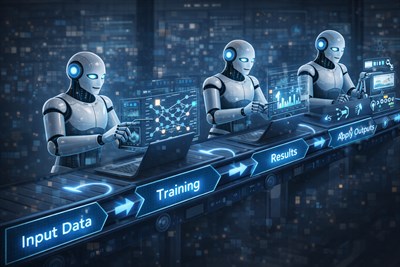
Some workflow bottlenecks AI cannot fix because they are not caused by slow writing, manual data entry or inefficient information retrieval. They are caused by unclear ownership, conflicting priorities, missing authority, limited expert capacity, contradictory policies or decisions that nobody wants to make.
AI may reduce the time needed to produce a report, classify a request or prepare a recommendation. Yet the complete workflow can remain just as slow if the output still waits for approval, moves between teams without an owner or enters a review queue that has no spare capacity.
This distinction matters at work because automating the wrong step can create the appearance of progress while making the underlying process harder to manage. The objective is not merely to make individual tasks faster. It is to improve the flow of work from the initial request to a useful, accountable outcome.
Core point: AI can reduce the time required to perform a task, but it cannot repair unclear ownership, conflicting incentives, missing authority or an organization’s refusal to make a decision. When these constraints remain, automation often moves the queue rather than removing it.
What a Workflow Bottleneck Actually Is
A workflow bottleneck is a step, resource or decision point that limits the flow of work because incoming demand exceeds its effective capacity. As a result, work begins to queue, wait, return for correction or depend on a person, system or decision that cannot keep pace.
The bottleneck is not always the task that appears most difficult. A task may require two hours of concentrated work but still cause no serious delay if it is completed immediately. Another task may require only five minutes but hold the workflow for three days because the responsible person is unavailable or the approval rules are unclear.
That is why workflow analysis must separate working time from waiting time. Working time is the period during which someone or something actively processes the task. Waiting time is the period during which the task sits in a queue, waits for information, awaits approval or remains blocked by an unresolved decision.
Task Bottlenecks
A task bottleneck exists inside a specific operation. Common examples include extracting information from documents, classifying support requests, drafting repetitive messages, formatting reports or transferring data between systems.
AI can often reduce this type of friction because the expected output is relatively clear. The model can summarize a document, generate a first draft, categorize an incoming request or identify missing fields. The work may still require review, but the task itself can become faster.
System Bottlenecks
A system bottleneck is created by the way the overall process is designed and governed. It may involve unclear ownership, conflicting departmental goals, insufficient decision authority, mandatory approvals, inconsistent policies or disagreement about which data is authoritative.
AI may help reveal these problems, but it cannot independently redesign the organization around them. It cannot appoint a process owner, delegate budget authority, choose which department’s objective takes priority or decide that an old approval step is no longer necessary.
| Bottleneck type | Example | Can AI help? | Can AI fix it alone? |
|---|---|---|---|
| Repetitive task | Categorizing support requests | Yes | Often |
| Data retrieval | Finding relevant policy sections | Yes | Sometimes |
| Approval authority | A director must approve every exception | Limited | No |
| Conflicting priorities | Sales wants speed while compliance wants review | Limited | No |
| Limited expert capacity | One lawyer reviews every contract | Partial | No |
Which Workflow Bottlenecks AI Cannot Fix?
The most important AI workflow bottlenecks are rarely solved by adding a better prompt or switching to a more capable model. They require a change in ownership, authority, capacity, policy or organizational behavior.
1. Unclear Ownership
A workflow cannot move reliably when several people participate but nobody is accountable for the final outcome. Tasks begin to circulate between teams. Each participant completes a small part and assumes that someone else will decide what happens next.
Consider a marketing campaign that has already been drafted, designed and scheduled. Marketing believes product should confirm the claims. Product believes legal should approve the wording. Legal believes the campaign owner should identify the final version before review. The campaign remains unpublished even though every individual task appears almost complete.
AI can summarize open questions, display the history of handoffs, remind participants about deadlines and identify tasks without an assigned owner. It can make the lack of ownership more visible.
It cannot decide who should be accountable, give that person authority or resolve a disagreement between departments. Assigning responsibility is an organizational decision.
Human fix: Name one accountable process owner, define the owner of every major output and create an escalation path for unresolved issues.
Metrics to track: number of handoffs, approval latency, percentage of tasks without an owner and average time between completion of one step and acceptance by the next owner.
2. Conflicting Goals and Incentives
Many organizational workflow bottlenecks are created by teams that are behaving rationally according to different performance measures.
A customer support team may be measured by response speed. Compliance may be measured by risk reduction. Finance may be measured by limiting refunds. An AI assistant can generate a response in seconds, but the workflow still slows down whenever a case forces the company to choose between speed, customer satisfaction, financial cost and regulatory caution.
The model can summarize the case, compare options and show how similar requests were handled. It may even recommend a response based on predefined rules.
What it cannot do is decide which business objective should dominate when the objectives conflict. That decision reflects the company’s priorities and risk tolerance. It must be made by people with the authority to accept the consequences.
Human fix: Align performance measures, define the order of priorities and document how trade-offs should be handled in recurring situations.
Metrics to track: escalation rate, decision reversals, rework, cross-team dispute time and percentage of cases delayed because teams apply different success criteria.
3. Missing Decision Rights
An AI recommendation is not the same as an authorized decision. A workflow can contain excellent analysis and still stop because the person receiving the recommendation lacks the right to act.
For example, an AI system may identify that a supplier repeatedly misses delivery deadlines and calculate the operational cost of those delays. The procurement specialist may agree with the recommendation to replace the supplier but have no authority to change the contract, approve a more expensive alternative or adjust the budget.
The bottleneck is not analysis. It is the absence of delegated decision rights.
AI can prepare evidence, identify patterns, estimate consequences and generate decision briefs. It cannot grant budget authority, sign a contract or accept responsibility for the commercial outcome.
Human fix: Create a decision-rights matrix, define monetary and risk thresholds, delegate routine authority and specify which cases require escalation.
Metrics to track: time waiting for approval, number of escalations, decisions returned because of missing authorization and percentage of routine cases sent to senior leadership.
4. Ambiguous Policies and Unmanaged Exceptions
AI cannot reliably automate a process when the organization itself has not decided which rules apply.
Imagine a support workflow in which one internal policy permits refunds after a delivery delay, while another policy requires manual approval for all refunds above a certain amount. A customer may qualify under one rule and require escalation under another.
An AI system can locate both policies, summarize the conflict and identify similar cases. If instructed to continue, however, it may select one rule, combine them incorrectly or produce inconsistent outcomes across similar requests.
This is not primarily a model problem. It is a governance problem. The organization has not identified the authoritative rule or designed a reliable exception process.
Human fix: Remove contradictory instructions, publish a governing policy, define who owns exceptions and state what should happen when the rules do not cover a case.
Metrics to track: exception rate, number of policy conflicts, manual override rate, inconsistent outcomes and time spent interpreting internal rules.
5. Poor or Politically Contested Data
Data problems are often described as a simple “garbage in, garbage out” issue. In real workflows, the problem can be more difficult because different teams may disagree about what the data should mean.
Sales may define an active customer as anyone who has made a purchase within the last twelve months. Finance may define an active customer as an account with recognized revenue in the current reporting period. An AI forecasting system can calculate results from either definition, but it cannot declare which definition is officially correct for the business.
Similar problems occur when teams maintain separate spreadsheets, employees avoid updating a central system or nobody is responsible for correcting inaccurate records.
AI can standardize formats, detect duplicates, identify missing fields and highlight contradictory definitions. It cannot establish a source of truth without an organizational decision about ownership and governance.
Human fix: Assign a data owner, create a business glossary, identify the authoritative source and define validation and correction procedures.
Metrics to track: missing fields, duplicate records, reconciliation time, conflicting definitions and percentage of records that require manual correction.
Before adding another model or automation layer, conduct a structured AI workflow audit to verify where work actually waits, returns for correction or loses ownership.
6. Mandatory Human Capacity Constraints
AI can accelerate every step before a human review and still fail to improve the complete workflow.
Suppose an AI system extracts contract clauses, compares them with standard terms and produces a risk summary in three minutes. Every contract must still be reviewed and signed by one lawyer. If the organization begins processing more contracts because the earlier steps are faster, the lawyer’s queue grows.
The workflow may become slower even though the AI step is highly efficient. More work arrives at the fixed-capacity resource than that resource can complete.
AI can pre-screen cases, prepare summaries and identify low-risk items. It cannot remove a legally or organizationally required approval, expand the reviewer’s available hours or delegate authority without human authorization.
Human fix: Introduce risk tiers, change review thresholds, distribute authority, remove unnecessary checks or increase qualified expert capacity.
Metrics to track: review queue size, average age of queued items, reviewer utilization, percentage of low-risk items receiving full manual review and total review cost per completed case.
7. Trust, Resistance and Organizational Politics
Employees may resist an AI workflow for reasons that cannot be solved by improving the interface.
If employees believe the new system will be used to justify job cuts, they may withhold information, maintain private spreadsheets or continue using the old process. Managers may publicly support automation while still demanding the previous reports. Workers may check every AI output manually because they fear being blamed for an error.
The result is a shadow workflow in which the official AI process and the old manual process run at the same time. Instead of removing work, the automation creates duplication.
AI can analyze usage patterns, collect feedback and identify where manual duplication occurs. It cannot create trust, promise psychological safety, redesign incentives or guarantee that leaders will use the system fairly.
Human fix: Explain how the system will be used, involve employees in workflow redesign, remove duplicate reporting requirements and define who is accountable when the process fails.
Metrics to track: shadow workflow usage, manual duplication, override rate, adoption rate, repeated use of unofficial tools and employee-reported trust.
Example: A company uses AI to draft purchasing requests in two minutes instead of twenty. The requests still wait four days for approval because three managers must review every purchase and none of them owns the final decision. AI improved task speed, but the real bottleneck remained unchanged.
What AI Can Do Around a Bottleneck
The fact that AI cannot independently remove a system constraint does not make it useless. AI can reduce the cost of understanding, preparing and monitoring a workflow problem.
Detect
AI can analyze timestamps, handoffs, queues, returned tasks and approval histories. This can reveal where work accumulates and which steps generate repeated delays.
Summarize
AI can group recurring reasons for rejection, summarize employee feedback and identify common exception patterns. This is especially useful when evidence is spread across emails, tickets, meeting notes and operational systems.
Simulate
AI can help model alternatives. A team can compare what may happen if an approval step is removed, if low-risk cases are processed automatically or if authority is delegated below a certain threshold.
The simulation is not the decision. It is evidence that helps an accountable person make the decision.
Prepare
AI can create decision briefs, assemble supporting documents, identify missing information and draft recommendations. This reduces the preparation burden around a human-controlled step.
Monitor
AI can track cycle time, queue size, rework, exception frequency and deviations from the expected process. It can alert the owner when the workflow begins to degrade.
| Bottleneck | Useful AI contribution | Required human action |
|---|---|---|
| Slow approval | Prepare evidence and summarize risk | Delegate approval authority |
| Conflicting policies | Identify contradictions | Select and publish the governing policy |
| Poor data | Flag gaps and inconsistencies | Assign ownership and definitions |
| Expert review backlog | Pre-screen low-risk cases | Redesign review thresholds |
| Unclear ownership | Map handoffs and open decisions | Assign one accountable owner |
Practical rule: Use AI to reduce the cost of seeing, preparing and monitoring the problem. Do not describe the bottleneck as solved until ownership, authority, capacity or policy has actually changed.
How to Diagnose Whether the Problem Is Technical or Organizational
A team should not begin by asking which AI tool to add. It should begin by identifying where the flow of work breaks down and why.
Step 1: Map the Workflow as It Actually Operates
Do not rely only on the formal standard operating procedure. Document the process employees actually use, including workarounds, spreadsheets, informal approvals and repeated requests for clarification.
Record the trigger, required inputs, expected outputs, owners, systems, handoffs, approvals, exceptions and rework loops. Identify which version of the process is official and which version is real.
Step 2: Separate Working Time From Waiting Time
Measure how long each task takes to perform and how long it waits before or after that work. If AI reduces a twenty-minute task to two minutes but the item waits four days for approval, the task improvement will have little effect on end-to-end cycle time.
Cycle time is the total elapsed time from the start of a workflow to its completed outcome. Wait time is the period during which no productive work is being performed on the item.
Step 3: Locate the Constraint
Look for the point where work accumulates, ages or repeatedly returns. Ask which person or team controls the next move, which decisions require escalation and which exceptions occur too frequently to remain exceptions.
A bottleneck usually produces visible evidence: a queue, a recurring delay, a dependency on one person, repeated rework or a growing difference between incoming demand and completed output.
Step 4: Classify the Bottleneck
Classify the problem before proposing a solution. Useful categories include task, system, data, capacity, policy, authority, incentives and trust.
A task bottleneck may be suitable for automation. A policy or authority bottleneck usually requires management action first. A capacity bottleneck may need augmentation, delegation or removal of unnecessary work.
Prompt: Diagnose the real workflow bottleneck
You are auditing a real business workflow. Do not recommend AI tools yet. Review the workflow I provide and identify its trigger, desired outcome, steps, owners, inputs, outputs, wait times, handoffs, rework loops, exceptions and approval rights. Separate task-level friction from organizational constraints.
Return a table with these columns: suspected bottleneck, evidence, likely root cause, whether AI could help, required human change and metric to track.
State every assumption. List any missing evidence that would be required before recommending automation.
Workflow description: [paste the actual workflow here]
When AI Makes a Workflow Bottleneck Worse
AI workflow automation can increase throughput at one step while reducing the performance of the complete system. This happens when faster production sends more work into a constrained review, approval or exception process.
Faster Production Creates a Larger Review Queue
A software team may use AI to generate more code, tests and documentation. If only two senior developers can approve pull requests, the review queue grows. Code generation becomes faster while delivery becomes slower.
Errors Compound Across Connected Steps
An incorrect classification can be passed into a summary, recommendation, database update and customer message. When several automated steps trust the previous output, one early mistake becomes a workflow-wide failure.
Adding more AI stages does not necessarily add more intelligence. It may simply increase the number of places where an undetected error can spread.
Automation Hides the Real Waiting Point
A dashboard may show that the AI task completed in seconds while ignoring the three days the result spent waiting for human confirmation. Teams then optimize the visible automated step instead of the invisible queue.
Review Work Becomes the New Bottleneck
Generating one hundred AI-produced items can be easy. Meaningfully reviewing one hundred items may not be. If the reviewer must compare each output with source data, policy and context, review costs can exceed the original production cost.
Exceptions Turn Into Automation Debt
An automated process may work well for standard cases while sending every unusual case into a manual queue. If exceptions are frequent, the company creates a second workflow that is slower, less visible and harder to manage.
Automation debt is the accumulated operational burden created by exceptions, workarounds, manual corrections and maintenance requirements around an automated process.
False Confidence Delays Process Redesign
Teams sometimes continue rewriting prompts or changing models because the problem has been labelled an AI implementation issue. The real cause may be missing authority, contradictory rules or a required approval that no longer adds value.
Prompt: Red-team an AI automation proposal
Examine the proposed AI workflow below as a skeptical operations reviewer. Identify where faster AI output could create larger queues, additional review work, silent errors, duplicated work, unresolved exceptions or unclear accountability.
For each risk, explain the failure mechanism, likely consequence, early warning metric, human checkpoint and condition under which the automation should be paused.
Distinguish risks caused by the model from risks caused by workflow design. Do not assume that a human review step is effective unless the reviewer has enough time, evidence and authority to reject the output.
Proposed workflow: [paste the proposal here]
Fix, Augment, Automate or Stop?
Not every bottleneck needs the same response. A practical workflow decision should distinguish between four options: fix the process, augment a human, automate the task or stop performing the step.
Fix the Process First
Choose this option when the workflow has no clear owner, when policies conflict, when decision rights are missing or when exceptions dominate the workload.
Adding AI before these issues are resolved can make the process execute inconsistent rules faster. The workflow needs redesign before automation.
Augment the Human Step
Choose augmentation when professional judgment remains necessary but AI can reduce preparation work. Legal review, financial analysis, hiring decisions and sensitive customer cases often fit this pattern.
AI may assemble evidence, identify deviations and prepare a recommendation. A qualified person still evaluates the context, applies judgment and owns the decision.
Automate the Task
Automation is more appropriate when inputs are standardized, rules are stable, outputs are verifiable, errors are reversible and exceptions can be routed safely.
The workflow should also have a named owner, defined monitoring metrics and a clear procedure for pausing the automation when quality declines.
Stop or Remove the Step
Some workflow bottlenecks should not be optimized. They should be eliminated.
A team may be producing a report nobody uses, entering the same data into two systems or requesting an approval that never changes the outcome. Automating such work preserves waste instead of removing it.
Before automating any step, ask who uses the output, what decision it supports and what would happen if the step disappeared. If no meaningful consequence can be identified, removal may be more valuable than automation.
If review costs, uncertainty or potential consequences exceed the value of automation, apply clear criteria for when to stop using AI in a workflow.
| Condition | Fix | Augment | Automate | Stop |
|---|---|---|---|---|
| No clear owner | Yes | No | No | Possible |
| Stable rules and inputs | No | Possible | Yes | No |
| High consequence of error | Possible | Yes | Rarely | Possible |
| Step creates no used output | No | No | No | Yes |
| Human judgment is required | Possible | Yes | Limited | Possible |
| Exceptions dominate the workload | Yes | Possible | No | Possible |
Prompt: Decide whether to fix, augment, automate or stop
Evaluate the workflow step below using four options: fix the process, augment a human, automate the task or remove the step.
Consider ownership, decision authority, input quality, rule stability, exception frequency, reversibility, review cost, consequences of error and whether anyone uses the output.
Recommend one primary option and one fallback. Explain the evidence supporting each recommendation. Do not recommend automation unless the required operational conditions are present.
Return your answer as: current purpose, primary constraint, recommended option, required human owner, implementation conditions, stop conditions and metrics to monitor.
Workflow step: [describe the step here]
Limits and Risks of Using AI to Address Bottlenecks
AI can support workflow improvement, but it introduces risks that must be evaluated at the level of the complete system rather than the individual model response.
Hallucinated Facts or Policy Interpretations
An AI system may produce a plausible interpretation that is not supported by the source material. If that output enters an approval, customer communication or compliance process, the error can affect later decisions.
Sensitive Information Exposure
Employees may paste contracts, customer records, financial data or internal communications into tools that are not approved for that information. A faster workflow does not justify bypassing privacy, confidentiality or security controls.
Biased or Inconsistent Recommendations
AI outputs may vary across similar cases or reflect patterns that create unfair outcomes. This is especially important in hiring, employee evaluation, credit, pricing, healthcare administration and customer access decisions.
Weak Auditability
A workflow becomes harder to defend when nobody can explain which data was used, which model produced the output, what instructions were applied or why the final decision was approved.
Model and Provider Changes
Model behavior can change after updates. A prompt that produced reliable classifications last month may begin handling edge cases differently. Monitoring must continue after deployment.
Silent Failure Across Multiple Steps
In a multistep workflow, one AI output may become the input for another. A small early error can propagate without attracting attention, especially when later steps produce polished and confident text.
Feedback Loops
AI-generated summaries, labels or scores may be stored as if they were verified facts. If those records later become training data or future workflow inputs, the system begins reinforcing its own earlier assumptions.
Loss of Tacit Knowledge
When employees stop performing a task manually, they may gradually lose the practical knowledge needed to recognize unusual cases or recover when the automation fails.
Vendor Dependency
A workflow that depends on one model, provider or proprietary format may become difficult to maintain, migrate or audit. The organization should know how work continues when the service is unavailable or changes significantly.
Human review is not automatically a safety control. It is meaningful only when the reviewer has enough time, access to primary evidence, clear evaluation criteria, the authority to reject the output and the ability to stop the workflow. A person who simply clicks “Approve” is not providing effective oversight.
AI Can Support the Workflow, but People Still Own the System
AI is not the owner of the business objective. It does not determine the organization’s acceptable level of risk, establish official policy, distribute accountability or accept the consequences of a failed decision.
A model can produce the next draft, identify a pattern, recommend an action or monitor a queue. It cannot decide that a department should surrender authority, that an outdated control should be removed or that a particular trade-off is acceptable.
Every AI-assisted workflow therefore needs a human owner with real authority. That owner must define the intended outcome, decide where human judgment is required, monitor exceptions, evaluate failures and stop the system when the costs or risks exceed the value.
A faster task does not automatically create a faster workflow. The workflow improves only when the constraint that limits the complete flow of work has actually changed.
AI can produce the next output. Only people can decide whether the workflow itself deserves to continue, change or stop.
FAQ
What is a workflow bottleneck?
A workflow bottleneck is a step, resource or decision point that limits the flow of work. Incoming demand exceeds the step’s effective capacity, causing tasks to queue, wait, return for correction or depend on a person or system that cannot keep pace. The bottleneck determines the performance of the complete workflow, even if other steps operate quickly.
Can AI fix a broken workflow?
AI can improve individual tasks and help identify where a workflow is failing, but it cannot independently fix unclear ownership, missing authority, conflicting incentives, contradictory policies or mandatory human decisions. Those problems require changes to management, governance, resources or process design. Adding AI before those changes may accelerate the wrong part of the system.
Which workflow bottlenecks can AI not solve?
AI cannot independently solve bottlenecks caused by unclear ownership, conflicting priorities, missing decision rights, disputed data definitions, limited expert capacity, organizational resistance or unresolved policies. It can collect evidence, expose delays and prepare recommendations, but people must decide who owns the process, which rule applies and what level of risk is acceptable.
How do you know whether a bottleneck should be automated?
A bottleneck is a stronger automation candidate when inputs are standardized, rules are stable, outputs are verifiable, errors are reversible and exceptions are limited. The workflow also needs a clear owner, monitoring metrics and a safe escalation path. If authority, policy or ownership remains unresolved, the process should usually be fixed before it is automated.
Can AI remove approval bottlenecks?
AI can reduce the preparation work around an approval by checking completeness, summarizing evidence, estimating risk and routing cases. It cannot remove the bottleneck if the approval rights, thresholds and reviewer capacity remain unchanged. The organization must decide which approvals are necessary, who can make them and which low-risk cases can move without senior review.
Why can AI make a workflow slower?
AI can make a workflow slower by producing more work than reviewers can evaluate, increasing exceptions, creating duplicate manual checks or allowing errors to spread across connected steps. A fast AI stage can feed a fixed-capacity approval queue. End-to-end cycle time then increases even though the automated task itself becomes faster.
Where is human oversight required in an AI workflow?
Human oversight is especially important for high-impact decisions, sensitive data, legal or financial consequences, ambiguous cases, irreversible actions and low-confidence outputs. The reviewer must have access to primary evidence, clear criteria, enough time and authority to reject or stop the process. A nominal approval step without those conditions does not provide meaningful oversight.
How do you measure whether AI improved a workflow?
Measure the complete workflow rather than only the AI step. Useful metrics include end-to-end cycle time, waiting time, throughput, queue size, rework, error rate, exception rate, review cost and approval latency. AI has improved the workflow only when the final outcome becomes faster, more reliable or less costly without creating unacceptable risk elsewhere.