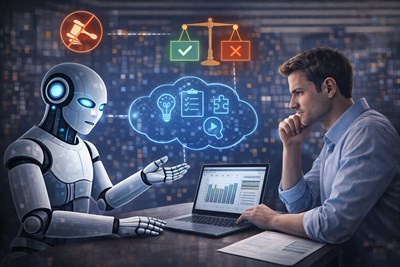
AI can improve decision-making at work — but only when it strengthens structure, not replaces judgment. In modern organizations, decisions fail not because people lack intelligence, but because complexity overwhelms attention, trade-offs remain implicit, and risks are discovered too late. AI appears to offer relief by processing more information faster, yet this creates a dangerous illusion: that decisions themselves can be delegated. In practice, the opposite is true.
The most reliable results come when AI enhances decision frameworks — helping surface options, assumptions, and risks — while humans retain full control over weighting, judgment, and accountability.
AI should never make final decisions. Its role is to structure information, not to choose outcomes.
For a deeper foundation on keeping AI in a supportive role, see Using AI as a Second Brain for Decisions (Not a Judge).
What Decision Frameworks Actually Do (And Why AI Fits Here)
Decision frameworks exist because human thinking breaks down under pressure, scale, and ambiguity. When choices multiply, deadlines tighten, and stakes rise, intuition becomes inconsistent. Important variables are forgotten, risks are underestimated, and decisions become reactive rather than deliberate. Frameworks solve this not by telling people what to do, but by forcing clarity: defining options, making trade-offs explicit, and slowing down impulsive judgment.
Why do raw instincts fail at scale? Because the problem is rarely “not enough intelligence” and almost always “too many interacting variables.” Frameworks create a shared language for trade-offs, reduce noise in meetings, and make it easier to audit how a decision was made later.
This is precisely where AI fits — and where it does not. AI excels at structured expansion: generating options, listing trade-offs, mapping risks, and spotting missing variables. It is best treated as a decision support system, not a decision authority. It does not own consequences, cannot validate assumptions by itself, and can be confidently wrong. That is why AI decision-making only works when humans remain human-in-the-loop at the points that matter: assumptions, weighting, and final choice.
Decision frameworks exist to reduce chaos, not to outsource responsibility. AI only works when it supports this goal.
Where AI Enhances Decision Frameworks (With Examples)
AI delivers the most value when roles are explicitly separated. Humans define the decision boundary, constraints, and success criteria. AI organizes inputs and stress-tests the structure. Humans make the judgment call and accept accountability.
Human control in AI-assisted decision-making means ownership of assumptions, weights, and consequences.
Hiring Decisions
What humans define: Role requirements, cultural expectations, non-negotiable skills, interview process, and final hiring authority.
What AI processes: Structured comparison of candidate profiles against stated criteria; highlighting inconsistencies (e.g., timeline gaps, unclear scope); turning interview notes into a criteria-based summary; surfacing potential bias in evaluation language (e.g., vague “culture fit” claims).
What stays human: Interpretation of signals that depend on real context (team dynamics, leadership style, stakeholder trust) and the final hiring decision.
Product Prioritization
What humans define: Strategy (growth, retention, reliability), constraints (capacity, budget), and what “impact” means for the business.
What AI processes: Option matrices across impact, effort, dependencies, and second-order effects; identifying hidden trade-offs (e.g., “fast to ship” but increases support load); summarizing disagreements into explicit decision questions.
What stays human: Weighting criteria, deciding what to sacrifice, and owning the roadmap in front of leadership and customers.
Go / No-Go Launch Decisions
What humans define: Launch thresholds, reputational risk tolerance, rollback plans, and escalation ownership.
What AI processes: Pre-mortem risks; scenario mapping (best-case, expected, failure); identifying missing data (e.g., unclear SLAs, untested edge cases); drafting a “launch memo” outline that makes assumptions explicit.
What stays human: The final “Go/No-Go” call, because the organization bears consequences if it fails.
Vendor or Tool Selection
What humans define: Business requirements, legal/security constraints, long-term ownership concerns, and negotiation boundaries.
What AI processes: A structured comparison by total cost of ownership, lock-in risk, scalability, integration complexity, support models, and plausible failure modes; generating questions to ask in demos and reference calls.
What stays human: Trust decisions, negotiation strategy, contract approval, and security sign-off.
For decisions where this separation is not possible, AI should not be used. A detailed breakdown is covered in Where AI Should Not Be Used: High-Stakes Decisions Explained.
Quick Self-Check Before Using AI in a Decision
- Is this decision reversible? If not, AI should be limited or avoided.
- Who owns the outcome? Name a human decision owner.
- What assumptions is AI likely missing? Context, incentives, constraints, and “why now.”
- What data would change the decision? Identify the “decision-critical” inputs.
- What could make the AI output misleading? Vague prompts, missing constraints, or biased framing.
AI-Enhanced Decision Models You Can Actually Use
AI works best when paired with frameworks that already enforce structure. The models below are reliable in real work because they keep authority human while using AI for analysis and organization.
Pros / Cons With Weighted Criteria
What it is: A criteria list with weights (importance) and option scores (fit). You do not “argue” in meetings; you make trade-offs explicit.
How AI helps: Expands criteria you may be missing, drafts pros/cons per option, and highlights where a criterion overlaps with another (double-counting risk).
What stays human: Choosing criteria, setting weights, scoring, and deciding what “good enough” means.
Pre-Mortem Analysis
What it is: You assume the decision failed and ask: “What caused it?” This exposes blind spots before commitment.
How AI helps: Generates plausible failure causes across people/process/tech/market; clusters them into themes; proposes mitigation questions to investigate.
What stays human: Deciding which risks are real, which are acceptable, and what mitigation is worth the cost.
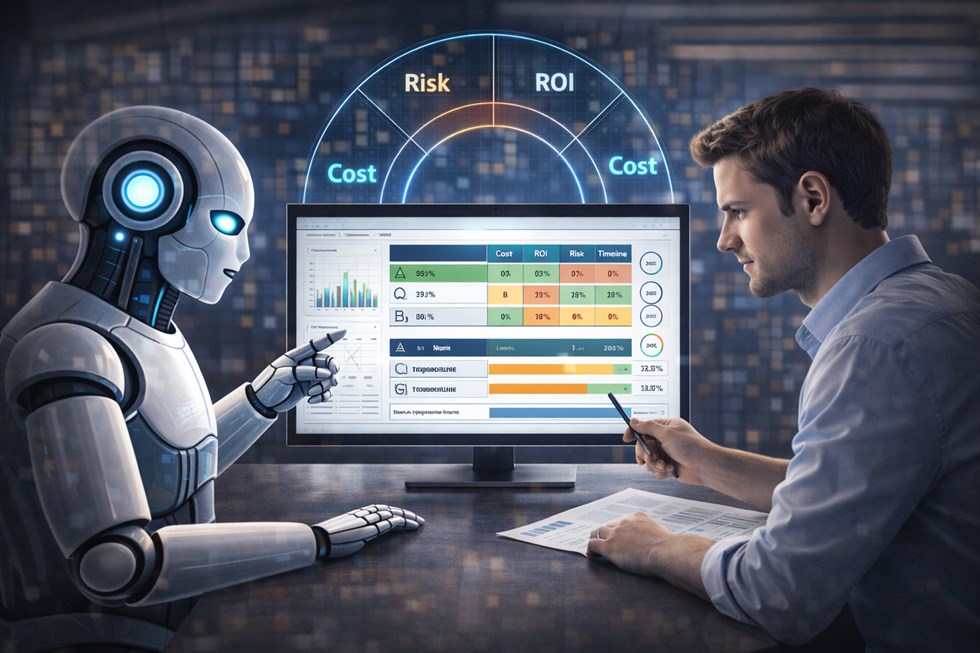
Option Comparison Matrix
What it is: A structured comparison across dimensions like cost, reversibility, time-to-value, risk, dependencies, and second-order effects.
How AI helps: Converts messy notes into a clean matrix, suggests missing comparison dimensions, and drafts “what would need to be true” for each option to work.
What stays human: Choosing which dimensions matter and how they’re weighted.
Risk–Impact Mapping
What it is: Risks are mapped by likelihood and impact, then translated into actions (mitigate, monitor, accept, avoid).
How AI helps: Enumerates risk lists, suggests early warning indicators, and produces a monitoring checklist.
What stays human: Accepting risk and funding mitigations.
Example: Using AI to compare three strategic options by risks, costs, reversibility, and second-order effects — without selecting the winner.
How to Apply an AI-Enhanced Decision Framework in Practice
- Define the decision boundary and owner: What is being decided, by whom, and by when?
- State constraints: Budget, time, legal/security requirements, and “non-negotiables.”
- Pick a framework: Weighted criteria, pre-mortem, comparison matrix, or risk–impact map.
- Use AI only for structuring inputs: Options, trade-offs, risks, missing variables.
- Audit assumptions manually: Ask “What did AI assume that we didn’t say?”
- Decide and document: Record the human reasoning, weights, and sign-off.
Prompting AI Without Letting It Decide
The examples below are control prompts. They are not meant to replace judgment or automate decisions. Their purpose is to constrain AI behavior during specific workflow steps — helping structure information without introducing assumptions, ownership, or commitments.
You are not making the decision. Help structure the options, surface risks, and highlight trade-offs. Do not recommend or rank a final choice.
Given the decision context below, generate 6–10 plausible options (including “do nothing” and “delay”). For each option, list: key assumptions, likely trade-offs, and what evidence would confirm or falsify it. Do not rank or recommend.
Detect potential cognitive biases in how the decision is framed. Highlight: missing stakeholders, leading assumptions, sunk cost effects, and overly narrow success metrics. Do not propose a final choice.
List missing variables that could change the decision. For each missing variable: why it matters, how to measure it quickly, and what range would shift the outcome. Do not recommend an option.
Limits and Risks of AI-Enhanced Decisions
AI can strengthen frameworks, but it also introduces failure modes that teams often underestimate. The goal is not to “trust AI more” — it is to design decision processes that remain robust even when AI outputs are imperfect.
- False confidence: AI outputs can sound polished and certain even when based on weak evidence or generic assumptions.
- Hidden assumptions: AI may fill missing context with defaults (industry clichés, average-case scenarios) unless you force it to state assumptions explicitly.
- Bias amplification: If the prompt is biased (“prove option A is best”), AI will reinforce that framing and generate supporting arguments.
- Accountability illusion: Teams may treat “AI recommended it” as shared responsibility, which quietly removes decision ownership.
- Scope creep: Once AI starts suggesting, people let it expand into authority (ranking, recommending, deciding) unless boundaries are enforced.
AI often sounds confident even when it is wrong. Decision frameworks must protect humans from false certainty, not reinforce it.
Final Decision Always Belongs to Humans
In real work environments, decision failures are rarely caused by lack of data. They happen when responsibility becomes blurred — especially when AI tools are introduced without clear ownership. AI can accelerate analysis, but it cannot absorb consequences. It does not carry legal liability, reputational damage, ethical responsibility, or the operational burden of being wrong.
“AI recommended it” is not a defense. It does not explain the decision, justify the risk, or transfer accountability. The decision owner must be a person (or a clearly defined group) who can be held responsible for outcomes.
To maintain human control, document the decision in a way that can be audited:
- Decision owner: Who is accountable for the call?
- Options considered: What alternatives were evaluated (including “do nothing”)?
- Criteria and weights: What mattered most and why?
- Assumptions: What had to be true for the chosen option to work?
- Risks and mitigations: What risks were accepted, reduced, or monitored?
- AI usage note: Where AI supported structure (options/risks/unknowns) and where humans made judgments.
FAQ
Can AI make business decisions on its own?
No. AI can support decision frameworks, but accountability and final judgment must remain human.
What decision frameworks work best with AI?
Structured models like option matrices, pre-mortems, and risk mapping benefit most from AI support.
Is it dangerous to rely on AI for decisions?
Yes, when AI recommendations replace human reasoning instead of structuring it.
How do I stop AI from acting like a judge?
By using constrained prompts that forbid recommendations and focus only on structure and analysis.
When should AI not be used in decision-making?
In high-stakes, irreversible, legal, or ethical decisions where human accountability is critical.