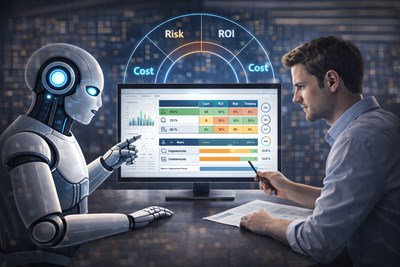
Decisions are the highest-risk zone for using AI at work — not because AI is “evil,” but because it’s persuasive, fast, and often confident in the wrong places. The most dangerous failure mode isn’t a spectacular hallucination you notice. It’s a quiet shift of ownership: “the model said so.”
If you use AI as a judge, you outsource responsibility to something that cannot hold consequences. If you use it as a second brain, you keep control while gaining structure, scenarios, and sharper thinking. This article shows practical ways to do that — and where it breaks.
For a deeper breakdown of what AI can and cannot do in decision support, see Can AI Help With Decisions? Where It Supports and Where It Fails — it’s the mental model that prevents most “delegated judgment” mistakes.
AI supports thinking, not responsibility. Use it to widen perspective and pressure-test logic — not to choose for you.
What “AI as a Second Brain” Actually Means
“Second brain” is a useful phrase, but it’s easy to misapply. A second brain is not a second boss, and it’s not a replacement for accountability. In decision-making, the distinction is simple:
- AI as an advisor: Generates options, highlights trade-offs, finds blind spots, suggests questions, and helps you articulate reasoning.
- AI as a calculator: Summarizes inputs, runs scenarios, applies a framework, or helps compare alternatives under explicit assumptions.
- AI as a judge: Produces a final answer (“choose A”) with implied authority, often without full context, and encourages you to stop thinking.
The goal is cognitive offloading without decision offloading. You can offload:
- Structuring messy information into decision-ready form
- Generating alternative hypotheses you didn’t consider
- Creating scenario branches (“if X, then Y”) to make uncertainty explicit
- Writing down criteria, risks, and counterarguments
You cannot offload:
- Responsibility for outcomes
- Ethical and legal accountability
- Context you never provided (culture, politics, constraints, reputational risk)
- Ownership of trade-offs (what you value, what you can tolerate, what you will defend)
Here’s the simplest operating rule: AI can help you think, but it cannot “own” the decision. Ownership means you can explain the decision to a skeptical stakeholder, defend the trade-offs, and name what would change your mind.
Cognitive offloading vs decision ownership
Cognitive offloading is beneficial when it reduces mental clutter. Decision ownership is non-negotiable because it ties to consequences. In practice, this means:
- You let AI expand the set of possibilities, not narrow them prematurely.
- You ask AI to surface assumptions, not to declare truth.
- You keep the “why” in a form you can explain without quoting the model.
AI works best when it expands perspective, not authority.
Where AI Strengthens Decision-Making
AI is useful in decision-making because most real decisions fail for boring reasons: unclear criteria, missing alternatives, hidden assumptions, and untested plans. Good AI usage attacks those failure points.
1) Structuring options when your brain is overloaded
When you’re tired or emotionally invested, you tend to collapse possibilities too early: “It’s either A or B.” AI can widen the option set by generating plausible alternatives you haven’t named yet (including “do nothing” or “delay and gather data”).
What to ask for:
- A complete list of viable options (including “hybrids”)
- Minimum viable option (the smallest reversible step)
- “What would a smart competitor do?” alternatives
2) Listing trade-offs and second-order effects
Humans are decent at first-order effects and terrible at second-order effects when under time pressure. AI can help you explicitly list trade-offs: what you gain, what you lose, and what the downstream consequences might be.
What to ask for:
- Pros/cons that are tied to your stated criteria
- Second-order effects (“what happens next?”)
- Risks by category (financial, operational, legal, reputational)
3) Scenario exploration under uncertainty
Uncertainty is not an excuse for guessing. It’s a prompt to model scenarios. AI is good at generating scenario branches quickly: best case, base case, worst case — plus “weird case” (the one no one expects but breaks plans).
What to ask for:
- 3–5 scenarios with triggers and early warning signals
- What you would do differently in each scenario
- Which inputs matter most (sensitivity analysis in words)
4) Bias detection (partial, not magical)
AI can help detect some biases by naming patterns in your language: overconfidence, sunk cost reasoning, confirmation bias, “status quo” framing. But AI is not neutral and it can introduce its own biases. The safest use is to ask AI to play roles that challenge you: skeptic, red team, risk officer, customer, regulator.
What to ask for:
- “What biases might be influencing my framing?”
- “What evidence would change my mind?”
- “Argue against my current preference as strongly as possible.”
Example: choosing between two job offers / vendors / strategies — AI can help you define criteria, quantify trade-offs, stress-test assumptions, and identify failure modes. It should not tell you “pick Offer A.”
Real-World Decision Examples (Work Context)
Below are three work contexts where AI decision support is genuinely useful — and where it commonly goes wrong. The point is not to copy the examples, but to notice the pattern: you’re using AI to structure, challenge, and test.
Example 1: Hiring decision (two strong candidates)
Situation: You have two finalists. Candidate A has deeper domain expertise but weaker communication. Candidate B is a strong communicator with broader experience but less depth in your niche. Stakeholders disagree. Deadline is near.
How AI helps (second brain):
- Turns vague impressions into explicit criteria
- Separates “must-have” from “nice-to-have”
- Builds an interview debrief template to reduce biased memory
- Generates structured questions for reference checks
What to do with AI output:
- Make criteria visible to the hiring panel
- Force each stakeholder to score independently before discussion
- Decide on “risk ownership”: what risk you accept with each candidate
Common failure mode (AI as judge): Prompting “who should we hire?” without providing the role’s true constraints (team dynamics, political reality, timeline, performance bar, company values). The model produces an answer that feels crisp, and people stop debating the real trade-off. That’s delegated judgment.
Decision ownership check: If you can’t explain the hire in two paragraphs without mentioning the model, you don’t own the decision yet.
Example 2: Product prioritization (too many “urgent” requests)
Situation: You have 25 feature requests, 10 internal demands, and constant “this is urgent” messages. You need a roadmap decision that won’t collapse in two weeks.
How AI helps (second brain):
- Normalizes requests into comparable units (problem, user segment, impact)
- Suggests a scoring model (RICE, ICE, WSJF) and makes assumptions explicit
- Creates a “trade-off narrative” you can share with stakeholders
- Generates “what will break if we choose wrong?” lists
Where it goes wrong: AI tends to over-trust the inputs. If your “impact” numbers are guesses or politically inflated, AI will happily produce a “scientific-looking” ranking. That can create a false sense of objectivity.
How to prevent silent error:
- Ask AI to label every claim as “fact / estimate / assumption.”
- Ask for sensitivity: “If impact is wrong by 30%, what changes?”
- Ask for “unknown unknowns” and missing stakeholders.
For the broader view of AI support vs failure modes in decision processes, revisit AI support vs failure modes and treat it like a pre-flight checklist before you trust any ranking output.
Example 3: Strategic choice under uncertainty (expand vs focus)
Situation: You’re deciding whether to expand into a new market or focus on improving core retention. Expansion could unlock growth. Focus could reduce churn and stabilize revenue. Data is incomplete, and the decision is partially about risk tolerance.
How AI helps (second brain):
- Clarifies what “success” means in measurable terms
- Builds a scenario tree with triggers and early signals
- Identifies decision reversibility (can you undo it?)
- Creates an experiment plan to reduce uncertainty
What you must add (human responsibility):
- Strategic intent (what you are willing to sacrifice)
- Company constraints (cash runway, legal exposure, team capacity)
- Stakeholder politics and timing reality
- What you will regret more: missed growth or instability
Common failure mode: AI’s “balanced” tone can create false neutrality. It may present expansion and focus as symmetrical when they aren’t — because your constraints make one option far riskier. If you don’t force the model to operate under your constraints, it will produce generic strategy talk.
Prompting AI as a Thinking Partner (Not a Judge)
Most “bad AI decisions” are actually bad prompts. People ask for an answer, not for a thinking process. Your job is to constrain the model into decision support: options, assumptions, trade-offs, risks, and what to validate next.
Ask AI to generate options, risks, assumptions, and counterarguments — never a final answer. Treat outputs as drafts to challenge, not truths to follow.
Core prompt pattern: decision brief builder
Use this when you want a clean, shareable structure.
Prompt: I’m making a decision about: [decision]. Context: [constraints, timeline, stakeholders]. My goals: [outcomes]. Non-negotiables: [rules]. Options I see: [A, B, C].
Do not choose for me. Build a decision brief with:
- Clarifying questions (max 10)
- Decision criteria (ranked)
- Expanded option set (include hybrids + “do nothing”)
- Pros/cons per option tied to criteria
- Key assumptions per option
- What evidence would change the ranking
- Risks (by category) and mitigations
- Next actions to reduce uncertainty in 7 days
Option generation without biasing the answer
When you fear the model will just mirror your preference, explicitly request diversity and role-based alternatives.
Prompt: Generate at least 8 distinct options for this decision, including at least:
- 2 conservative options (low risk)
- 2 aggressive options (high upside, higher risk)
- 2 hybrid options (partial implementation)
- 1 “do nothing” option
- 1 “delay and gather data” option
For each option, name: primary upside, primary downside, and what would make it fail.
Assumption audit (the prompt people skip)
If you do only one thing with AI for decisions, do this. Bad decisions are often made on invisible assumptions.
Prompt: Here’s my current plan and reasoning: [paste]. Identify all assumptions I’m making. Categorize them as:
- Unstated assumptions
- Questionable assumptions
- Assumptions that can be tested quickly
- Assumptions that are values/trade-offs (not testable)
For each testable assumption, propose a fast validation step and what result would invalidate it.
Failure-mode and pre-mortem prompts
AI is strong at generating structured failure scenarios. Use that strength deliberately.
Prompt: Run a pre-mortem. Assume we chose option [X] and six months later it failed. List the top 12 reasons it failed, grouped by:
- Execution / operations
- Market / users
- People / incentives
- Legal / compliance
- Finance
- Reputation / trust
Then propose 1–2 mitigations per reason, and 5 early warning signals we should track.
“Red team me” prompts (counterargument generation)
This is how you use AI for intellectual honesty without letting it choose.
Prompt: I’m leaning toward [option]. Argue against it as if you are:
- A skeptical CFO
- A legal/compliance lead
- A frontline operator who must execute
- A customer who is unhappy
Then list the strongest arguments in favor, and tell me what information would resolve the disagreement.
Three “never prompts” for decision safety
- “Which option should I choose?” (invites judge behavior)
- “Give me the best strategy.” (forces generic answers without your constraints)
- “Decide for me.” (outsources ownership; creates accountability gap)
Replace them with prompts that ask for structure and tests: options, trade-offs, assumptions, failure modes, and what to validate next.
Where AI Breaks Decisions
AI failure in decision-making is often subtle. Not “it made up a fake fact,” but “it sounded reasonable and nudged the group into complacency.” Here are the core failure modes to watch.
Hallucinated confidence
AI can present uncertain claims with confident language, especially when the prompt implies you want certainty. In ambiguous decisions, the model often fills gaps with plausible-sounding statements. This is especially dangerous when stakeholders interpret confidence as expertise.
Countermeasure:
- Ask it to label certainty: “high/medium/low confidence with reasons.”
- Require source boundaries: “If you’re not sure, say so.”
- Force “assumptions vs facts” tagging.
Missing context (and you won’t notice)
Decision quality depends on constraints: budget, timeline, politics, culture, legal limits, talent, brand promises. AI only sees what you provide. The model may produce a beautifully structured answer that is irrelevant because the real constraint was never stated.
Countermeasure:
- Give explicit constraints and non-negotiables.
- Ask: “What critical context might be missing?”
- Ask it to propose clarifying questions before analysis.
False neutrality
AI often sounds “balanced.” That tone can hide real asymmetry. In real life, one option might be catastrophically risky under your constraints, while another is boring but stable. If you don’t force the model to weight outcomes and risks the way you do, it can flatten differences.
Countermeasure:
- Define what you optimize for (speed, reliability, safety, growth).
- Define unacceptable outcomes (e.g., compliance violation, reputational harm).
- Ask for “worst-case downside per option” in concrete terms.
Pattern bias and “most typical answer”
AI is trained on patterns. That can be useful, but it can also anchor you to what’s common instead of what’s true for your situation. If your case is unusual, the model may default to generic playbooks that don’t fit.
Countermeasure:
- Explicitly state what makes your situation non-standard.
- Ask: “What would this advice be missing in a non-typical case?”
- Ask for multiple frameworks, not one “best.”
AI confidence ≠ correctness. Especially in ambiguous decisions.
Limits and Risks of AI-Assisted Decisions
Even when prompts are good, AI-assisted decisions have structural risks. These aren’t “bugs” you can prompt away. They’re system-level problems that appear when humans interact with persuasive tools.
1) Accountability gap
If the reasoning chain lives inside a chat and no one can explain it, accountability is gone. In meetings, “the model said so” becomes a shield. When the decision fails, no one owns the trade-offs.
Mitigation:
- Write a human-owned decision memo: criteria, trade-offs, rationale, risks, mitigations.
- Make AI output an input to that memo, not the memo itself.
- Assign an explicit owner for each key risk.
2) Automation bias
Humans overweight “machine-like” outputs, especially under stress. A ranked list, a confident recommendation, or a clean framework can trick the brain into thinking the work is done.
Mitigation:
- Force dissent: have someone argue the opposite option.
- Use independent scoring before discussion.
- Ask the model to generate counterarguments and failure cases.
3) Silent errors
In decision-making, many errors are not obviously wrong. A missing stakeholder, a wrong assumption about incentives, an overlooked legal risk — these don’t look like “mistakes” until later.
Mitigation:
- Use checklists: stakeholders, constraints, risks, reversibility, signals.
- Ask for “what would surprise us?” and “what are we ignoring?”
- Require explicit uncertainty labeling.
4) Legal and ethical exposure
Some decisions carry legal or ethical responsibilities that cannot be delegated. Hiring, performance management, credit decisions, health and safety, compliance-related choices, and anything that affects rights or fairness require careful human oversight and often formal processes.
Mitigation:
- Do not use AI as a final arbiter for high-stakes decisions.
- Document your reasoning and your data sources.
- Involve legal/compliance early when decisions touch regulated areas.
5) Data leakage and confidentiality risk
If you paste sensitive information into an AI tool without understanding your organization’s policy and the tool’s data handling, you can create a security incident. Decision support often involves internal numbers, customer details, or strategy.
Mitigation:
- Use approved tools and follow policy.
- Redact confidential details where possible.
- Provide abstractions: ranges, anonymized cases, “Company X” placeholders.
Final Responsibility Always Stays Human
AI cannot carry consequences. It does not experience loss, reputation damage, legal exposure, or moral responsibility. Humans do. That’s why “delegation” in decision-making is not efficiency — it’s abdication.
In practice, responsibility means:
- You can explain the decision and the trade-offs without referencing the model.
- You know which assumptions you are betting on.
- You can name what would change your mind.
- You have a plan for monitoring and course-correcting.
Here’s the practical rule that prevents most decision mistakes with AI:
If you can’t explain the decision without AI — you shouldn’t make it.
That doesn’t mean you can’t use AI to help write the explanation. It means the explanation must be true in your head, defensible in your words, and anchored in your constraints.
One simple operating model is to treat AI like a “decision QA function”:
- You: Own the problem framing, values, constraints, and final trade-offs.
- AI: Tests your framing, expands options, attacks weak logic, and proposes what to validate next.
To reinforce this model, it helps to connect decision-making to broader risk-aware AI usage. If your team is also using AI for research, summaries, or analysis, the same principle applies: AI can accelerate cognition, but it can’t own truth or accountability. A good related read is How to Cross-Check AI Research Outputs Efficiently, because decision errors often start as research errors that were never verified.
A short “human-owned” decision checklist
- Decision: What exactly are we choosing?
- Criteria: What matters most (ranked)?
- Constraints: What are the non-negotiables?
- Options: What are the real alternatives, including hybrids?
- Trade-offs: What are we giving up with each option?
- Assumptions: What are we betting on?
- Failure modes: How could this go wrong?
- Signals: How will we know early if it’s failing?
- Owner: Who owns the outcome and each key risk?
If AI helps you fill this out faster and better, it’s working as a second brain. If AI replaces this with a single “answer,” you’re using it as a judge.
FAQ
Should AI make decisions for you?
No. AI can support analysis, but responsibility must stay with a human. The safest use is to ask AI for options, trade-offs, assumptions, and failure modes — then make the call yourself.
Is AI reliable for business decisions?
Only as a decision support tool, not as a final authority. AI can be helpful for structuring decisions and exploring scenarios, but it can miss context, sound confident when wrong, and produce “generic” advice that doesn’t match your constraints.
What are the risks of using AI for decisions?
Silent errors, overconfidence, missing context, and loss of accountability. Another major risk is automation bias: people overweight AI outputs because they look structured and “objective.”
How do you use AI safely for decision-making?
Use it to structure options, not to choose between them. Ask for clarifying questions, ranked criteria, assumptions, pre-mortems, counterarguments, and what to validate next. Document the final rationale in human-owned language.
How do I prevent “delegated judgment” in my team?
Ban “the model said so” as a justification. Require a decision memo with criteria, trade-offs, and risk owners. Encourage dissent and run pre-mortems. Treat AI output as an input to discussion, not an authority.
What’s the best decision framework to use with AI?
Use frameworks that force explicit criteria and trade-offs: RICE/ICE/WSJF for prioritization, pre-mortems for risk, and scenario trees for uncertainty. The framework matters less than the discipline of labeling assumptions and testing them.
When should I avoid using AI for decisions?
Avoid using AI as the final arbiter for high-stakes decisions involving legal compliance, safety, fairness, or rights (for example, hiring decisions that rely on sensitive data, regulated financial decisions, or medical choices). Use AI only to support thinking and documentation.