Meetings are one of the weakest points in modern knowledge work. They consume time, attention, and energy — yet often fail to produce clear decisions or sustained action. Preparation is rushed or skipped, discussions drift, and outcomes dissolve into vague notes with no ownership.
AI is frequently introduced as a solution to this problem. Transcription, summaries, and automated follow-ups promise efficiency. In practice, however, AI often amplifies the same dysfunctions: more notes, more text, more perceived productivity — but not better decisions.
The core issue is not discussion quality. Meetings fail because of poor preparation and weak follow-through. This article explains how to use AI before and after meetings — for preparation, notes, and follow-ups — while keeping decision ownership, accountability, and intent firmly human.
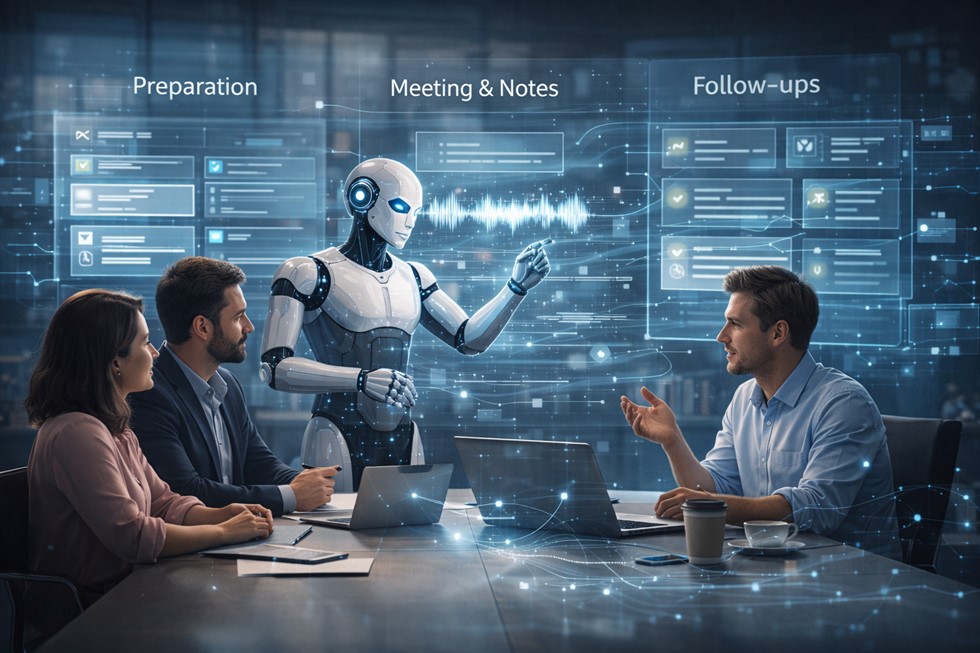
Meeting workflow with AI:
Before Meeting
→ Goal definition
→ Context preparation
→ Decision scope clarity

During Meeting
→ Human discussion
→ Alignment and trade-offs

After Meeting
→ Notes structuring
→ Decision confirmation
→ Action items with owners
→ Follow-ups and execution
AI supports preparation and follow-through, but never replaces human discussion or decision ownership.
Why Most Meetings Fail (Even with AI)
Most meetings fail for structural reasons, not because participants lack intelligence or tools. AI does not fix these problems automatically — it often masks them.
Common failure patterns appear repeatedly across teams and organizations.
- No clear goal or decision scope
- Little or no preparation
- Notes that describe discussion but not outcomes
- Action items without owners or deadlines
AI-generated notes can make a meeting feel productive while leaving these underlying issues unresolved. Text is produced, but decisions are not captured. Tasks are listed, but responsibility is unclear.
Where AI Actually Fits in the Meeting Workflow
AI should not be treated as a participant, facilitator, or decision-maker. It does not understand context, power dynamics, or responsibility.
AI fits best around meetings, not inside decision-making itself. Its value lies in preparation, structuring information, and supporting follow-through — not in defining outcomes.
Ownership always remains human. AI can assist the workflow, but it cannot own decisions, commitments, or accountability.
Using AI Before Meetings — Preparation That Actually Matters
Preparation is the most leverageable part of any meeting. A well-prepared meeting often requires less discussion and produces clearer outcomes. AI can significantly improve preparation — if its role is constrained.
How to Use AI Before Meetings (Step by Step)
- Define the decision first. Clarify what must be decided and what is explicitly out of scope.
- Provide bounded context. Share only information that changes the decision, not everything available.
- Use AI for structure, not judgment. Ask for agendas, talking points, or questions — not conclusions.
- Review outputs manually. Ensure the agenda reflects real priorities, not generic templates.
Preparation quality determines meeting quality. AI amplifies clarity — or confusion — depending on the inputs.
Clarifying the Meeting Goal and Decision Scope
Before a meeting, the most important question is not “what will we discuss,” but “what must be decided.” Many meetings fail because this is never made explicit.
AI can help structure this clarification, but it should not invent goals or agendas. The decision scope must come from the meeting owner.
Effective preparation makes three elements explicit:
- What decision (if any) needs to be made
- What is explicitly not in scope
- Who owns the decision
When this framing is missing, AI-generated agendas and summaries tend to reflect conversation rather than intent.
Preparing Context, Briefs, and Talking Points
AI is effective at organizing background material and preparing structured briefs. This reduces cognitive load before the meeting and helps participants arrive aligned.
Useful preparation tasks include:
- Summarizing background documents for review
- Structuring key questions and trade-offs
- Drafting neutral talking points
The most common mistake is overloading context. Feeding AI every available document produces noise rather than clarity. Preparation works best when context is selective and decision-relevant.
Using AI After Meetings — Notes, Decisions, and Follow-ups
The period after a meeting determines whether it had any real impact. Notes, decisions, and follow-ups must be translated into action — this is where AI can help or quietly undermine accountability.
Turning Raw Notes into Structured Outcomes
Meeting notes are not outcomes. Transcripts and summaries describe what was said, not what was decided.
AI can help restructure raw notes into clear categories:
- Decisions made
- Open questions
- Action items
The examples below are control prompts. They are not meant to replace judgment or automate decisions. Their purpose is to constrain AI behavior during specific workflow steps — helping structure information without introducing assumptions, ownership, or commitments.
"Convert these raw meeting notes into structured outputs: 1) Decisions made 2) Open questions 3) Action items with owners and deadlines. Do not invent decisions or assign ownership unless explicitly stated."
This distinction is critical. Treating summaries as outcomes creates false closure. For a deeper explanation of why summaries can mislead, see AI Summaries Explained: When They Help and When They Mislead.
Extracting Action Items and Ownership
AI can assist in identifying potential action items, but ownership cannot be automated. Assigning responsibility is a managerial and ethical act, not a pattern-matching task.
Effective use of AI here involves:
- Listing candidate actions discussed
- Highlighting ambiguities
- Prompting a human to confirm owners and deadlines
When AI is allowed to assign ownership implicitly, accountability erodes.
Writing Clear Follow-ups Without Losing Intent
Follow-up messages are commitments. They often shape expectations across teams and stakeholders.
AI is useful as an editor: improving clarity, structure, and tone. It should not author promises or commitments.
"Rewrite this meeting follow-up for clarity and professionalism. Preserve original intent. Do not add commitments, promises, or decisions that were not explicitly agreed."
This distinction mirrors professional document workflows. For guidance on controlled drafting and editing, see Using AI to Draft, Edit, and Refine Professional Documents.
Meetings and Decision-Making — Where AI Must Stop
AI should not formulate final decisions, especially in meetings where trade-offs, risk, and accountability are involved.
Decision framing — organizing options, surfacing risks, structuring trade-offs — is where AI adds value. Decision ownership must remain human.
This separation is central to effective AI use in professional settings and aligns with structured decision workflows described in A Practical AI Workflow for Knowledge Workers (From Task to Decision).
Common Mistakes When Using AI for Meetings
- Treating summaries as decisions
- Letting AI define outcomes
- Skipping human review
- Failing to assign action owners
- Assuming notes equal execution
These mistakes create the illusion of productivity while weakening accountability.
A Practical Checklist — Using AI Around Meetings Safely
- Meeting goal and decision scope defined before the meeting
- AI used for preparation and structure, not judgment
- Decisions reviewed and confirmed by humans
- Action items have explicit owners
- Follow-ups verified before sending
Frequently Asked Questions (FAQ)
Can AI prepare meetings effectively?
AI can help structure agendas, clarify goals, and organize context. However, humans must define the decision scope and priorities.
Are AI meeting notes reliable?
AI can structure notes, but it cannot determine what counts as a decision. Human review is required before notes are treated as outcomes.
Can AI handle meeting follow-ups?
AI can help rewrite follow-ups for clarity, but it should not introduce commitments or assign responsibility.
Should AI be used for meeting decisions?
No. AI can support analysis and framing, but final decisions require human judgment and accountability.
What is the biggest risk of using AI in meetings?
The biggest risk is treating summaries or notes as decisions, which leads to lost ownership and weak execution.