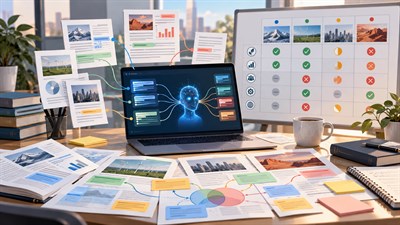
How to Summarize Multiple Sources With ChatGPT Without Losing Disagreement
ChatGPT can turn several reports, articles, or documents into one concise summary—but it can also flatten important disagreements between them. This practical workflow shows how to preserve conflicting claims, source attribution, evidence, and uncertainty when summarizing multiple sources with AI.

How to Proofread a Business Document With ChatGPT Without Introducing New Errors
ChatGPT can catch grammar, spelling, punctuation, and consistency problems in a business document, but accepting a rewritten version can introduce new mistakes. This guide shows a controlled proofreading workflow that preserves facts and meaning, exposes every important change, and keeps final approval with a human.

How to Turn Bullet Points Into a Professional Document With ChatGPT
Turn rough bullet points into a clear, professional document with ChatGPT. This practical workflow shows how to add context, choose the right structure, draft from your notes, refine the result, and check that AI has not changed or invented important details.

How to Use ChatGPT to Write a Business Memo: Structure, Drafting, and Verification
Use ChatGPT to turn notes, policies, meeting records, and other source material into a professional business memo — without handing factual accuracy or final judgment over to AI.

How to Use ChatGPT to Write a Business Proposal: Step-by-Step Workflow + Prompts
Learn a practical workflow for using ChatGPT to draft a business proposal from client notes, write each section with focused prompts, and verify it before sending.

How to Use ChatGPT to Review a Word Document Without Rewriting Everything
ChatGPT can review a Word document without turning it into a completely different piece of writing. The key is to ask for an issue-by-issue review, not a rewritten version. This guide shows a practical workflow for checking grammar, clarity, tone, consistency, and weak sections while keeping control of the original document.

ChatGPT for Data Analysis: From Raw Spreadsheet to Useful Insights
A practical workflow for turning raw Excel or CSV data into useful business insights with ChatGPT—without blindly trusting the first answer it gives you.

How to Write Executive Summaries With AI: A Practical Workflow for Accurate, Decision-Ready Briefs
AI can turn a long report into an executive summary in minutes—but a polished summary is not automatically an accurate one. This guide shows a practical workflow for extracting the right evidence, drafting with AI, checking facts and producing a concise summary that leaders can actually use.
AI Editing vs Human Editing: What AI Can Fix — and What Still Needs Human Judgment
AI can clean up grammar, tighten sentences, and speed up routine revisions. But it can also flatten voice, miss context, and introduce confident errors. This guide shows what to delegate to AI, what still needs human judgment, and how to combine both in a practical editing workflow.

ChatGPT for Reports: A Complete Workflow for Accurate, Professional Reports
ChatGPT can speed up report writing, but asking it to “write a report” is rarely enough. This guide shows a practical workflow for turning source documents, notes, and data into a structured professional report while keeping facts, numbers, judgment, and final approval under human control.

How High Performers Actually Use AI at Work
High performers do not use AI as a shortcut for avoiding difficult work. They use it to clarify problems, examine evidence, generate alternatives, challenge their thinking and move through complex workflows faster. This guide breaks down the practical AI habits that improve real work without outsourcing judgment.

AI Workflow Templates for Small Teams: 8 Repeatable Systems for Real Work
Small teams do not need more disconnected AI prompts. They need repeatable workflows with clear inputs, owners, review steps, and measurable outputs. This guide provides eight practical templates for meetings, reporting, content, support, sales, onboarding, SOPs, and research.

Workflow Bottlenecks AI Cannot Fix: What Humans Must Change
AI can accelerate tasks, but it cannot resolve unclear ownership, conflicting priorities, weak policies, missing capacity or decisions no one is willing to make. Learn how to identify these bottlenecks and decide what humans must change before automating the workflow.

The 80/20 Rule for AI Workflows: How to Focus AI on High-Impact Work
Most teams do not need more AI tools. They need to identify the small number of recurring workflows that create most of the value. This practical guide shows how to find those workflows, decide what AI should handle, and protect the human decisions that still require context, accountability, and judgment.

AI for Post-Project Reflection and Review: Structured Debriefs Without Bias
Post-project reviews often become emotional, shallow, or forgotten. This guide explains how to use AI to structure reflection, extract actionable lessons, reduce hindsight bias, and turn project outcomes into reusable decision intelligence — while keeping final responsibility human.

AI for Pre-Mortem Planning in Projects: Preventing Failure Before It Happens
Pre-mortem planning helps teams imagine project failure before it happens. This guide explains how AI enhances risk detection, scenario mapping, and decision clarity—while keeping human accountability in control.

Why AI Can Misread Business Metrics — Hidden Data Risks in Real Work
AI can summarize dashboards and explain KPIs, but it often misinterprets business metrics. This guide explains why AI misreads data, where errors occur in real work, and how to control the risks.

AI-Assisted Data Interpretation vs Data Analysis: What AI Can Explain — and What It Cannot Prove
AI can summarize trends and suggest explanations — but that’s not the same as performing structured data analysis. This article explains the critical difference, risks of over-trusting AI interpretation, and how to use it responsibly in real work.
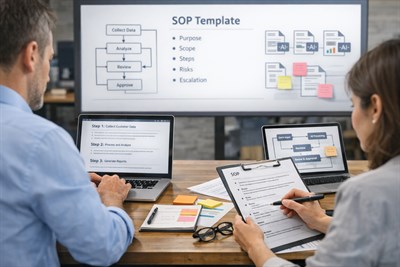
AI for Internal Documentation: How to Scale Processes Without Creating Operational Chaos
Internal documentation breaks first when teams scale. This guide shows how to use AI to build structured, reliable SOP systems — without creating confusion, duplication, or risk.

Turning Repetitive Tasks Into AI-Supported Micro-Systems: A Practical Framework for Real Work
Repetitive work drains focus and reduces strategic output. This guide shows how to turn recurring tasks into AI-supported micro-systems — structured, controlled, and sustainable. With real examples, prompts, risks, and human oversight rules.