For decades, career progression followed a predictable logic: juniors handled basic tasks, experienced employees took on harder versions of those tasks, and senior professionals gradually moved into decisions, coordination, and leadership. AI is disrupting that sequence.
Research, first drafts, summaries, basic analysis, reporting, data preparation, and administrative work can increasingly be completed with AI assistance. That does not mean expertise is disappearing. It means some of the work people historically used to build expertise is becoming easier to automate.
The result is a new career ladder in the AI era. Producing competent-looking work is becoming easier, so output alone is a weaker signal of professional value. The differentiators increasingly become whether you can verify that output, frame the right problem, understand the domain, design a reliable workflow, make decisions, and take responsibility for what happens next.
PwC's 2026 Global AI Jobs Barometer points to this shift in AI-exposed work, including stronger demand for capabilities traditionally associated with more experienced employees. The implication for workers is practical: judgment and responsibility may be expected earlier in a career than before.
The important shift: AI does not eliminate the need for expertise. It changes where expertise becomes visible. Producing the first draft is becoming cheaper; knowing what should be produced, whether it is correct, and what to do next becomes more valuable.
Why the Traditional Career Ladder Is Changing
The new career ladder in the AI era is a progression based less on performing increasingly complex tasks and more on taking increasing responsibility for problems, decisions, AI-assisted workflows, and outcomes. As AI handles more execution, career value shifts toward verification, judgment, orchestration, domain expertise, and leadership.
The old ladder was built around learning through execution
Traditional career development depended heavily on repetition. A junior marketer wrote dozens of basic drafts before developing a feel for positioning. A junior analyst prepared reports before learning which numbers actually mattered. A new project manager updated plans and meeting notes before becoming responsible for complex dependencies.
That work was not valuable only because someone needed the output. It was also a training mechanism.
Entry-level employees typically learned through tasks such as:
- researching background information;
- drafting documents and presentations;
- preparing recurring reports;
- cleaning or organizing information;
- summarizing meetings and source material;
- performing basic analysis;
- handling repetitive administrative work.
Over time, those tasks exposed employees to patterns, exceptions, mistakes, stakeholder preferences, and domain-specific tradeoffs. Eventually, they gained enough context to make harder decisions independently.
AI can remove work without removing the need for expertise
Generative AI can now assist with many of those formative tasks. It can produce an initial report, summarize research, draft a customer response, suggest a campaign plan, categorize feedback, or generate a first-pass analysis in seconds.
But completing the first version of a task is not the same as completing the professional work.
Someone still has to determine the objective, provide the right context, recognize missing information, detect unsupported conclusions, decide which tradeoffs matter, communicate the result to the right audience, and accept responsibility for the outcome.
This also changes what it means to become more capable over time. See How AI Changes Skill Progression (Beginner → Expert) for a deeper breakdown of how expertise develops when AI handles part of the execution.
The World Economic Forum's Future of Jobs Report 2025 estimates that a substantial share of workers' existing skill sets will change by 2030. Importantly, the shift is not purely toward technical abilities. Analytical thinking, resilience, leadership, collaboration, and other human capabilities remain important alongside AI and technology skills.
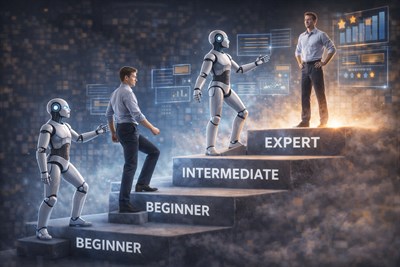
The New Career Ladder in the AI Era: Five Levels of Progression
The simplest way to understand the shift is to stop thinking only in terms of junior, mid-level, senior, and manager. Those titles may remain, but they tell you less about how professional value is created when AI becomes part of everyday work.
A more useful model is to track how much responsibility a person can safely and effectively own.
- AI-Assisted Executor
- Reliable AI Operator
- Problem Framer
- Workflow Owner
- Strategic AI-Augmented Leader
| Level | Your role | What AI does | What you must do | Proof you are ready to advance |
|---|---|---|---|---|
| 1. AI-Assisted Executor | Completes defined tasks | Speeds up research, drafting, formatting, and routine production | Follow instructions, add context, use tools appropriately | You produce useful work consistently with supervision |
| 2. Reliable AI Operator | Produces dependable AI-assisted work | Generates and analyzes possible outputs | Verify facts, numbers, assumptions, and quality | Others can trust your work without checking every detail |
| 3. Problem Framer | Defines what should be solved | Explores options and possible solutions | Clarify goals, constraints, assumptions, and success criteria | You improve the quality of decisions before execution starts |
| 4. Workflow Owner | Designs repeatable human-AI systems | Handles selected stages of a process | Design controls, review points, roles, metrics, and escalation rules | You improve a process, not just an individual task |
| 5. Strategic AI-Augmented Leader | Owns outcomes | Expands analytical and execution capacity | Choose priorities, allocate resources, manage risk, make decisions | You can connect AI-enabled work to measurable organizational outcomes |
Level 1 — AI-Assisted Executor
At the first level, you are still primarily responsible for completing clearly defined work. AI makes that execution faster.
Imagine a marketing assistant asked to generate 20 headline ideas for a campaign. A weak use of AI looks like this: open a chatbot, type a vague request, copy the 20 results, and send them to a manager.
A stronger Level 1 employee understands the brief, provides information about the audience and offer, specifies the required tone, removes obviously weak suggestions, and formats the final output so someone else can use it.
The employee is not yet deciding the campaign strategy. But they are already demonstrating that AI assistance does not remove the need to understand the assignment.
What moves you to the next level: reliability. Can your manager trust that AI makes your work faster without making your work more careless?
Level 2 — Reliable AI Operator
The second level is where basic AI literacy stops being enough.
Knowing how to use ChatGPT, Claude, Copilot, Gemini, or another AI tool is increasingly similar to knowing how to use search, spreadsheets, or presentation software. Useful? Yes. Differentiating on its own? Less and less.
A reliable AI operator can produce work that survives scrutiny.
That requires:
- providing sufficient context;
- checking sources;
- verifying calculations;
- testing assumptions;
- recognizing hallucinations;
- iterating when the first answer is weak;
- protecting confidential or sensitive information;
- knowing when AI should not be used.
Example: Two employees use the same AI tool. One produces a report in 15 minutes. The other produces it in 20 minutes but verifies the numbers, identifies a misleading conclusion, and explains the business implication. In an AI-heavy workplace, the second employee is creating more professional value.
Consider a business analyst who asks AI to summarize a monthly performance report. The summary sounds polished, but AI incorrectly attributes a revenue decline to weaker demand when the real cause is a temporary supply constraint.
A basic operator forwards the summary. A reliable operator notices the contradiction, returns to the source data, corrects the interpretation, and explains why the distinction matters.
The second employee is not valuable because they prompted better. They are valuable because they know enough to distrust a plausible answer.
Level 3 — Problem Framer
As AI becomes better at answering questions, the ability to decide which questions deserve to be answered becomes more valuable.
This is problem framing.
A task taker receives:
“Create a customer churn report.”
A problem framer asks:
“Which churn behavior can management realistically influence? Are all customer segments comparable? Do we care about total churn, high-value customer churn, early churn, or churn after a specific product experience?”
The difference is not semantic. The first approach can produce a technically impressive report that answers the wrong question. The second creates a better decision.
Strong problem framers define:
- the actual objective;
- the stakeholder who needs the result;
- the constraints;
- the relevant evidence;
- the assumptions that could invalidate the answer;
- what a useful outcome looks like.
As solution generation becomes cheaper, problem selection becomes more valuable.
Level 4 — Workflow Owner
At Level 4, you stop thinking about AI as something you use for individual tasks and start thinking about how work should flow through a system.
Suppose a content manager uses AI to create articles. A task-level user might generate a draft and edit it. A workflow owner designs an entire process:
research → source verification → outline → draft → factual review → brand review → approval → publication → performance review
They decide where AI should operate, where a human must intervene, what evidence is required, what information should never enter the model, how errors are caught, and what quality metrics determine whether the process is working.
This is where skills such as workflow design, AI orchestration, human-in-the-loop review, process measurement, and quality control become career accelerators.
It is also where AI starts producing organizational leverage rather than personal productivity alone.
Level 5 — Strategic AI-Augmented Leader
The highest level is not the person with the largest collection of AI subscriptions or the most elaborate prompts.
It is the person who can use AI-expanded capacity to make better organizational decisions.
A strategic AI-augmented leader can:
- identify which problems deserve investment;
- choose what should remain human-led;
- allocate people, data, tools, and time;
- evaluate uncertainty instead of hiding it;
- set standards for acceptable AI use;
- manage legal, operational, reputational, and quality risks;
- develop people whose tasks are being transformed;
- connect AI-enabled improvements to business outcomes.
This produces a different progression model:
Execution → Reliability → Problem Framing → Workflow Ownership → Outcome Ownership
This is not a universal corporate job classification. It is a practical framework for understanding where professional value can move as AI absorbs more execution.
Traditional Career Ladder vs. AI-Era Career Ladder
| Traditional career ladder | AI-era career ladder |
|---|---|
| Complete assigned tasks | Complete and verify AI-assisted work |
| Master execution | Frame problems correctly |
| Handle increasingly difficult tasks | Design repeatable workflows |
| Manage people and processes | Orchestrate people, AI, data, and processes |
| Make senior decisions | Own outcomes, risk, and accountability |
What Actually Gets You Promoted When Everyone Has AI
If everyone on your team has access to similar AI tools, access to AI cannot remain the differentiator.
Microsoft's Work Trend Index research has described a shift from using AI mainly for personal productivity toward redesigning work around AI and agents. That evolution matters for careers because the value moves from simply producing more output toward deciding how AI-enabled work should operate.
So what becomes more valuable?
1. Judgment
Judgment is the ability to decide whether a result is trustworthy, appropriate, useful, and worth acting on.
AI can generate recommendations. A professional still has to know whether the recommendation fits reality.
That becomes especially important when several answers are plausible, evidence is incomplete, or the cost of being wrong is high.
2. Problem Framing
The quality of an AI answer is constrained by the quality of the problem definition.
Professionals who can turn vague goals into clear questions, identify hidden assumptions, and define success criteria create leverage before any tool starts generating output.
3. Domain Expertise
AI can sound informed in domains where its answer is incomplete or wrong.
Domain expertise gives you the mental model needed to notice what is missing. It also helps you provide better context and distinguish an unusual but valid answer from a convincing hallucination.
4. Verification
Verification is becoming a standalone professional capability.
That includes checking:
- facts;
- citations;
- calculations;
- dates;
- assumptions;
- source quality;
- whether conclusions actually follow from the evidence.
The more quickly AI can generate work, the easier it becomes to generate errors at scale. People who can create trustworthy output therefore become more important, not less.
5. Communication
A technically correct answer is not automatically a useful answer.
Senior professionals adapt information to the stakeholder who needs to act on it. An executive may need a decision and three supporting facts. A legal reviewer may need assumptions and source documentation. An operating team may need actions, owners, and deadlines.
AI can help draft those formats. Human communication skill determines which format the situation requires.
6. Workflow Design
The career value of AI increases significantly when you stop saving ten minutes on one task and start improving a process that happens hundreds of times.
Workflow design means deciding how inputs become outputs, which stages can be automated, where human review is mandatory, how exceptions are handled, and how performance is measured.
7. Ownership
Ownership may become one of the clearest dividing lines on the new career ladder.
A weak professional response is:
“AI generated this.”
A stronger professional response is:
“I used AI to accelerate the analysis, verified the important claims, reviewed the risks, and I stand behind the recommendation.”
Many of these capabilities are becoming more important precisely because AI makes routine production easier. See Skills That Became More Valuable After AI for the broader skill shift.
Career advantage: Do not compete with colleagues on who can generate more AI output. Compete on who can turn AI output into a reliable decision, workflow, improvement, or measurable business result.
Real Examples: How the Ladder Changes Across Jobs
The shift becomes clearer when you look at real work rather than abstract skill lists.
Marketing
Traditional progression: write content → manage campaigns → develop positioning → own strategy.
AI-era progression: generate and edit with AI → evaluate positioning → interpret customer signals → design campaign workflows → own growth outcomes.
A junior marketer may now create ten landing-page variants in an afternoon. That speed is useful, but it does not answer the harder questions: Which customer segment matters? What promise is believable? Why did one message outperform another? Did the campaign create qualified demand or merely clicks?
The career advantage moves toward the person who can interpret those results and make the next decision.
Data and Business Analysis
AI can increasingly help write formulas, produce queries, summarize dashboards, detect patterns, and explain datasets.
That can move analysts toward interpretation earlier.
An analyst who simply asks AI to “find insights” may receive several interesting correlations. A stronger analyst asks whether the data is complete, whether variables are comparable, whether the correlation could be spurious, and what decision the business is actually trying to make.
As AI reduces the effort required for parts of analysis, senior value concentrates around question selection, data quality, causal reasoning, and decision support.
Project and Operations Management
AI can summarize meetings, draft project plans, turn notes into action items, classify risks, write status updates, and prepare documentation.
But projects rarely fail because nobody could generate a status report.
They fail because priorities conflict, ownership is unclear, stakeholders disagree, dependencies are hidden, risks are tolerated too long, or nobody makes a difficult decision.
That means the strongest project professionals use AI to reduce administrative overhead and reinvest the time into coordination, negotiation, escalation, prioritization, and decision-making.
Writing and Knowledge Work
AI has made first drafts dramatically easier to produce across many forms of knowledge work.
A writer can brainstorm angles, structure an outline, summarize source material, create a draft, and generate alternative headlines with AI support.
But those capabilities also make generic writing cheap.
The differentiators become editorial judgment, evidence selection, argument quality, audience understanding, originality, context, and accountability for the final claims.
The professional ladder therefore moves from “Can you produce words?” toward “Can you produce something accurate, distinctive, useful, and appropriate for this audience and decision?”
How to Find Your Current Level on the AI Career Ladder
You do not need a new job title to assess where you are.
Ask yourself five questions:
- Can I use AI to complete assigned work effectively?
- Can I reliably detect when AI output is wrong, incomplete, or misleading?
- Can I define the problem without being given a detailed task?
- Can I build a repeatable workflow involving both AI and human review?
- Can I own the business consequences of the result?
If you can mainly answer the first question, you are operating near Level 1. If you can consistently answer the first two, you are closer to Level 2. Problem framing signals Level 3. Repeatable process ownership indicates Level 4. Consistent responsibility for decisions and outcomes points toward Level 5.
But do not treat the framework like a personality test. Your level can differ by task.
A content operations leader may be excellent at designing AI-assisted editorial workflows while remaining a beginner when using AI for financial modeling. A senior analyst may demonstrate Level 5 judgment in their domain but require substantial guidance when automating a new process.
The useful question is not “What level am I?”
It is:
“Where am I currently dependent on instructions, and where can I already own the result?”
Prompt: Audit Your Next Career Step With AI
AI can also help you analyze your own work, provided you do not outsource the final career judgment to the model.
Prompt 1 — Career Ladder Audit
Prompt: Act as a career development analyst. My role is [ROLE]. My main responsibilities are [RESPONSIBILITIES]. Separate my work into: (1) tasks AI can already assist with, (2) tasks where human verification is essential, (3) tasks requiring judgment or domain expertise, and (4) tasks involving ownership of outcomes. Then identify which level of the AI-era career ladder I currently demonstrate most often and what three capabilities I should build to move one level higher. Do not recommend AI tools yet.
Prompt 2 — Find the Skills AI Is Exposing
Prompt: Review the following list of tasks from my job: [TASKS]. Assume AI can perform the routine execution increasingly well. For each task, tell me what higher-value human capability remains: verification, judgment, problem framing, stakeholder communication, workflow design, domain expertise, or decision-making. Show me where I should invest my learning time.
Prompt 3 — Promotion Gap Analysis
Prompt: Compare my current responsibilities [CURRENT RESPONSIBILITIES] with the responsibilities of the next role I want [TARGET ROLE]. Ignore job titles and compare them by level of responsibility: execution, verification, problem framing, workflow ownership, decision-making, and business outcome ownership. Identify the five strongest evidence gaps I need to close before asking for a promotion.
Prompt 4 — Build Proof Instead of Just Learning Skills
Prompt: For each skill I need to develop — [SKILLS] — propose one small workplace project that would create visible proof of that skill. Each project should produce a measurable before/after result or a concrete artifact that I could show to a manager or include in a professional portfolio.
Use these prompts to generate hypotheses, not verdicts. An AI model does not know your internal company politics, your manager's priorities, undocumented performance expectations, or whether a seemingly attractive project is strategically relevant. Validate its suggestions against real workplace evidence.
Build Career Proof, Not Just AI Skills
Learning AI is not the same as demonstrating career value.
This distinction matters because AI education is rapidly becoming more accessible. Courses, tutorials, prompt libraries, and tool demonstrations can help you start, but they are weak evidence that you can create reliable business outcomes.
Compare these signals:
| Weak career signal | Strong career signal |
|---|---|
| “I know ChatGPT.” | “I redesigned a recurring workflow using AI.” |
| “I completed an AI course.” | “I applied AI to improve a measurable outcome.” |
| “I can prompt well.” | “I can get reliable results and verify them.” |
| “I use five AI tools.” | “I know when AI should and should not be used.” |
Strong proof can be small. You do not need to lead a company-wide AI transformation.
You might:
- reduce the time required for a recurring report while preserving accuracy;
- create a source-verification process for AI-assisted research;
- document common AI errors in your team's workflow;
- design an approval rule for sensitive outputs;
- improve customer response time without lowering quality;
- automate a repetitive internal task and measure the time saved;
- teach colleagues a safer, more reliable process for using AI.
The important word is proof. Promotions are easier to justify when your development can be seen in outcomes, not merely claimed in a list of tools.
The Career Ladder May Become Less Linear
The new career ladder does not necessarily lead from junior to middle manager to senior manager.
AI may make career progression less dependent on managing increasingly large groups of people and more dependent on expanding the scope of problems you can responsibly own.
That creates room for several paths:
- deep specialist careers;
- senior individual-contributor tracks;
- AI workflow ownership;
- cross-functional operating roles;
- project-based leadership;
- portfolio careers combining several areas of expertise.
A highly capable specialist may design and govern a workflow used across an organization without becoming a traditional people manager. A project lead may coordinate human experts and AI systems without building a permanent department. A domain expert may become more valuable because AI increases the amount of work their judgment can influence.
Titles will still matter inside organizations. But the more useful long-term measure may be the scope of problems you can own with acceptable risk.
Limits and Risks of the AI-Era Career Ladder
The shift toward AI-assisted work creates real opportunities, but it also creates new failure modes. Treating AI as an automatic career accelerator is as misleading as treating it as an automatic job destroyer.
Entry-level learning can disappear with entry-level work
One of the biggest risks is that companies automate the very work through which beginners traditionally learned their profession.
If a junior analyst never builds a report manually, do they understand how the underlying metrics relate? If a junior writer always starts with an AI draft, do they learn how to structure an argument from scratch? If a new developer accepts generated code without understanding it, what happens when the code fails in an unfamiliar way?
Organizations may need to redesign training intentionally instead of assuming that experience will emerge naturally from routine work.
Workers should do the same. Sometimes the fastest AI-assisted path is not the best learning path.
AI can create the illusion of expertise
Generative AI is extremely good at producing work that looks professional.
That can create a dangerous gap between output quality and understanding.
A person may generate a convincing financial explanation without understanding the accounting. They may produce technically sophisticated code they cannot debug. They may draft a policy without recognizing a legal or operational assumption embedded in the text.
The higher the stakes, the less safe it is to equate polished output with competence.
Over-automation can weaken judgment
AI can support thinking, but it can also replace too much of the thinking process if used carelessly.
If every problem arrives already summarized, every option arrives pre-ranked, and every first interpretation arrives pre-written, professionals may have fewer opportunities to build their own mental models.
A useful discipline is to decide which cognitive steps you still need to perform yourself, particularly when developing expertise in a new domain.
AI access is unequal
Not every employee has access to the same models, data, integrations, security permissions, or automation tools.
Regulated companies may restrict AI use. Smaller organizations may lack internal data infrastructure. Some roles involve physical work or confidential information that limits automation. Local laws and company policies also differ.
There will not be one identical AI career ladder across every profession and organization.
Not every job will be transformed at the same speed
Claims such as “all junior jobs will disappear” are too broad to be useful.
AI tends to affect tasks before it eliminates entire occupations. A role may keep the same title while its internal mix of work changes substantially.
A better question is:
Which tasks inside this role are becoming easier to automate, and what responsibilities become more valuable as a result?
That task-level view is more practical than trying to predict whether an entire profession will exist ten years from now.
Final Human Responsibility: The Higher You Climb, the More You Own
AI can help produce the work.
AI can help analyze the options.
AI can even recommend a decision.
But career progression still follows the human who can responsibly own what happens next.
At the lower levels of the new career ladder, you are responsible for using AI correctly. Then you become responsible for checking whether its output is correct. Later, you become responsible for defining the problem, designing the workflow, choosing among competing options, and managing the consequences.
The progression looks like this:
Use → Verify → Frame → Design → Decide → Own
This is why the strongest long-term career strategy is not simply to become faster at generating work. Speed matters, but speed without judgment can scale mistakes as efficiently as it scales good work.
The new career ladder is ultimately a ladder of responsibility. AI increases leverage; the human earns advancement by proving they can use that leverage without giving up judgment or accountability.
FAQ
What is the new career ladder in the AI era?
The new career ladder is a way of thinking about professional progression based on increasing responsibility rather than simply doing increasingly difficult tasks. A typical progression moves from AI-assisted execution to reliable verification, problem framing, workflow ownership, and finally responsibility for decisions and business outcomes. The exact titles vary by company, but the underlying shift is similar: as AI handles more execution, human value moves toward judgment, context, orchestration, and accountability.
How is AI changing career progression?
AI is reducing the effort required for some routine research, drafting, analysis, documentation, and administrative tasks. That can compress parts of the traditional junior-to-senior progression and make higher-level skills relevant earlier. Employees may need to demonstrate verification, critical thinking, domain understanding, and problem framing sooner because producing the basic output is no longer sufficient evidence of expertise.
Will AI eliminate entry-level jobs?
AI may reduce, redesign, or automate some entry-level tasks, but that does not mean every entry-level job will disappear. The impact differs substantially by occupation, company, industry, and regulatory environment. A more useful way to evaluate risk is to examine which tasks inside a junior role can be automated and which still require human context, verification, interaction, learning, judgment, or accountability.
What skills are most important for career growth with AI?
Important skills include AI literacy, verification, critical thinking, problem framing, domain expertise, stakeholder communication, workflow design, decision-making, and ownership. Technical AI skills can increase productivity, but lasting career value usually comes from combining them with the ability to understand context, identify errors, choose the right problem, and turn AI-assisted work into a reliable outcome.
Is prompt engineering still an important career skill?
Prompting remains useful as an operational skill because clear instructions, relevant context, constraints, and examples can improve AI output. But prompt engineering alone is unlikely to be a durable career advantage for most knowledge workers. As AI systems become easier to use, the stronger differentiators are likely to be domain knowledge, verification, workflow design, judgment, and the ability to decide what should be done with the result.
How can junior employees gain experience if AI does the basic work?
Junior employees may need more deliberate practice. That can include reviewing AI output against original sources, completing selected tasks manually before automating them, shadowing senior decisions, participating in postmortems, explaining why an answer is correct, and taking supervised ownership of small real projects. The goal is to preserve the learning that routine work once created automatically instead of allowing AI to hide the underlying reasoning.
How do I know if AI is helping or hurting my career?
Ask whether AI is only helping you produce more output or whether it is also making you better at understanding, checking, designing, deciding, and owning work. If you are becoming dependent on AI for tasks you cannot evaluate independently, that may weaken your expertise. If AI frees time for deeper analysis, better decisions, stronger communication, or process improvement, it is more likely to be expanding your professional capability.
Can AI skills help you get promoted?
Yes, but simply knowing how to use AI is usually a weak promotion case. Stronger evidence connects AI use to increased responsibility or measurable impact: faster processes, better quality, fewer errors, improved decisions, stronger customer outcomes, or a workflow other people can use reliably. Employers are more likely to value demonstrated results than a list of AI tools or completed courses.
What should I learn to future-proof my career from AI?
No skill can guarantee that a career is completely future-proof. Instead, focus on transferable capabilities that remain useful as tools change: domain expertise, analytical thinking, verification, problem framing, communication, decision-making, workflow design, and accountability. Combine those with practical AI literacy so that you can use new tools without becoming dependent on any single platform or model.