AI can draft an email, summarize a report, generate code, analyze a spreadsheet, produce research notes, and outline a presentation in minutes. That changes more than how quickly work gets done. It changes which parts of work are actually valuable.
The skills that became more valuable after AI are increasingly the ones that help people decide what should be done, give AI the right context, evaluate what it produces, recognize when something is wrong, and take responsibility for the final outcome.
When producing a plausible first draft becomes cheap, the bottleneck moves. The difficult questions become: Is this the right problem? Is the output accurate? What context is missing? Which trade-off should we accept? Is this safe to send to a customer? Should we act on this recommendation at all?
The skills gaining value are therefore not simply the ones AI “cannot do.” A more useful way to think about the shift is this: AI increases the value of skills that direct, evaluate, contextualize, and improve AI-assisted work. Critical thinking, judgment, domain expertise, problem framing, communication, systems thinking, relationship building, adaptability, and practical AI literacy all become more important when execution itself gets easier.
The key shift: AI makes producing an answer cheaper. That increases the value of knowing which question to ask, whether the answer is good, and what should happen next.
Why AI Makes Some Skills More Valuable, Not Less
The simplest way to understand the change is to look at what happens when execution costs fall.
Before generative AI, an analyst might spend three hours producing a first draft of a market analysis. A marketer might spend an afternoon writing campaign variations. A software developer might spend significant time producing routine implementation code. A manager might manually summarize several documents before preparing a decision memo.
AI can compress much of that work into minutes.
But faster execution does not eliminate the rest of the workflow. Instead, it often creates more outputs to evaluate, more alternatives to choose between, and more opportunities for errors to move quickly through an organization.
The pattern looks like this:
AI lowers execution cost → output volume increases → evaluating output becomes harder → context, judgment, verification, and accountability become bottlenecks.
| Work activity | AI makes cheaper | What becomes more valuable |
|---|---|---|
| Writing | First drafts and variations | Editing, judgment, audience awareness |
| Research | Finding and summarizing information | Source evaluation and verification |
| Analysis | Producing calculations and explanations | Problem definition and interpretation |
| Coding | Generating routine implementation | Architecture, testing, security, trade-offs |
| Marketing | Producing copy and creative variants | Positioning, customer understanding, taste |
| Management | Summaries, notes, draft plans | Prioritization, alignment, decision-making |
The value is moving up the stack. Producing something acceptable is becoming easier. Knowing what should be produced, what good looks like, where the risks are, and what to do next is becoming more important.
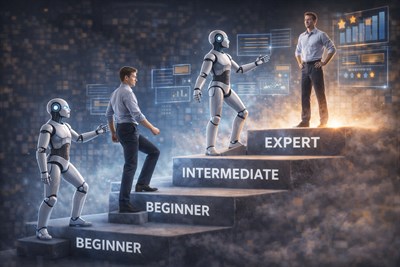
This also changes what “beginner,” “intermediate,” and “expert” mean at work. Our guide to how AI changes skill progression from beginner to expert explains why producing acceptable work is no longer the same thing as mastering a skill.
9 Skills That Became More Valuable After AI
The skills that gained value after AI include:
- Critical thinking and verification
- Judgment and decision-making
- Domain expertise
- Problem framing
- Communication and persuasion
- Systems thinking
- Relationship building
- Adaptability
- AI literacy and orchestration
1. Critical Thinking and Verification
Critical thinking becomes more valuable when producing a convincing answer is easier than determining whether that answer is correct.
Generative AI is exceptionally useful for creating hypotheses, summaries, comparisons, drafts, and explanations. But fluent language can make weak reasoning look stronger than it is. A response may contain an outdated fact, an unsupported assumption, a calculation based on the wrong denominator, or a source that does not actually support the claim.
That creates a new quality-control problem.
Consider a market analyst who asks AI to summarize a competitor report. The AI states that the market grew by 34% last year. A weak workflow copies the number into a presentation. A stronger analyst checks the original source, notices that the figure refers to revenue growth in one geographic segment rather than total market growth, and prevents the company from presenting a misleading conclusion.
The value created was not the summary. AI produced that quickly. The valuable skill was recognizing that the summary needed verification.
Research from Microsoft Research has examined how knowledge workers use critical thinking with generative AI, including activities such as setting goals, refining prompts, and evaluating responses. It also highlights an important risk: greater confidence in AI can reduce the amount of critical scrutiny people apply to its output.
To strengthen this skill at work, build verification into the workflow rather than treating it as an optional final step. Check sources, assumptions, time periods, calculations, and whether the model had access to the context required to make the claim.
2. Judgment and Decision-Making
AI can help analyze a decision. It cannot remove the need to make one.
That distinction matters because analysis and judgment are not the same skill.
An AI system can generate options, identify patterns, compare scenarios, list advantages and disadvantages, and estimate possible consequences. But real workplace decisions often involve incomplete information, competing goals, political constraints, customer commitments, legal considerations, timing, and different levels of acceptable risk.
Imagine a project manager preparing a product launch. AI generates three detailed launch plans. All three are plausible. The valuable work is not asking AI to produce a fourth.
The valuable work is deciding which plan best fits the actual engineering capacity, contractual commitments, available budget, customer expectations, and the cost of being wrong.
Judgment means knowing which variables deserve more weight. It also means knowing when the available evidence is not strong enough to justify a decision.
As AI makes recommendations easier to generate, people who can make good decisions under ambiguity become more valuable because organizations still need someone to turn information into action.
3. Domain Expertise and Context
One of the weakest assumptions about AI is that access to a model with broad knowledge makes expertise less important.
In many jobs, the opposite happens.
AI can produce more ideas, more drafts, and more recommendations. Domain expertise is what allows a professional to recognize which of them make sense in the real environment.
An experienced SaaS operator, for example, can ask AI for a customer-retention strategy and receive a credible list of actions. But the operator understands details the AI may not know: which customer segment is actually churning, which experiments have already failed, which changes would create implementation problems, what the sales team has promised, and which metrics are misleading.
The model can provide general knowledge. The expert provides situational context.
This is why domain expertise becomes particularly valuable in industries with regulation, unusual exceptions, tacit knowledge, long organizational histories, or high costs of error.
The advantage is no longer simply “knowing more facts.” AI can retrieve or synthesize many facts quickly. Expertise increasingly means knowing which facts matter in this situation, what is missing, and when standard advice does not apply.
4. Problem Framing and Asking Better Questions
Prompt engineering receives a lot of attention, but the more durable skill is problem framing.
Prompting is about communicating effectively with a model. Problem framing is about deciding what problem deserves to be solved in the first place.
Suppose a manager says:
“Sales are down. Ask AI what we should do.”
A weak workflow produces a generic list of sales tactics.
A stronger professional reframes the situation:
- Did qualified traffic decline?
- Did conversion rates change?
- Did average deal size fall?
- Did the sales cycle become longer?
- Did pricing change?
- Did the customer mix shift?
Those questions lead to completely different analyses.
AI amplifies the person who knows what to investigate. If the problem is poorly framed, faster execution simply produces the wrong answer faster.
Prompt — Skill Value Audit:
I work as a [ROLE] in [INDUSTRY]. Break my job into 10–15 recurring tasks. For each task, identify: (1) what AI can already accelerate, (2) what still requires human judgment or context, (3) which underlying skill becomes more valuable as AI handles more execution, and (4) one real work artifact I could create to demonstrate that skill. Do not call any skill “AI-proof.” Explain why its value changes.
5. Communication, Persuasion, and Alignment
Communication matters more after AI for a simple reason: producing information is becoming easier, while getting people to understand, trust, agree, and act is not.
Anyone with access to generative AI can quickly create a memo, presentation outline, strategy proposal, customer email, or analysis. That means the existence of a polished document is a weaker signal of professional value than it used to be.
The harder part often begins after the document exists.
A product leader may use AI to prepare a technically strong proposal. But someone still has to explain it to finance, respond to legal concerns, translate technical implications for executives, negotiate trade-offs with engineering, and gain support from teams whose incentives are different.
That is communication as business execution, not communication as polished writing.
The same applies to sales. AI can prepare account research, draft outreach, summarize calls, and suggest objections. But winning a complex deal may depend on understanding what the buyer is reluctant to say, recognizing who actually influences the decision, adjusting the conversation in real time, and building enough trust for a customer to commit.
AI increases the supply of words. It does not automatically increase alignment.
6. Systems Thinking and Workflow Design
Using AI for an isolated task can save minutes. Redesigning an entire workflow can change how a team operates.
This is why systems thinking is becoming one of the highest-leverage AI-complementary skills.
A low-leverage use case might be:
“Use AI to write a customer-support response faster.”
A higher-leverage approach asks:
- Which requests should AI classify?
- What information should be pulled into the response?
- Which cases require human review?
- Which topics should never be answered automatically?
- How should sensitive cases be escalated?
- What should be logged for future analysis?
- How do we measure whether the new workflow is actually better?
That requires understanding inputs, dependencies, handoffs, feedback loops, bottlenecks, exceptions, and failure modes.
An operations manager who can design a reliable human-in-the-loop process is often more valuable than someone who simply knows how to produce good prompts. The first person changes the system. The second improves one interaction with a tool.
7. Relationship Building, Trust, and Collaboration
AI can help prepare for a conversation, summarize the history of an account, draft a difficult message, or simulate possible objections. Those are useful capabilities.
But workplace trust develops through repeated behavior: reliability, shared experience, negotiation, difficult conversations, fulfilled commitments, and accountability when something goes wrong.
Consider an account manager preparing for a renewal meeting. AI can analyze past correspondence, identify unresolved issues, and suggest talking points. But whether the customer renews may depend on whether they believe the account manager understands the real problem, can make credible commitments, and will take responsibility if the solution fails.
Relationship skills become especially important when AI makes communication more abundant. If customers and colleagues receive more polished messages than ever, authenticity, reliability, and actual follow-through become stronger differentiators.
8. Adaptability and Learning Agility
“Keep learning” is generic advice. Adaptability in the AI era is more specific.
It is the ability to repeatedly move through this cycle:
Notice change → test a tool → understand its limits → redesign the workflow → measure the result → keep or discard the approach.
The valuable skill is not memorizing how one AI product works today. Interfaces, models, features, and vendors will change.
A more durable capability is being able to assess a new tool quickly without reorganizing your entire job around hype.
For example, a recruiter might test AI-generated candidate summaries. Instead of simply adopting them, an adaptable recruiter compares them with manual evaluations, identifies where important context disappears, defines which decisions require human review, and adjusts the process based on evidence.
That is learning agility applied to work: rapid experimentation without surrendering professional standards.
9. AI Literacy and AI Orchestration
Human skills are not becoming more important instead of AI skills. Practical AI literacy is itself becoming more valuable.
But AI literacy means more than knowing a collection of prompts.
It includes knowing:
- when AI is appropriate for a task;
- when it is not;
- what context the model needs;
- what information should not be shared;
- how to decompose a complex task;
- how to compare outputs;
- how to verify important claims;
- where human review belongs;
- how AI should interact with other tools and workflows.
This is increasingly closer to orchestration than prompting.
A strong AI user does not simply ask a model to “do the work.” They decide which parts should be automated, which should remain human-led, how quality will be checked, and what happens when the system encounters an exception.
This focus on human agency, critical thinking, and quality control is also visible in Microsoft's recent work on AI-enabled organizations and agent-based workflows.
Example: A marketer who can generate 50 headlines with AI is not necessarily more valuable than one who generates five. The higher-value skill is knowing which message fits the audience, brand, channel, evidence, and business goal—and being able to explain why.
What “Good at Your Job” Looks Like After AI
AI changes the skill ladder because it can compress the distance between having no output and having an acceptable-looking output.
That does not mean it automatically compresses the distance between beginner and expert.
| Level | Old signal | Stronger AI-era signal |
|---|---|---|
| Beginner | Can complete the task | Can complete it with AI without obvious errors |
| Intermediate | Works independently | Chooses tools, verifies output, handles exceptions |
| Advanced | Produces high-quality work | Designs workflows and makes sound trade-offs |
| Expert | Knows more than others | Defines standards, diagnoses unusual cases, makes consequential decisions |
| Leader | Allocates human work | Designs human + AI systems and remains accountable for outcomes |
A junior employee may now produce a polished report much earlier in their career because AI can help with structure, wording, calculations, and research. But the polished appearance of that report does not prove that the employee can identify a faulty assumption, defend the methodology, respond to an unusual case, or predict how a decision will affect another part of the business.
AI can compress the distance to acceptable output. It does not automatically compress the distance to expertise.
This matters for both employees and managers. Employees need to build evidence of judgment, not just output volume. Managers need to avoid confusing AI-assisted polish with deeper competence.
What Became Less Differentiating After AI
Some skills still matter but create less differentiation when performed at a basic level because AI can now handle much of the routine execution.
Examples include:
- producing generic first drafts;
- basic summarization;
- simple information retrieval;
- boilerplate marketing copy;
- routine formatting;
- basic translation;
- generic presentation outlines;
- straightforward code generation;
- rewriting text without strategic judgment.
This does not mean those activities disappear.
A task becoming easier does not mean the underlying profession disappears. Writing, for example, still requires understanding the audience, purpose, evidence, tone, positioning, and consequences of what is being said. Coding still requires architecture, testing, debugging, security, integration, and maintenance. Research still requires source evaluation and interpretation.
The difference is that the baseline has moved.
If everyone can generate a decent first draft, generating a decent first draft is no longer enough to distinguish you.
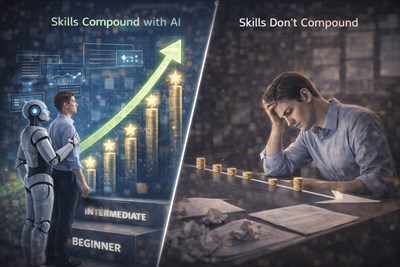
The most useful career question, therefore, is not simply whether a skill can be automated. It is whether the skill becomes more powerful when paired with AI. We explore that distinction in which skills compound with AI and which don’t.
How to Build AI-Complementary Skills at Work
You do not need to learn these skills through abstract courses alone. In many cases, the fastest way to build them is to use real work as the training environment.
1. Choose a Real Recurring Task
Pick something you already do regularly:
- reporting;
- planning;
- customer communication;
- analysis;
- research;
- content production;
- product decisions;
- operations reviews.
Real tasks provide constraints, feedback, and consequences. That makes them better practice than hypothetical exercises.
2. Let AI Accelerate Execution
Use AI for the parts it can genuinely make faster:
- drafting;
- generating alternatives;
- summarizing;
- organizing information;
- creating hypotheses;
- identifying possible risks;
- producing a first-pass analysis.
The purpose is not to avoid AI in order to protect your skills. The purpose is to use AI while deliberately retaining the parts of the process that build judgment.
3. Keep the Judgment Step Human
Before accepting the result, ask:
- What assumptions are hidden here?
- What could be wrong?
- What evidence would change my mind?
- What context does the AI not have?
- Who could disagree with this and why?
- What happens if we act on this recommendation?
This simple practice changes AI from an answer machine into a tool for structured reasoning.
4. Ask Humans for Feedback
A manager, colleague, customer, or subject-matter expert can evaluate things AI cannot fully observe: whether your recommendation was useful, whether the communication worked, whether you understood the organizational context, and whether the decision produced the intended result.
5. Produce Evidence of the Skill
Career value comes from demonstrating a skill, not merely claiming to have it.
Instead of writing:
“Strong critical-thinking skills.”
A stronger example is:
“Redesigned an AI-assisted reporting workflow and introduced source-verification checks that identified incorrect data before reports reached clients.”
Instead of:
“Experienced with AI.”
Show:
“Built a human-in-the-loop content workflow that reduced drafting time while keeping legal and factual review with designated owners.”
Prompt — Practice Judgment Instead of Outsourcing It:
Help me practice judgment on this work problem: [PROBLEM]. First, identify the major decision criteria and possible failure modes, but do not make the final decision for me. Ask me to choose an option and explain my reasoning. Then challenge my assumptions, show me what I may have missed, and help me improve the decision.
Prompt — Build a 30-Day Skill Ladder:
I want to strengthen [SKILL] for my role as [ROLE]. Create a 30-day practice plan built around real work rather than passive learning. For each week, define one capability to improve, one work task to practice on, one way AI can assist without replacing the skill itself, one feedback method, and one artifact I can keep as evidence of progress.
Use AI as a training partner, not only as a shortcut. Ask it to challenge your reasoning, expose assumptions, simulate stakeholders, generate counterarguments, and critique decisions after you make them. The goal is to strengthen the underlying skill while still gaining AI leverage.
The Risk: AI Can Strengthen a Skill or Let It Decay
AI can accelerate learning, but it can also make it easier to avoid the difficult cognitive work that creates expertise.
The difference depends on how the tool is used.
Automation Bias
Automation bias appears when people give an automated recommendation more credibility than it deserves simply because it came from a system that usually performs well.
Generative AI makes this especially easy because its outputs can sound confident, complete, and professionally written even when the underlying reasoning is weak.
A useful rule is simple: the higher the consequence of the decision, the less appropriate it is to treat fluent AI output as evidence of correctness.
Cognitive Offloading
Outsourcing routine cognitive work can be helpful. Outsourcing every stage of reasoning can gradually reduce practice.
If AI always defines the problem, generates the options, evaluates them, writes the recommendation, and explains why it is correct, the user receives an answer without necessarily building the underlying skill.
This is one reason research on generative AI and critical thinking deserves attention. AI can reduce unnecessary effort, but convenience can also reduce the amount of active evaluation a person performs if the workflow does not deliberately preserve it.
Loss of Junior Learning Opportunities
Many tasks that AI handles well were historically training grounds for junior employees.
Researching background information, creating first drafts, debugging straightforward issues, preparing summaries, and performing basic analysis may not have been glamorous work, but they exposed beginners to patterns, terminology, mistakes, and edge cases.
If AI absorbs those tasks completely, organizations need to create new learning loops rather than assume expertise will emerge automatically.
A junior analyst who receives an AI-generated model still needs to learn how the model works. A developer using AI-generated code still needs enough technical understanding to debug it when the normal case breaks.
False Expertise
AI can allow a beginner to produce work that looks more sophisticated than their current level of understanding.
That is useful for productivity but dangerous when appearance is confused with competence.
A polished recommendation does not prove that the person can defend the assumptions behind it. Clean code does not prove that the person understands the architecture. A professional-looking strategy deck does not prove that the author can choose between competing strategic options.
Deskilling Through Convenience
Fast output is not the same as learned capability.
If you ask AI to perform a difficult task today, you have completed the task. You have not necessarily acquired the skill required to perform or supervise it independently tomorrow.
The solution is not to stop using AI. It is to decide consciously which parts of a skill you still need to practice yourself.
AI Can Assist the Work. Humans Still Own the Outcome.
AI can suggest, draft, calculate, classify, summarize, compare, and simulate alternatives.
But in real organizations, someone still has to answer:
- Is this correct?
- Is it appropriate?
- Is it safe?
- Does it fit the goal?
- What evidence supports it?
- Should we act?
- Who will be affected?
- What happens if it fails?
- Who is accountable for the outcome?
This is why the most valuable skills in the age of AI are not necessarily the skills that remain untouched by technology. Many valuable skills will be deeply intertwined with AI.
The stronger position is to become the person who can use AI while still supplying what the system lacks: context, professional standards, judgment, verification, prioritization, and responsibility.
Reports such as the World Economic Forum's Future of Jobs Report 2025 point toward a labor market where technological capabilities and human skills develop together rather than as simple substitutes. The practical implication is important: career adaptation is not a choice between learning AI and developing human expertise.
You need both.
The more work AI can execute, the more valuable it becomes to know what should be executed, what should be trusted, and what should never be delegated.
FAQ
What skills are becoming more valuable because of AI?
The skills gaining value are those that help people direct, evaluate, and apply AI-generated work: critical thinking, judgment, domain expertise, problem framing, communication, systems thinking, relationship building, adaptability, and AI literacy. Their value rises because AI makes basic execution faster while increasing the need for context, verification, and responsible decision-making.
What human skills are most important in the age of AI?
Critical thinking, judgment, communication, collaboration, domain expertise, adaptability, and the ability to understand complex context are especially important. The advantage does not come from being “more human than AI,” but from doing the parts of work that become bottlenecks when generating information, analyses, and first drafts becomes easier.
What skills are hardest for AI to replace?
No skill should be treated as permanently AI-proof. Skills tend to be harder to automate when they depend heavily on changing context, accountability, trust, ambiguous trade-offs, tacit expertise, or interaction with other people. A better career strategy is to build skills that complement AI rather than trying to predict which capabilities AI will never develop.
Why is critical thinking more important with AI?
AI can produce plausible answers very quickly, which makes checking assumptions, evidence, sources, and reasoning more important. Critical thinking helps workers distinguish useful output from confident but incomplete or incorrect output and decide when additional evidence, testing, or human expertise is required.
What skills should I learn to stay relevant with AI?
Start with the skills closest to your existing role that increase your ability to use AI well: domain expertise, verification, decision-making, communication, workflow design, and practical AI literacy. You usually do not need to reinvent your career. The highest-leverage move is often combining deeper expertise in your field with better AI-assisted ways of working.
Can using AI make my skills weaker?
Yes, if AI consistently performs the parts of a task that previously required you to think, recall, write, analyze, or make decisions. The risk is greatest when outputs are accepted without evaluation. To reduce skill decay, keep some deliberate practice human-led and use AI for feedback, alternatives, critique, and acceleration rather than automatically outsourcing the entire reasoning process.
How can I prove AI-complementary skills to an employer?
Show evidence from real work. Instead of listing “critical thinking” or “AI skills” on a résumé, describe outcomes: a workflow you redesigned, an AI error you caught, a decision you improved, a process you automated while adding human review, or a project where AI accelerated execution and your judgment improved the final result.