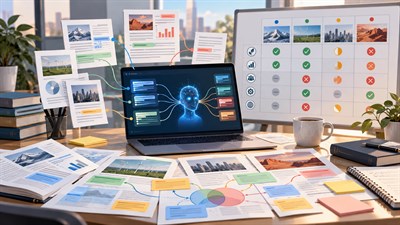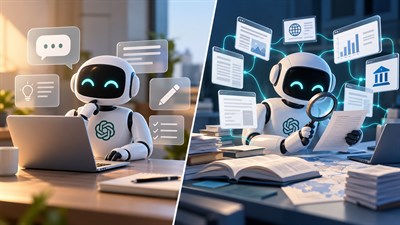
AI can now write reports, analyze data, generate code, summarize meetings, create presentations, and produce first drafts in seconds. But the skills AI still cannot reliably replace are not necessarily the skills used to produce the first output. They are increasingly the skills used to decide what should be done, whether an answer is good enough, how people will respond, and who takes responsibility when the decision matters.
The most durable human capabilities tend to depend on context, ambiguous judgment, relationships, trust, responsibility, and real-world consequences. They include judgment, problem framing, critical thinking, emotional intelligence, relationship-building, negotiation, leadership, creative direction, adaptability, and ethical decision-making.
AI can assist with parts of all of them. That distinction matters. Generating a useful response is not the same as reliably owning a decision in a messy workplace environment. The goal, therefore, is not to build a career around things AI supposedly will “never” do. It is to become exceptionally good at the human capabilities that become more important as AI handles more of the routine work around them.
AI can generate an answer. That is not the same as understanding whether the question is worth asking, whether the answer fits the situation, or whether someone should act on it. The durable human advantage increasingly sits in judgment, context, trust, and responsibility.
What Does “AI Cannot Replace” Actually Mean?
Calling a skill “irreplaceable” can be misleading. AI capabilities are changing quickly, and many behaviors once described as uniquely human can now be partially simulated or supported by AI systems.
A better question is this: Can AI reliably own the entire skill in a real workplace situation?
Consider a difficult client email. AI can draft a polished response, suggest a more empathetic tone, summarize the history of the account, and generate several possible solutions. Those are valuable capabilities. But someone still has to decide whether the message should be sent, what the company can responsibly promise, whether the client is actually upset about the issue mentioned in the email, and how much commercial risk the company should accept to preserve the relationship.
The same pattern appears across knowledge work. AI may perform significant parts of a task while the broader responsibility remains human.
That creates an important distinction:
- Task: produce an analysis, draft, recommendation, summary, or option.
- Skill: interpret the situation and apply knowledge appropriately.
- Responsibility: decide what happens next and own the consequences.
McKinsey's work on human-AI collaboration makes a similar distinction: technology can take over large amounts of information processing and communication work while human contribution remains especially important where nuanced judgment, situational awareness, creativity, social understanding, and oversight are required.
That is why claims such as “AI cannot be creative” or “AI cannot show empathy” are too simplistic. AI can generate creative material. It can produce empathetic language. It can offer arguments, recommendations, and even convincing reasoning. The harder problem is whether it can perform reliably in context, under uncertainty, with changing human reactions and real consequences.
The 10 Skills AI Still Cannot Reliably Replace at Work
The following capabilities are not immune to AI. In fact, AI can make many of them stronger. What makes them durable is that the human still has to interpret context, choose between competing priorities, work with other people, or take responsibility for the result.
1. Judgment Under Ambiguity
Workplace decisions rarely arrive with complete information and one objectively correct answer. More often, they involve incomplete data, conflicting goals, uncertain consequences, and trade-offs between several imperfect options.
That is where judgment matters.
Imagine a product manager preparing to launch a major feature. The deadline matters because sales has already promised it to customers. Testing shows that the feature works, but several unresolved UX problems may create confusion for new users.
AI can help enormously. It can summarize test results, build a risk matrix, calculate possible impacts, generate launch scenarios, and argue both sides of the decision.
But AI cannot eliminate the trade-off. Someone still has to decide whether the remaining risk is acceptable, whether delaying the release would create a larger commercial problem, which users should be prioritized, and when “good enough” is actually good enough.
That is judgment: not finding the perfect answer, but making a defensible choice when no perfect answer exists.
To strengthen it, practice making your assumptions explicit. Before important decisions, write down what you know, what you are estimating, what could change the decision, and which trade-off you are consciously accepting.
2. Problem Framing
AI is exceptionally useful once a problem has been clearly defined. In many organizations, however, defining the problem is the hardest part.
A team might say:
“Sales are falling. We need better ads.”
That statement already contains an assumption: that advertising is causing the problem.
A strong operator does not immediately optimize the ads. They ask whether acquisition actually changed. Perhaps traffic is stable but conversion fell. Perhaps pricing changed. Perhaps a competitor introduced a better offer. Perhaps onboarding is broken. Perhaps existing customers stopped renewing. Perhaps the apparent “marketing problem” is actually a product problem.
AI can investigate every one of those hypotheses. But someone must first widen the frame enough to consider them.
Problem framing means deciding what problem is actually worth solving, what evidence would reveal its cause, and what should be excluded from the investigation.
This skill becomes especially valuable in an AI-rich workplace because poorly framed problems can now produce impressive-looking answers faster than ever.
Example: A support team asks AI to identify why ticket volume is increasing. AI analyzes complaint categories and recommends adding more agents. A human operator notices that most new tickets appeared immediately after a confusing product update. The real problem is not support capacity. It is product design.
3. Critical Thinking and Verification
Critical thinking is not the ability to disagree with AI. It is the ability to separate evidence from confident language, question assumptions, compare alternative explanations, identify missing information, and decide how much confidence a conclusion deserves.
This matters because AI can produce answers that are coherent, well structured, and still wrong.
Suppose an AI-generated market analysis concludes that declining sales are caused by a new competitor. A weak workflow accepts the explanation because it sounds plausible. A stronger analyst checks whether the timing matches, whether the competitor actually gained share, whether pricing changed, whether traffic quality changed, whether conversion declined across all segments, and whether there are alternative explanations.
The valuable skill is not simply “checking facts.” It is knowing what needs checking.
Critical thinking also means recognizing when a question cannot be answered from the available evidence. In an AI-assisted workplace, the ability to say “we do not know yet” can be more valuable than producing another polished conclusion.
Prompt: Stress-test my reasoning
I am considering the following decision: [decision].
Do not make the decision for me. Instead:
1. identify the assumptions I may be making;
2. show me what evidence would weaken my current conclusion;
3. give me three plausible alternative explanations;
4. identify missing information;
5. tell me which parts require human judgment rather than more analysis.
My goal is to improve my reasoning, not outsource the decision.
4. Empathy and Emotional Intelligence
AI can generate empathetic language. It can analyze sentiment, suggest a tactful response, and help someone prepare for a difficult conversation.
Emotional intelligence at work goes further.
It includes noticing hesitation, recognizing when someone's stated objection is not the real concern, understanding the history behind a reaction, changing your approach in real time, and knowing when a technically correct message is emotionally inappropriate.
Imagine a manager telling an employee that a project they have led for six months is being cancelled.
AI can prepare the talking points. It can suggest how to explain the decision clearly and respectfully. But the conversation may change within seconds. The employee may become angry, go silent, ask whether their job is at risk, or reveal that they had built their promotion case around the project.
The manager must respond to the person in front of them, not continue reading the optimal script.
That live adjustment is where emotional intelligence becomes operational rather than theoretical.
5. Building Trust and Long-Term Relationships
Trust is not the same as good communication.
It develops through repeated behavior: keeping commitments, exercising discretion, understanding shared history, being consistent under pressure, admitting mistakes, and demonstrating competence over time.
This creates what can be thought of as relationship capital.
Consider an account manager who has worked with a major client for years. AI may have access to every email, contract, meeting note, purchasing pattern, and preference associated with the account. It may know more factual details than the account manager can remember.
But access to the history is not the same as participating in that history.
The client may trust the account manager because she defended them internally during a previous crisis, told them uncomfortable truths before they became expensive problems, and repeatedly delivered what she promised.
That accumulated credibility changes how future conversations work. It influences what the client reveals, which risks they are willing to take, and whether they believe a promise before the outcome is known.
AI can help maintain a relationship. It does not automatically inherit the trust inside it.
6. Negotiation and Conflict Resolution
Negotiation is sometimes treated as a communication exercise: find the right argument, phrase the offer persuasively, and reach a compromise.
Real negotiations are more complicated. They involve incentives, status, emotion, power, future cooperation, hidden constraints, and information that neither side states directly.
Imagine two department heads who both need the same senior engineer for critical projects. An AI system can evaluate workloads, rank business priorities, and suggest allocation models that look rational on paper.
But the decision may also affect whether one manager feels repeatedly deprioritized, whether a strategic customer loses confidence, whether the engineer burns out, and whether the two departments cooperate next quarter.
A strong negotiator understands not only what each side asks for, but what each side must protect.
AI is useful for preparation: simulate objections, identify possible concessions, map interests, and test alternatives. The human still has to read the room, decide when to push, know when to concede, and preserve relationships after the agreement is made.
7. Leadership, Motivation, and Accountability
AI can automate a surprising amount of management work. It can prepare plans, summarize performance data, draft feedback, track tasks, identify missed deadlines, and suggest priorities.
Leadership is not task administration.
Leadership means creating direction when there is uncertainty, setting standards, making difficult decisions, building trust, motivating people through setbacks, resolving conflicts, and accepting responsibility when the outcome is poor.
Suppose an important project fails.
AI can analyze what happened. It may identify delayed dependencies, unrealistic assumptions, communication failures, or poor resource allocation.
A leader still has to decide what changes, explain the failure to stakeholders, determine whether expectations or personnel need to change, rebuild confidence inside the team, and take responsibility for decisions that were ultimately theirs.
People do not only follow plans. They follow people whose judgment they trust.
8. Creative Direction, Taste, and Originality
“AI cannot create” is no longer a useful argument. AI can generate images, campaigns, headlines, product concepts, scripts, interface ideas, music, and thousands of variations on almost any creative brief.
The more interesting question is what happens when generating another option becomes cheap.
A marketing team may be able to produce 100 campaign concepts in an afternoon. That does not mean 100 of them deserve to exist.
Someone still has to recognize what feels generic, what fits the brand, what is culturally tone-deaf, what the audience has seen too many times, what is strategically interesting, and which unusual idea deserves investment.
This is creative judgment: the combination of taste, context, intention, and selection.
AI increases the supply of options. Taste becomes the ability to decide which options deserve to exist.
The same applies beyond creative industries. Product managers need taste in product decisions. Executives need taste in strategy. Editors need taste in information. Designers need taste in what to remove rather than what else to generate.
9. Adaptability and Learning
Adaptability is not simply learning how to use the latest AI tool.
Tools change too quickly for that to be a durable strategy. A more valuable capability is learning how to evaluate a new tool, understand where it fits into a workflow, test its limitations, change your process when appropriate, and abandon it when a better approach appears.
This requires changing mental models, not just adding software knowledge.
A marketer, for example, does not need lifelong expertise in every new AI application. They need to recognize which parts of research, ideation, production, analysis, and distribution can now be accelerated, while protecting the judgment-intensive parts of the job.
Adaptability also means recognizing when your own expertise has become outdated. The person who was excellent at a process five years ago may be less valuable than someone who can redesign that process for the current environment.
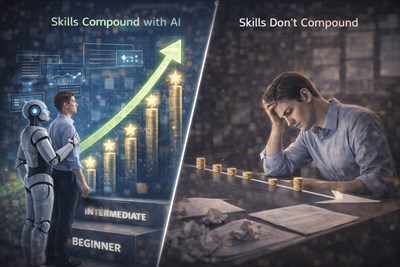
This is why the strongest career strategy is not simply collecting “AI-proof” skills. It is understanding which skills compound with AI and which don’t as tools become more capable.
10. Ethical Judgment and Responsibility
AI can identify ethical risks, compare frameworks, highlight potential bias, suggest safeguards, and list stakeholders who might be harmed by a decision.
It cannot make value conflicts disappear.
Organizations still have to decide what they are willing to do.
Should an employer use a highly predictive model if employees cannot meaningfully understand how it affects them? Should a customer support system use sensitive personal data if doing so makes recommendations more accurate? Should a company automate a process that reduces costs but creates unacceptable risks for a vulnerable group?
These are not purely technical questions. They involve fairness, privacy, consent, risk tolerance, law, company values, reputation, and consequences for real people.
AI can help map the decision. It cannot remove the need for someone to own it.
Do not confuse “AI can generate a plausible response” with “AI can safely own the decision.” The more consequential the decision becomes, the more important context, escalation, verification, and accountable human oversight usually become.
AI Can Assist the Skill Without Owning the Skill
The practical boundary between AI and human work is rarely “AI can do this” versus “AI cannot do this.” A more useful distinction is between assistance and ownership.
| Human skill | AI can help with | Human still owns |
|---|---|---|
| Judgment | Scenarios, trade-offs, analysis | Final decision |
| Problem framing | Hypothesis generation | Deciding what problem matters |
| Critical thinking | Counterarguments, evidence comparison | Evaluating credibility |
| Empathy | Wording, sentiment cues, preparation | Human response and relationship |
| Trust | Remembering context and commitments | Earning credibility |
| Negotiation | Scenario preparation and concessions | Live trade-offs |
| Leadership | Plans, analysis, feedback drafts | Direction and accountability |
| Creativity | Generating options | Taste and selection |
| Adaptability | Learning support and experimentation | Changing behavior |
| Ethics | Identifying risks and stakeholders | Value-based decision |
This distinction also explains why the best AI users are not necessarily the people who delegate the most. They are the people who know where delegation improves the work and where it removes the very capability they need to develop.
Why Human Skills Can Become More Valuable as AI Gets Better
When a capability becomes cheaper and more abundant, value often moves to whatever remains scarce.
Generative AI is rapidly reducing the cost of many first-stage knowledge tasks: drafting, summarizing, searching, formatting, generating variations, extracting information, and producing routine analysis.
If nearly everyone can generate a decent first draft, the first draft becomes less differentiating.
The differentiating work shifts toward questions such as:
- Was this the right problem to solve?
- Is the output accurate enough to use?
- What context is missing?
- Which recommendation fits our situation?
- What trade-off are we accepting?
- How will customers, employees, or partners respond?
- What should happen next?
This is one reason AI does not simply create a race between technical and non-technical skills. Research into AI-exposed occupations increasingly points toward a combination: people need enough AI literacy to use new systems effectively and enough human judgment to direct, evaluate, and apply what those systems produce.
An analysis of millions of job vacancies by researchers Maksim Mäkelä and Fabian Stephany found evidence that demand can increase for skills that complement AI, including teamwork, resilience, and digital literacy. The important career implication is not that every “human skill” automatically becomes more valuable. It is that complementary skills can gain value when they help people turn AI capability into reliable outcomes.
The World Economic Forum's Future of Jobs research similarly describes a labor market in which technological skills are rising alongside capabilities such as analytical thinking, resilience, flexibility, leadership, and social influence.
The pattern is practical: the more output AI can produce, the more organizations need people who can decide what to do with that output.
How to Build Skills AI Cannot Easily Replace
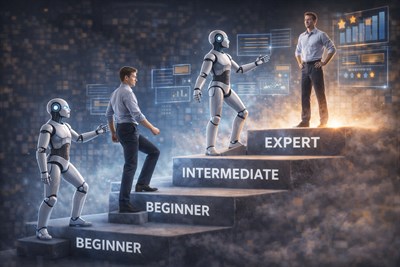
Knowing which skills matter is not enough. A Skill Ladder requires progression: from recognizing a skill to practicing it, applying it under pressure, demonstrating evidence, and eventually helping other people perform it well.
Level 1 — Recognize
At the first level, you can identify the skill when it appears.
You understand, for example, that a disagreement between teams is not simply an information problem. You can recognize when a recommendation requires judgment, when a problem has been framed too narrowly, or when an AI-generated answer needs verification.
This sounds basic, but recognition changes how you use AI. You stop treating every difficult situation as something that can be solved by asking for a better prompt.
Level 2 — Practice
At the second level, you deliberately exercise the skill rather than outsourcing it.
You make smaller judgment calls. You check AI outputs. You generate alternative hypotheses before accepting an explanation. You conduct difficult conversations yourself after using AI to prepare. You explain why you chose one option over another.
The goal is repetition with feedback.
Level 3 — Apply
At this level, the skill is used in real work where constraints conflict.
You are no longer practicing negotiation in a simulated scenario. You are negotiating scope with a real stakeholder. You are not merely learning critical thinking. You are deciding whether evidence is strong enough to change a business decision.
Real application introduces uncertainty, pressure, incomplete information, and consequences. That is what makes the skill transferable.
Level 4 — Demonstrate
A professionally valuable skill must eventually be visible to other people.
You should be able to explain:
- what situation you faced;
- what alternatives existed;
- what assumptions or constraints mattered;
- what you decided;
- what trade-off you accepted;
- what happened as a result.
At this level, “strong judgment” stops being a résumé adjective and becomes a body of evidence.
Level 5 — Lead
The highest level is not simply being good at the skill yourself. It is creating an environment in which other people can exercise it well.
You establish standards for verification. You teach teams how to escalate uncertain decisions. You improve review processes. You help people recognize badly framed problems. You design workflows that use AI where it is strong without allowing it to quietly take over decisions that still require accountable human judgment.
A durable skill is not something you claim to have. It is something you repeatedly demonstrate when the answer is not obvious.
Prompt: Turn a work situation into a skill exercise
I want to strengthen my [judgment / problem framing / negotiation / leadership / critical thinking] rather than have AI do the work for me.
Here is the situation: [context].
Act as a coach. Ask me one question at a time. Challenge my assumptions, introduce realistic constraints, and make me choose between trade-offs. Do not give me the final answer unless I explicitly ask for it.
At the end, evaluate my reasoning and identify one part of the skill I should practice next.
What These Skills Look Like in Real AI-Assisted Work
The difference between replaceable output and durable human value becomes clearer in actual workflows.
Marketing: AI Generates the Campaign, Humans Choose the Position
A marketing team asks AI to generate 30 campaign concepts for a new product. Within minutes, it has headlines, audience segments, creative angles, social posts, and suggested visuals.
The bottleneck is no longer idea generation.
The human team must understand which customer tension actually matters, which positioning supports the brand, which concepts feel derivative, which ideas may create reputational risk, and which unusual direction is worth investing in.
AI accelerates creative production. Human judgment determines strategic relevance.
Data Analysis: AI Finds a Pattern, Humans Decide What It Means
An AI system finds that customers who use a certain feature renew at a much higher rate.
The tempting conclusion is obvious: encourage everyone to use the feature.
A strong analyst asks more questions. Do customers renew because they use the feature, or do highly engaged customers simply happen to use it more? Is the relationship consistent across customer segments? Did another change happen at the same time?
AI can identify correlation and help test hypotheses. A human still has to decide whether the evidence justifies changing the business.
Management: AI Drafts the Feedback, Humans Conduct the Conversation
A manager needs to address a high-performing employee whose behavior is damaging the team.
AI can summarize previous feedback, suggest wording, anticipate objections, and produce a structured conversation plan.
But once the conversation begins, the employee may deny the problem, become defensive, raise an unrelated grievance, or reveal information the manager did not know.
The manager must listen, interpret, adapt, set a boundary, and decide what happens next.
The document was the easy part. The human interaction is the work.
Product and Operations: AI Finds the Efficient Process, Humans Handle Reality
An AI-assisted process review suggests that a company can remove two approval steps and significantly reduce turnaround time.
On paper, the recommendation is excellent.
An experienced operations manager knows that one of those approvals exists because a small group of high-risk transactions occasionally requires expert review. Removing it entirely may improve the average case while creating serious problems at the edges.
The stronger solution may be to automate the standard path while preserving escalation for exceptions.
This is a common pattern in AI-enabled operations: optimization is useful, but context determines where optimization must stop.
Client Work: AI Writes the Reply, Humans Protect the Relationship
A major client is unhappy after a missed deadline. AI produces five sensible replies: apologize, explain the cause, offer a discount, propose a revised plan, or schedule a call.
The human account owner knows that the client's real frustration is not the delay. It is that a similar problem happened six months ago and they were promised it would not happen again.
The right response requires acknowledging broken trust, not merely explaining a missed deadline.
Example: AI may produce five sensible recommendations for a dissatisfied client. The valuable human skill is not generating a sixth recommendation. It is recognizing which issue the client actually cares about, what the company can responsibly promise, and how to preserve the relationship after something has already gone wrong.
How to Prove These Skills Instead of Just Listing Them
One of the weaknesses of traditional career advice is that it encourages people to list skills without showing evidence.
“Critical thinking,” “leadership,” “communication,” and “problem solving” appear on countless résumés. The words themselves prove almost nothing.
A stronger approach is to turn the skill into a decision story.
Weak claim: “I have strong problem-solving skills.”
Stronger proof: “When conversion declined, I challenged the assumption that acquisition quality was the cause, traced the problem to onboarding friction, redesigned the workflow with the product team, and improved activation by 18%.”
The second version shows the skill in action.
You can apply the same approach across durable human capabilities:
- Judgment: describe a decision, the trade-offs involved, and why you chose one path.
- Critical thinking: show an assumption you challenged and what evidence changed the conclusion.
- Leadership: explain a difficult team situation, what action you took, and how the team changed.
- Negotiation: describe conflicting interests, what each side needed, and what agreement you reached.
- Creativity: show how you selected an unconventional direction and what business outcome followed.
- Adaptability: demonstrate how you changed your process, learned a new system, or abandoned an outdated approach.
The same principle applies across an AI-assisted career: employers need evidence, not adjectives. Here is a practical framework for how to prove human value in AI-assisted work through decisions, artifacts, outcomes, and credible evidence.
When building a portfolio, preparing for interviews, or documenting internal accomplishments, capture the parts of the story AI cannot reveal by looking only at the final output: your reasoning, constraints, alternatives, decisions, and responsibility.
The Limits of Calling Any Skill “AI-Proof”
It is tempting to turn a list like this into a permanent map of what humans will always do better. That would be a mistake.
AI Capability Keeps Changing
Tasks that seemed difficult to automate a few years ago can now be performed surprisingly well by modern AI systems. The boundary will continue to move.
A durable career strategy therefore cannot depend on predicting one permanent set of things AI will never do.
A Skill Is Not Binary
Most skills are not simply automated or untouched.
They are decomposed.
Parts become automated. Parts become faster. Some become more important because a human must supervise larger amounts of AI-generated work. Others become less valuable because the scarce part of the workflow has moved elsewhere.
The useful categories are often:
- automation;
- augmentation;
- human oversight;
- human ownership.
AI Can Simulate Parts of “Human” Behavior
AI can produce empathetic wording. It can brainstorm creative ideas. It can simulate a negotiation partner. It can generate coaching questions and leadership advice.
Those capabilities are real.
The argument for durable human skills should therefore not be “AI cannot do this at all.” The stronger question is whether AI can reliably perform the entire capability in a changing real-world context without accountable human involvement.
Over-Reliance Can Weaken the Skill
AI can strengthen judgment when it exposes you to counterarguments. It can weaken judgment when you repeatedly ask it to make decisions for you.
It can strengthen writing when it critiques your reasoning. It can weaken writing when you stop constructing arguments yourself.
It can strengthen problem framing when it helps test competing hypotheses. It can weaken problem framing when every task begins with “tell me what the problem is.”
The workflow matters as much as the tool.
Human Judgment Can Also Fail
Human involvement is not automatically superior.
People are biased. They miss evidence. They become attached to previous decisions. They can be inconsistent, overconfident, emotional, or limited by experience.
The goal is not to replace AI with human intuition.
The goal is to design workflows where AI and human strengths compensate for each other's weaknesses.
The best human-AI workflow is not “AI recommends, human approves.” Meaningful oversight requires enough expertise, time, evidence, and authority for the human to challenge the system rather than simply confirm what it produced.
High-Stakes Work Requires Stronger Oversight
The acceptable level of automation depends on the consequences of being wrong.
A weak headline suggestion may cost a few clicks. A bad medical, legal, financial, hiring, security, or safety-related recommendation can have far more serious consequences.
As stakes rise, verification, escalation, specialist expertise, documentation, and human accountability become increasingly important.
Use AI to Strengthen the Skill, Not Outsource It
One of the most useful career questions is not “Can AI do this?” but “What happens to my capability if AI always does this for me?”
The difference often comes down to prompt design and workflow design.
Weak workflow: “Tell me what decision to make.”
Better workflow: “Identify assumptions, missing information, alternative interpretations, and risks. I will make the decision.”
Weak workflow: “Write my strategy.”
Better workflow: “Challenge my strategy from the perspective of a competitor, CFO, customer, and skeptical employee.”
Weak workflow: “Tell me what to say in this conflict.”
Better workflow: “Simulate the other person's strongest objections so I can practice the conversation.”
Weak workflow: “Choose the best idea.”
Better workflow: “Create evaluation criteria, apply them consistently, and show me where each option performs differently.”
This keeps AI in a productive role: expanding your view, increasing the number of alternatives, revealing blind spots, and reducing routine cognitive load without removing the part of the work you need to own.
Prompt: Keep the human decision with me
Help me analyze this problem without making the final decision for me.
Context: [context]
Goal: [goal]
Constraints: [constraints]
Give me:
1. the strongest options;
2. the trade-offs of each;
3. missing information;
4. assumptions that need verification;
5. stakeholders who may see the issue differently;
6. consequences I may be overlooking.
Finish by asking me which trade-off I am willing to accept.
The Skill AI Cannot Take From You: Responsibility
There is one theme running through nearly every skill in this article: responsibility.
AI can recommend.
AI can summarize.
AI can calculate.
AI can rank options.
AI can generate scenarios.
AI can predict.
But in a real organization, someone still has to decide whether the output should be used.
Someone must determine whether the evidence is sufficient, whether the risk is acceptable, whether the situation should be escalated, whether affected stakeholders have been considered, and whether the organization is prepared to accept the consequences.
This does not mean every AI-assisted decision needs executive review. It means responsibility has to be designed into the workflow.
A junior employee may own a low-risk communication. A manager may own a hiring decision. A compliance specialist may have authority over a regulated process. A board may own a major strategic risk.
AI can change how each person performs the work. It does not remove the need to define who is accountable for the outcome.
The most durable career advantage may not be doing everything better than AI. It may be knowing what to delegate to AI, what to verify, what to decide yourself, and what you are willing to take responsibility for.
Build Around Human Ownership, Not AI Resistance
AI will keep improving. That makes it increasingly risky to build a career around a claim that a particular task will remain permanently beyond automation.
A stronger strategy is to move toward the parts of work where value comes from combining information with judgment, applying context, navigating relationships, framing ambiguous problems, making trade-offs, and taking responsibility for what happens next.
That does not mean rejecting AI. In many cases, the strongest professionals will use more AI than their peers, not less. They will use it to generate options, expose blind spots, accelerate research, test assumptions, prepare conversations, and reduce routine work.
But they will also know where assistance should stop.
Develop judgment. Practice problem framing. Build trust. Learn to negotiate. Strengthen critical thinking. Become better at leading people through uncertainty. And make your value visible through decisions and outcomes rather than generic claims about being “good with people.”
Do not compete with AI at producing more output. Become the person who knows what output matters, whether it can be trusted, what should happen next, and who is prepared to own the result.
FAQ
What skills can AI not replace?
AI still struggles to reliably replace human judgment in ambiguous situations, problem framing, trust-building, emotional intelligence, negotiation, leadership, ethical judgment, and responsibility for consequential decisions. AI can support parts of all these skills, but producing a plausible response is different from understanding the full context and owning the outcome.
What human skills will be most valuable in the age of AI?
Skills that complement AI are likely to be especially valuable: critical thinking, judgment, communication, leadership, adaptability, relationship-building, problem framing, and AI literacy. The advantage comes from combining these abilities with AI rather than trying to compete with AI on routine information processing or first-draft production.
Can AI replace critical thinking?
AI can support critical thinking by generating counterarguments, comparing scenarios, and identifying missing information, but humans still need to evaluate evidence, challenge assumptions, understand context, and decide whether a conclusion is reliable enough to act on. Critical thinking becomes particularly important when AI produces answers that sound confident but still require verification.
Can AI replace emotional intelligence?
AI can recognize patterns in language and generate empathetic responses, but workplace emotional intelligence involves more than wording. It includes reading changing social situations, understanding relationships, responding to unspoken concerns, adapting in real time, and taking responsibility for how decisions affect other people.
What skills should I learn to stay relevant with AI?
Combine AI literacy with skills that help you direct, evaluate, and apply AI-generated work. Focus on problem framing, critical thinking, judgment, communication, adaptability, domain expertise, leadership, and the ability to verify AI output. The goal is not to avoid AI but to become better at the parts of work that AI makes more important.
What jobs are safest from AI?
No career should be treated as permanently AI-proof. Jobs tend to be harder to automate when they combine several factors: unpredictable environments, human trust, physical interaction, complex judgment, responsibility, and changing interpersonal situations. A stronger strategy is to evaluate which tasks within a role can be automated and which human capabilities remain essential.
Will AI replace managers?
AI can automate parts of management such as reporting, scheduling, analysis, documentation, and draft feedback. Management also requires setting direction, resolving conflicts, motivating people, making judgment calls, handling exceptions, and taking responsibility for outcomes. Those parts of the role remain strongly dependent on human leadership.