A research paper can be 20 or 30 pages long while the part you actually need for work may be buried in a few paragraphs, a table, or one carefully qualified result. If you are an analyst, consultant, product manager, researcher, or strategy professional, learning how to summarize a research paper with ChatGPT can dramatically reduce reading time. But there is an important catch: a fast summary is not necessarily an accurate one.
The simplest approach—uploading a PDF and asking ChatGPT to “summarize this paper”—can produce polished prose while quietly losing the study design, sample characteristics, important numbers, uncertainty, or limitations. In the worst case, a cautious association can turn into a confident causal claim.
A better approach is to separate extraction, verification, and summarization. First map the paper. Then extract the evidence. Verify the claims that matter. Only after that should ChatGPT turn the verified information into a concise summary.
This workflow takes a few more prompts, but it creates something far more useful for real work: a summary you can inspect, challenge, and trace back to the source.
How Do You Summarize a Research Paper With ChatGPT Accurately?
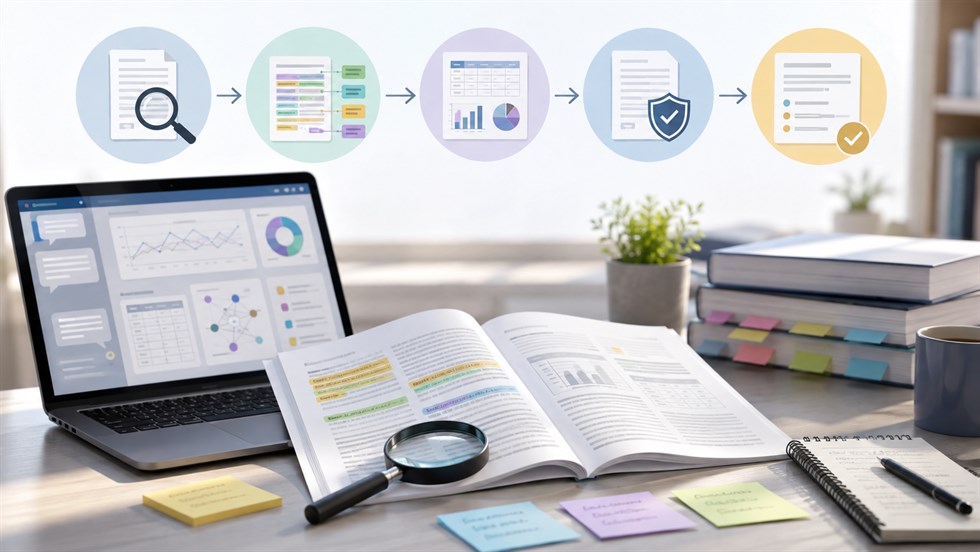
The most reliable way to summarize a research paper with ChatGPT is not to ask for a polished summary immediately. Upload the paper, identify its structure, extract the research question, study design, sample, results, key numbers, and limitations, verify the most important claims against the original paper, and only then generate the final summary.
A useful five-step version looks like this:
- Map the paper so you know what ChatGPT can identify in the document.
- Extract an evidence record containing the study design, sample, findings, numbers, and limitations.
- Separate results from interpretation so the authors' conclusions are not confused with the underlying data.
- Verify decision-critical claims against the relevant page, table, figure, or section.
- Generate the final summary using only the information that survived the verification pass.
Think of ChatGPT as a reading and extraction assistant, not as the research source itself.
Can ChatGPT Summarize a Research Paper?
Yes. ChatGPT can work with uploaded documents and can be used to summarize, extract information from, compare, and answer questions about research papers. The exact workflow depends on how you provide the paper and what kind of document it is.
Upload the PDF
For most research papers, uploading the PDF is the most convenient starting point because ChatGPT can work directly with the document instead of relying on text copied manually into the conversation.
After uploading it, do not immediately ask for a final summary. Start by checking what ChatGPT can actually identify in the file: the Methods section, Results, Discussion, tables, figures, appendices, and limitations.
Paste the Research Paper Text
If the paper is short, or if you only need a specific part of it, you can paste the relevant text directly into ChatGPT. This can also be useful when a PDF has poor text extraction.
For long papers, avoid pasting random fragments without labels. Tell ChatGPT whether the text comes from the Introduction, Methods, Results, Discussion, or another section so that background research is less likely to be confused with the paper's own findings.
Provide Only the Sections You Need
You do not always need to summarize an entire academic paper. For example, a product team checking whether a study supports a specific claim may care primarily about the Methods, Results, and Limitations.
Reducing the task to the sections that matter can improve focus, but it also creates a risk: conclusions can be misleading without the surrounding context. Use section-level summarization when you already know what evidence you need, not as a substitute for understanding the overall study.
Important: A fluent ChatGPT summary is not proof that every part of the research paper was read or interpreted correctly. Before using a finding in a report, recommendation, presentation, or decision, verify the important claims against the original paper.
Why “Summarize This Research Paper” Is the Wrong First Prompt
A one-line research paper summary prompt often optimizes for readability. Your work probably requires something different: fidelity to the source.
That distinction matters because academic papers contain details that look minor linguistically but can completely change how a finding should be interpreted.
The Sample Disappears
Imagine a study conducted with 43 undergraduate students at one university. A compressed summary may say:
Researchers found that the intervention improved performance.
That sentence sounds broader than the evidence. Who participated in the study determines where the result may reasonably apply. A finding from a narrow population should not silently become a universal statement about employees, consumers, patients, or the general public.
Correlation Becomes Causation
Academic authors often use careful phrases such as was associated with, was correlated with, or may contribute to. Summarization can compress those distinctions into a stronger statement such as caused or led to.
This is especially dangerous with observational research. If the study design cannot establish causation, the summary should not imply that it can.
Important Numbers Disappear
“The treatment improved the outcome” tells you much less than the original result might.
Depending on the paper, you may need to preserve:
- sample size;
- percentage differences;
- effect sizes;
- confidence intervals;
- subgroup sizes;
- study duration;
- statistical significance or non-significant findings.
You do not need to reproduce every statistical test. You do need to retain numbers that materially change the meaning of the result.
Limitations Get Compressed Away
Research papers frequently devote significant space to what the study cannot establish. A short AI-generated summary may devote almost all of its attention to the headline finding and one sentence—or nothing at all—to limitations.
For decision-making, that priority is often backwards. A limitation may determine whether the study is relevant to your business, market, users, or decision.
Previous Research Gets Confused With This Paper's Findings
The Introduction and literature review often describe findings from other researchers. Those statements are background, not results produced by the paper you are currently reading.
A reliable ChatGPT research paper summary should clearly distinguish:
- what previous research reported;
- what this paper tested;
- what this paper actually found;
- what the authors infer from those findings.
The Accurate Workflow: How to Summarize a Research Paper With ChatGPT
A reliable workflow is easier to remember as:
Paper → Map → Extract → Verify → Summarize → Human Review
The important change is that the polished summary appears near the end, not at the beginning.
Step 1: Decide What You Need From the Paper
Before prompting ChatGPT, define the work task. “Understand this paper” is too vague.
You may actually be trying to answer one of these questions:
- Should our product team care about this finding?
- Does this study support a claim in a client presentation?
- What did the researchers actually find?
- Was the study experimental or observational?
- Is the sample relevant to our customers or employees?
- Should this paper be included in a literature-review matrix?
- What limitations would weaken this evidence in a decision memo?
The same research paper should not necessarily produce the same summary for every task.
Example: A product manager reviewing a paper about remote-work productivity does not need a generic academic summary. They need the population studied, research design, measured outcomes, main effect, limitations, and whether those results can reasonably apply to their own workforce.
Step 2: Ask ChatGPT to Map the Paper Before Summarizing It
Start by determining whether ChatGPT can locate the important components of the document.
Prompt:
I have uploaded a research paper. Do not summarize it yet. First create a map of the paper. Identify the title, authors, research question or objective, study type, major sections, methods section, results section, discussion, limitations, conclusion, and any important tables or figures. If something is not available in the document, say “Not found.” Do not fill gaps using outside knowledge.
This step serves two purposes. First, it creates a navigational map. Second, it can reveal extraction problems before they contaminate the final summary.
If ChatGPT cannot identify the Methods section or says a visible table is missing, that is useful information. Fix the document problem before trusting a summary.
For unusually long reports, books, dissertations, or evidence packs, one-pass summarization becomes even less reliable because the workflow also needs document mapping and chunking. See our guide to how to summarize a 200-page document with AI.
Step 3: Build an Evidence Record
Now extract the factual skeleton of the paper without asking ChatGPT to turn it into polished prose.
A useful evidence record contains:
- Research question
- Study design
- Population, sample, or dataset
- Comparison or control
- Primary outcome
- Main findings
- Important numbers
- Authors' interpretation
- Limitations
- What the study does not establish
- Source location
Prompt:
Extract an evidence record from this paper. Use only information stated in the paper. For each item, provide the section, page, table, or figure where possible.
1. Research question or objective
2. Study design
3. Sample, participants, or dataset
4. Comparison or control group
5. Primary outcome or variable
6. Main findings
7. Important quantitative results
8. Authors' interpretation
9. Limitations explicitly stated by the authors
10. What this study does not establish
11. Source location for each important claim
If the paper does not provide an item, write “Not reported.” Do not infer missing information.
The instruction to write “Not reported” matters. Without it, an AI system may try to produce a complete-looking answer even when the document does not clearly provide one.
Step 4: Separate Results From Interpretation
A research paper usually contains at least two different kinds of claims.
Results describe what happened in the data.
Discussion and interpretation describe what the authors believe those results mean.
Both are useful, but they should not be merged.
Prompt:
Separate the paper's reported results from the authors' interpretation. Create two sections: “What the data shows” and “What the authors believe it means.” Do not move interpretations into the results section. Preserve uncertainty and qualifying language.
This is particularly useful for papers with ambitious conclusions. The result may be narrow while the Discussion places it in a much broader theoretical or practical context.
Step 5: Extract the Numbers That Could Change the Meaning
Ask ChatGPT for numbers selectively rather than requesting every statistic in the paper.
Depending on the study, useful items may include:
- total sample size;
- intervention and control group sizes;
- baseline differences;
- percentage changes;
- effect sizes;
- confidence intervals;
- statistically significant and non-significant outcomes;
- study duration;
- dropout or attrition rates.
The goal is not to turn ChatGPT into a substitute statistics textbook. The goal is to prevent a sentence such as “performance improved” from hiding whether the reported improvement was tiny, large, uncertain, limited to a subgroup, or measured under highly specific conditions.
Step 6: Ask What the Paper Does Not Prove
One of the most useful research prompts is a negative one: what conclusions would go beyond the available evidence?
Prompt:
Based only on the study design, results, and limitations stated in this paper, list conclusions that a reader should NOT draw from the study. Pay particular attention to causation, generalization beyond the sample, subgroup claims, and claims stronger than the authors make themselves.
This can help expose overgeneralization before it enters a report or presentation.
However, treat this output as an additional review layer, not as an authoritative methodological assessment. ChatGPT can also make mistakes when criticizing research methodology.
Step 7: Run a Claim Verification Pass
Before creating the final summary, ask ChatGPT to trace important claims back to the document.
Prompt:
Audit the evidence record you created. For every important claim, identify the exact section, page, table, or figure that supports it. Flag any statement that you cannot confidently trace back to the paper. Do not repair unsupported claims by guessing.
Then manually verify at least the claims that could change your decision:
- the main finding;
- the sample or dataset;
- the strongest quantitative result;
- the most important limitation;
- any claim you intend to quote or repeat publicly.
Best practice: Verify the strongest claims, not just the most interesting ones. Pay extra attention whenever the summary says a study “proves,” “causes,” “always,” “significantly improves,” or applies broadly to people who were not represented in the original sample.
Step 8: Generate the Final Research Paper Summary
Only now ask ChatGPT to write the polished version.
Prompt:
Using only the verified evidence record above, write a 250-word summary of this research paper for a professional reader who has not read the study. Include the research question, study design, sample or data source, main findings, the most decision-relevant quantitative result, limitations, and practical meaning. Preserve uncertainty and do not introduce facts that are not in the verified evidence record.
The important phrase is “using only the verified evidence record.” You are constraining the writing stage to material already extracted and reviewed.
Step 9: Adapt the Summary to the Actual Work Task
A good research summary is not simply shorter than the original. It should be shaped around the reader's decision.
For an Executive Brief
Ask for 100–150 words covering the finding, evidence strength, biggest limitation, and practical implication.
For a Literature Review
Use a consistent structured record such as:
- citation;
- research question;
- study design;
- sample;
- main result;
- limitation;
- relevance to your research question.
For a Decision Memo
Ask for:
- what the study suggests;
- strength of the evidence;
- applicability to your situation;
- important risks or limitations;
- additional evidence you would want before deciding.
For a Meeting
A five-bullet summary plus two unresolved questions may be more useful than a 500-word narrative.
A Complete ChatGPT Research Paper Summary Prompt
If the paper is low-risk and you need speed, you can combine several stages into one detailed prompt. This is still better than “Summarize this paper,” although the staged workflow above is safer for research that will influence an important decision.
Prompt:
Summarize this research paper using only information contained in the uploaded document. Do not use outside knowledge to fill gaps.
Structure the response as follows:
1. Research question or objective
2. Study design
3. Sample, participants, or dataset
4. Methods
5. Main results
6. Important quantitative findings
7. Authors' interpretation
8. Limitations stated in the paper
9. What the study does NOT establish
10. Practical relevance
Clearly separate reported results from interpretation. Preserve uncertainty, qualifiers, and distinctions between correlation and causation. For important claims, provide the page, section, table, or figure where the information appears when possible. If information is missing, write “Not reported” instead of guessing. Finish with a 150-word plain-English summary based only on the evidence extracted above.
Real Example: Turning a Research Paper Into a Work-Ready Summary
Consider the 2015 paper Does Working from Home Work? Evidence from a Chinese Experiment by Nicholas Bloom, James Liang, John Roberts, and Zhichun Jenny Ying.
The study examined a work-from-home experiment at Ctrip, a large Chinese travel company. Call-center employees who volunteered for the experiment were randomly assigned either to work from home or to remain in the office for nine months.
The Task
Imagine that a strategy team is considering a remote-work policy and wants to know whether the paper supports the claim that working from home improves employee productivity.
What a Generic Summary Might Emphasize
A highly compressed summary could easily become:
The study found that employees working from home were more productive and happier, suggesting that remote work improves employee performance.
The statement sounds useful, but it is incomplete. It removes important information needed for a business decision.
What Is Missing?
- The participants were call-center employees at one company in China.
- Workers volunteered to participate before being randomly assigned to home or office work.
- The experiment lasted nine months.
- The study reported a 13% performance increase during the experiment.
- Part of that improvement came from employees working more minutes per shift, while another part came from more calls per minute.
- Home workers reported higher job satisfaction and lower attrition.
- The paper also reported a downside: promotion rates conditional on performance were lower for home workers.
A More Useful Evidence Record
Research question: What happens to employee performance and related outcomes when eligible call-center employees work from home?
Study design: Randomized work-from-home experiment.
Setting: Ctrip, a large Chinese travel company.
Duration: Nine months.
Main reported result: Working from home produced a 13% performance increase during the experiment.
Mechanism reported in the paper: Part of the increase came from more minutes worked per shift and part from higher performance per minute.
Other outcomes: Higher work satisfaction and substantially lower attrition were reported among home workers, while promotion rates conditional on performance were lower.
Important limitation for application: The result comes from a specific workforce, company, job type, and experimental setup. It should not automatically be generalized to every form of remote knowledge work.
A Better Work-Ready Summary
A randomized nine-month experiment at Ctrip compared eligible call-center employees assigned to work from home with employees who remained in the office. The study reported a 13% performance increase among home workers during the experiment. The improvement reflected both more minutes worked per shift and an increase in calls handled per minute. Employees working from home also reported higher job satisfaction and lower attrition, although their promotion rate conditional on performance was lower. For a company evaluating remote work, the study provides evidence that working from home can improve performance under some conditions, but it does not establish that the same gains will occur across different job types, organizations, or employee populations. The operational context and worker-selection process matter when applying the result elsewhere.
The difference is not simply that the second summary is longer. It preserves the study design, population, key number, downside, and boundaries of the evidence.
Can ChatGPT Read Tables, Figures, and Charts in Research Papers?
Do not assume that every visual element embedded in a PDF has been processed simply because ChatGPT can discuss the document's text.
OpenAI's current documentation distinguishes between different PDF processing workflows. ChatGPT Enterprise supports visual retrieval for PDFs uploaded in supported conversational contexts, allowing embedded images, graphs, and diagrams to be interpreted alongside text. Other file-processing contexts can rely on text retrieval instead.
That distinction matters because research papers often place critical information in:
- figures;
- forest plots;
- regression tables;
- flow diagrams;
- supplementary charts;
- image-based appendices.
If a chart contains information that matters to your conclusion, test whether ChatGPT actually has access to it.
Prompt:
List every table and figure you can identify in this paper. For each one, give its label, title or caption, and a one-sentence description of what you can actually read from it. If you cannot access the contents of a figure, state that explicitly rather than inferring what it probably shows from the surrounding text.
Then manually inspect the most important visual yourself. If necessary, upload a specific chart or figure separately as an image and ask focused questions about it.
What About Scanned Research Papers?
Some PDFs do not contain a usable text layer. They are effectively collections of scanned page images.
Before relying on a summary, run a simple extraction test.
Prompt:
Find the Methods section in this document and reproduce the first complete sentence under its heading. Then tell me which page it appears on. If you cannot reliably extract that text, say so.
If ChatGPT cannot reliably locate visible text, do not continue directly to summarization. Use a better digital copy, perform OCR, or extract the required sections another way first.
A sophisticated prompt cannot repair missing source text.
How to Summarize Different Types of Research Papers
The same research paper summary template does not work equally well for every methodology.
Experimental or Randomized Studies
Extract:
- intervention;
- control or comparison;
- randomization process;
- sample;
- primary outcome;
- effect size or main difference;
- attrition;
- limitations.
Ask whether the experiment supports a causal claim and exactly which outcome that claim applies to.
Observational Studies
Pay particular attention to the difference between association and causation.
Extract:
- population;
- exposure or predictor;
- outcome;
- confounding variables considered;
- adjusted versus unadjusted results;
- limitations affecting causal interpretation.
If the paper reports that two variables are associated, the summary should not quietly upgrade that relationship to “X causes Y.”
Systematic Reviews and Meta-Analyses
Do not summarize a meta-analysis as if it were one experiment.
Instead extract:
- review question;
- databases searched;
- inclusion and exclusion criteria;
- number of included studies;
- total population where relevant;
- pooled result;
- heterogeneity;
- risk-of-bias assessment;
- major limitations.
If different studies produced inconsistent effects, that disagreement belongs in the summary.
Qualitative Research
For interviews, focus groups, observations, and other qualitative studies, extracting a “sample size + effect size” template makes little sense.
Focus instead on:
- participants;
- setting;
- data collection method;
- coding or analysis method;
- main themes;
- representative evidence;
- researcher interpretation;
- limitations and transferability.
Theoretical or Conceptual Papers
A conceptual paper may contain no participants, experiment, or dataset at all.
Ask ChatGPT to identify:
- central argument;
- key concepts;
- assumptions;
- evidence used to support the argument;
- counterarguments;
- implications;
- open questions.
Do not force empirical fields such as “sample size” into a paper that was not designed as an empirical study.
Common Mistakes When Using ChatGPT to Summarize Research Papers
1. Asking for a One-Shot Summary
This makes it difficult to distinguish correct extraction from confident compression. Map and extract before polishing.
2. Using Only the Abstract
The abstract is excellent for screening relevance. It is not always sufficient for making a decision based on the research.
Methods, results, tables, appendices, and limitations may contain information that materially changes how the abstract should be interpreted.
3. Losing the Sample and Study Context
A result without a population can become misleadingly universal. Preserve who or what was actually studied.
4. Dropping Limitations
If your summary contains 10 lines about benefits and one vague sentence about limitations, ask for a separate limitation extraction.
5. Treating Correlation as Causation
Check whether the methodology supports causal inference before allowing causal verbs into the summary.
6. Trusting Page References Without Checking Them
Source locations generated by AI are verification aids, not proof. Open the source and check important references yourself.
7. Letting ChatGPT Fill Missing Information
Explicitly instruct it to write “Not reported” or “Not found” when evidence is unavailable.
8. Ignoring Tables and Figures
A summary based mostly on narrative text can miss the most decision-relevant evidence in a paper.
9. Mixing Prior Research With the Current Study
Ask ChatGPT to label claims from the literature review separately from findings generated by the current paper.
10. Citing the AI Summary Instead of the Paper
ChatGPT can help you understand and organize the research. It is not the source of the research finding.
When you use a finding in your own work, cite the original paper.
Limits and Risks
Even a structured ChatGPT research paper summarizer workflow does not eliminate error. It makes errors easier to detect.
Omission Risk
A sentence buried in the Methods or Limitations section may materially change a conclusion but receive little attention in the generated summary.
Compression Risk
Academic language is often cautious for a reason. Phrases such as may indicate, within this sample, or under these conditions can disappear when text is compressed.
Attribution Risk
A model may confuse background findings discussed in the Introduction with results generated by the current study.
Extraction Risk
The relevant information may never have entered the usable context correctly because of a malformed PDF, scan, complex table, equation, or inaccessible visual.
Hallucination Risk
When an expected field is missing, ChatGPT may occasionally produce a plausible answer rather than an explicit gap unless you constrain it carefully.
Rule of thumb: The more decision-critical a claim is, the less appropriate it is to trust the generated summary without opening the original source.
When You Should Read the Original Paper Yourself
Using ChatGPT does not mean avoiding the original paper entirely. In many workflows, AI is most valuable because it tells you where your attention should go.
Read the relevant parts of the original paper yourself when:
- a business or policy decision depends on one key result;
- you need to quote an exact number;
- the reported result is unusually strong or surprising;
- the study affects a health, financial, legal, safety, or other high-stakes decision;
- methodology determines whether the result applies to your situation;
- you are going to publish or publicly repeat the finding;
- the AI summary seems inconsistent with the abstract, Results, table, or figure;
- the authors' conclusion seems stronger than the raw result you extracted.
A useful workflow is not “AI instead of reading.” It is “AI before targeted reading.”
The Final Check Still Belongs to You
ChatGPT can dramatically reduce the cost of finding, structuring, comparing, and explaining evidence. It can turn a dense academic paper into a research map in minutes, extract the parts relevant to your decision, and convert verified information into a concise brief.
What it cannot do is transfer responsibility for interpreting the evidence.
The most reliable division of labor is:
AI extracts → human verifies → AI formats → human decides.
That distinction is especially important because a well-written AI response can feel more certain than the underlying research actually is. Do not judge a summary by how polished it sounds. Judge it by whether the claims can be traced back to the study, whether the important qualifiers survived compression, and whether the conclusion stays inside the boundaries of the evidence.
The goal is not to read a research paper without reading it. The goal is to know exactly where your attention is worth spending.
FAQ
Can ChatGPT summarize a research paper?
Yes. ChatGPT can work with uploaded documents and summarize research papers, but an accurate workflow should separate extraction, verification, and final summarization rather than relying on a single generic prompt.
Can ChatGPT summarize a PDF research paper?
Yes, if the PDF can be processed successfully. Text-based PDFs are generally easier to work with than scans or complex documents. Important tables, figures, and numerical results should still be checked against the original PDF.
What is the best prompt to summarize a research paper with ChatGPT?
A strong prompt should request the research question, study design, sample or dataset, methodology, main findings, important numbers, limitations, and source locations. It should also instruct ChatGPT to mark missing information as “not reported” instead of guessing.
How accurate is ChatGPT at summarizing research papers?
ChatGPT can produce useful summaries, but fluent output can still omit limitations, flatten uncertainty, misread numbers, or overstate findings. Accuracy improves when the paper is summarized in stages and important claims are verified against the source.
Can I summarize a research paper using only the abstract?
The abstract is useful for deciding whether a paper is relevant, but it is usually not enough for a reliable research summary. Methods, results, discussion, limitations, tables, and figures may contain details that materially change the interpretation.
Should I ask ChatGPT for citations when summarizing a research paper?
You can ask for page, section, table, or figure locations to make verification easier, but those references should still be checked manually. When using the research in your own work, cite the original paper rather than the AI-generated summary.
What is the difference between summarizing and critically evaluating a research paper with ChatGPT?
Summarizing explains what the researchers asked, did, found, and concluded. Critical evaluation asks whether the methodology, evidence, assumptions, and conclusions are convincing. Complete the factual summary first so that critique does not get mixed into the description of what the paper actually says.